Showing posts with label knowledge. Show all posts
Showing posts with label knowledge. Show all posts
10 March 2012
Read more... Sphere: Related Content
 Polar lights are one manifestation of activity in the Earth's magnetosphere
28 February 2012
Why are gas prices high?
Gas prices are going up again, resulting in a lot of discussion by people who don't normally think about the oil markets, and therefore aren't necessarily that well informed about the subject
by Stuart Staniford | Feb 27 2012 by Early Warning in Energy Bulletin | Feb 27 2012

27 February 2012
What is climate change adaptation? - The Guardian's ultimate climate change FAQ
There are two main policy responses to climate change: mitigation and adaptation. Mitigation addresses the root causes, by reducing greenhouse gas emissions, while adaptation seeks to lower the risks posed by the consequences of climatic changes
Grantham Research Institute and Duncan Clark | guardian.co.uk | 27 February 2012
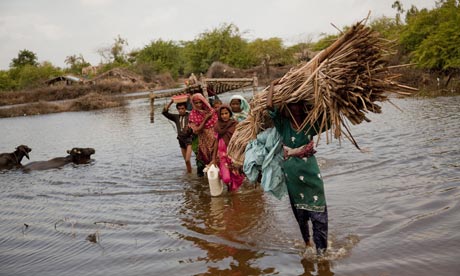 A family carries their possessions from their village which had become engulfed by rising floodwaters, on September 14, 2011 in Badin, Pakistan. Photograph: Warrick Page/Getty Images for UNICEF
Read more...
Sphere: Related Content
06 January 2012
Co-operative renewable energy in the UK: a guide to this growing sector (report)
Co-operatively-owned energy generation is a vibrant and growing sector in the UK. The first co‑operatively-owned wind turbines, Baywind in Cumbria, started turning in 1997. Since then, over 7,000 individual investors have ploughed over £16 million into community-owned renewable energy
by Rebecca Willis and Jenny Willis | Jan 5 2012 by Cooperatives UK in Energy Bulletin | Jan 5, 2012
Read more... Sphere: Related Content20 December 2011
Adaptation to Climate Change
OECD documents on Adaptation to Climate Change
OECD | December 19, 2011
Read more... Sphere: Related Content15 December 2011
The Munden Project: “Investing in communities is the most effective way of reducing deforestation”
In March 2011, a consulting firm called the Munden Project put out a report about forest carbon markets. The report concluded that carbon trading is “unworkable as currently constructed”
By Chris Lang | REDD-Monitor | 15th December 2011
Read more... Sphere: Related Content20 March 2010
Aiming for a no-carbon economy
Taking the 'low-carbon' path means we are designing an economy not fit for purpose
Mike Mason | guardian.co.uk | 19 March 2010
Drax power station near Selby, Yorkshire. At what point does the level of CO2 set us on a path to irreversible climate change? Photograph: John Giles/PA
Who would get on a flight across the Atlantic if most of the aeronautical engineers in the world were saying that the plane had a 50% chance of crashing before it got to the destination? No one. So why then are we prepared to take our chances on a planet which the vast majority of serious scientists say has a high chance of catastrophic system failure? I don't care whether the odds are 50% or 10% or even 1% - this is the only planet going and we're all on it.
In that case, when governments talk of aiming for a "low-carbon economy" by 2050, shouldn't we all rejoice? Perhaps not. If you're going to design an aeroplane you have to know how far it is expected to fly. Designing a transatlantic airliner that "nearly" gets across the ocean is not only a disaster for the passengers but it is also a waste of money. The same is true of the move towards a "low-carbon economy", which I believe is the wrong path to take. Here's why.
There are greenhouse gas emissions from industry, transport and the domestic sector, and there are emissions from agriculture and land use change. Take those emissions from agriculture, which are difficult to reduce substantially, and combine them with a world population that is expected to grow by 50% by 2050 and incomes that are growing at rates of up to 6% in the developing world, and you have a situation in 2050 where roughly 10 billion people are living at a standard close to ours in the UK. All those extra and relatively rich people will drastically increase those agricultural emissions.
Bearing that in mind, how much wiggle room do we have to generate future emissions before we set ourselves on the route to catastrophicclimate change? Some notable scientists are saying we should emit no more. Some, more pragmatic voices, are arguing that the risks are acceptable if we stabilise at 450 parts per million CO2 in the atmosphere by 2050. The Stern review suggests the emissions level we would need to do this is around 13bn tonnes per year. After we've factored in the emissions from agriculture, which we need to feed ourselves, what's left for industry, transport and homes? Zero.
Not only is it zero, but we've got to get there by 2050. This is a massive engineering project – the biggest the planet has ever seen. We could do it, with the technology we already know about, provided we abandon our squeamishness about nuclear power, windfarms in our backyards and carbon capture and storage. However the timescale is short. It is shorter than the life of a power station, or a gas grid, or even a new jumbo jet.
Now, here's the danger. There is a big difference between a "low-carbon economy" and a "no carbon economy". Both will need massive investments in new infrastructure and the deployment of huge swaths of new technology which will take decades to build. However, getting the last bit of carbon out of the economy is going to be terribly difficult, and many key choices needed to get there must be made more or less today. Look at a few examples.
The EU and individual governments are pumping billions of Euros into a form of carbon capture and storage that will only save 85% of emissions. Let's allow 10-15 years to get the technology sorted, and then 10-15 years to build the power stations. That takes us to 2040. If the life of a power station is 40 years, what are they all going to do in 2050? If we are serious about saving the planet we have to shut them down prematurely – what a waste of money and time.
Here's another. The UK has 20m homes with a gas supply. The government is currently providing incentives to install really efficient gas-fired combined heat and power in those homes. This will lock in 20 million sources of CO2 that can't be captured – instead of starting now to phase gas out of our homes and shift everyone to heat pumps.
Another example is the plan for Heathrow's third runway, which will allow more planes to come in. New planes have a 30-40 year lifespan. The runway won't be built for 10 years. The planes and runway will be obsolete before they are worn out – unless of course we spend a vast amount of new money on the research and development of biofuels. I don't see that in the coming budget.
In short, by going "low carbon" we're designing an economy not fit for purpose. We will waste a lot of time, and spend a vast amount of money, installing long-life assets and infrastructure that future politicians will have to scrap. You couldn't think of a more expensive and wasteful way to approach such a major and costly project. We will have designed that transatlantic airliner that doesn't quite reach the runway at the other end – but sadly you and I will have to fly on it.
Mike Mason is the founder of Climate Care and Biojoule.
guardian.co.uk © Guardian News and Media Limited 2010
Read more... Sphere: Related Content04 June 2009
Tropical East Asian forests under great threat
An interview with ecologist Dr. Richard Corlett of National University of Singapore
Rhett A. Butler, mongabay.com, June 02, 2009
Tropical East Asia's rapid population growth and dramatic economic expansion over the past half century have taken a heavy toll on its natural resources. More than two-thirds of the region's original forest cover has been cleared or converted for agriculture and plantations, while its flora and fauna have suffered dearly from a burgeoning trade in wildlife products—several charismatic species have gone extinct as a direct consequence of human exploitation. Nevertheless tropical East Asia remains a top global priority for conservation, supporting up to a quarter of the world's terrestrial species.
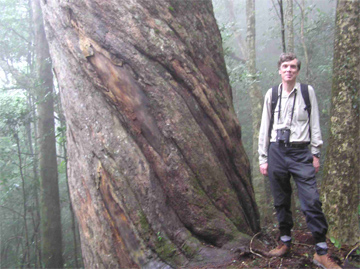
Richard Corlett in Yunnan Province, China
A new book by Richard Corlett of National University of Singapore is the first to describe the terrestrial ecology of the entire East Asian tropics and subtropics, from southern China to western Indonesia. The Ecology of Tropical East Asia explores the elements that foster the region's richness of plant and animal species as well as the threats facing biodiversity and conservation, including deforestation, hunting, climate change, logging and resource extraction. Corlett concludes that high human population densities, continued population growth, rural poverty, corruption, and globalized markets will present obstacles for conservation but that the chief aim for conservationists should be to safeguard existing protected areas.
"We need to work on all fronts, but the number one priority is to protect existing protected areas (national parks, nature reserves, forest reserves etc.) from further degradation," he told mongabay.com. "All parks in the region are currently underfunded and their staff under-supported and underappreciated. In many cases this just requires more people on the ground to keep out hunters and illegal loggers. In other cases, conflicts with local people must be resolved.
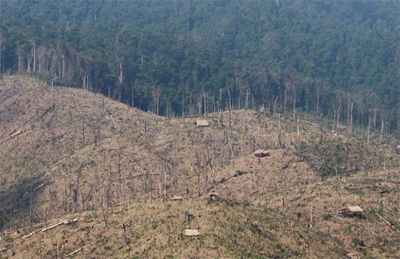
Forest conversion for rubber plantations in Northern Laos in January 2009
"If this is done, then a big chunk of the region's biodiversity will make it through the next 50 years into a future region with declining human population and expanding forest cover – but possibly also devastating climate change."
Corlett talked about his new book, his career, and the future of biodiversity in tropical East Asia in a June 2009 interview with mongabay.com.
An interview with ecologist Dr. Richard Corlett
Mongabay: What is your background and current field of study?
Richard Corlett: I am from London and did my first degree at Cambridge. While an undergraduate, a friend and I spent a summer in Southeast Asia doing ecological research and traveling, and I have been hooked on the region ever since. I did my PhD at the Australian National University, with fieldwork in Papua New Guinea, and have lived in tropical East Asia since then – almost 30 years. I have taught at Chiang Mai University in northern Thailand, then Singapore, then Hong Kong for almost 20 years, and I am now back in Singapore, as a Professor in the Department of Biological Sciences at the National University of Singapore. I have broad interests in terrestrial ecology and biodiversity conservation in tropical East Asia, with a current focus on plant-animal interactions, invasive species, urban ecology, and the potential impacts of climate change. On-going projects include the role of the Asian megafauna in seed dispersal (with Ahimsa Campos-Arceiz), the rehabilitation of degraded peatlands in Kalimanatan (with Mary Posa and others), and enhancement of native biodiversity in urban Singapore (with Hugh Tan).
Mongabay: Why did you decide to write a book about the ecology of tropical East Asia? Aren't already there field guides covering this part of the world?

The Ecology of Tropical East Asia -
The cover features a gibbon. Photo © Jurgen & Christine Sohns/FLPA
Richard Corlett: I have had the idea in the back of my mind for years, but I finally decided to do it after having dinner with a group of Thai graduate students in Bangkok four years ago. They knew a great deal about their research sites and quite a lot about Thailand, but very little about the rest of the region and what other people were doing. The region is united by biology but divided by history and language. There have been several books on the tropical rainforests of Malaysia and Indonesia - including Tim Whitmore's classic 'Tropical Rain Forests of the Far East' - but that is only a fraction of the region and only one of its major natural ecosystems. There are also books on some single countries. But there are no real biological boundaries between southern China in the north and western Indonesia in the south, or between the Andamans in the west and the Ryukyus, Philippines and Sulawesi in the east. The western land boundary of the book is the border between Myanmar and India - purely for convenience - but the other boundaries are biological, if not always very sharp. I called it "Tropical East Asia" rather than Southeast Asia, because modern political Southeast Asia excludes tropical China, which is part of the region, and includes eastern Indonesia, which is biologically very different. Coverage extends to 30 degrees north in China and the Ryukyu Islands so that I can cover the tropical-temperate transition.
It is not a field guide: it is the book you need to read before (and after) going into the field. My aim was to cover everything I thought those Thai graduate students should know about the terrestrial ecology and biogeography of the region they lived in, but in a readable way, so it would be accessible also to advanced undergraduates, specialists in other fields and to interested amateurs. I have been particularly careful to make it easy to read for non-native speakers of English, so technical jargon is used only where it is unavoidable or helps readability. The book is as comprehensive as I could make it in 262 pages. It starts with the environmental history of the region (plate tectonics, past climates, archaeology etc.), then moves on to physical geography (climate, soils, vegetation etc.), biogeography (including islands and the transitions to other regions), the ecology of plants (focusing on the stages in the plant life cycle) and animals (focusing on foods and feeding), energy and nutrients, and then ends with chapters on threats to biodiversity and conservation. There are lots of maps and photos, all black and white to cut costs.
Mongabay: Who is your target audience?
Corlett with students during a frugivory training course he ran with Chen Jin in Yunnan

Richard Corlett:Graduate and advanced undergraduate students, professional ecologists, specialists in other fields, and interested amateurs. I assume some basic knowledge of ecology, but no knowledge of the region, although outsiders will need to use the maps a lot. Amateurs and specialists in other fields may want to skip some of the more technical bits, but most of the book should be of interest to anyone viewing this web site.Mongabay: Generally, what is the state of natural ecosystems in the region? Are some on the brink and others in relatively good shape?
Richard Corlett: Mostly bad and getting worse. I have been in the region for almost 30 years and almost everywhere has lost forest and species over that period. Most remaining forest has been logged and/or lost its large mammals and birds to hunters. The small number of global extinctions is misleading, since so many species hang on in only a tiny fraction of their natural range. Nowhere in the region has all the species that used to be there. My favorite picture in the book is a bronze ritual vessel in the shape of a Sumatran rhino from Shandong Province, central China, around 3000 years ago. There are no rhinos in China anymore and only a few hundred left in the whole region.
Mongabay: What are the biggest threats to ecosystems and wildlife in tropical East Asia? What are the biggest obstacles to conservation efforts?
Small-scale forest clearing near Gunung Leuser national park in Sumatra.
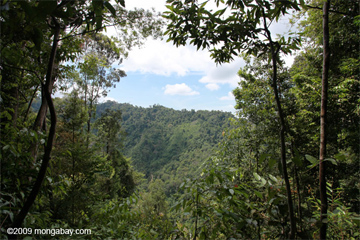
Richard Corlett: Deforestation and hunting are currently the biggest threats, followed by logging, with climate change waiting in the wings. Mining, urbanization, and air pollution are locally important. The biggest obstacles to conservation include high human population densities and continued population growth, despite the recent precipitous decline in birth rates, rural poverty, corruption, and globalization, which means that land-use changes are determined by global markets. Ignorance and indifference are also major obstacles, and I hope my book will help reduce the former.
Mongabay: What do you see as the best way forward for conservation in the region? Are you optimistic that at least fragments of most ecosystems will be preserved for future generations?
Richard Corlett: We need to work on all fronts, but the number one priority is to protect existing protected areas (national parks, nature reserves, forest reserves etc.) from further degradation. All parks in the region are currently underfunded and their staff under-supported and underappreciated. In many cases this just requires more people on the ground to keep out hunters and illegal loggers. In other cases, conflicts with local people must be resolved. This will cost money and tends not to attract funding from NGOs and other international sources because it is unspectacular, but it is what needs doing most urgently. If this is done, then a big chunk of the region's biodiversity will make it through the next 50 years into a future region with declining human population and expanding forest cover – but possibly also devastating climate change.
Mongabay: Is it practical to make human-dominated landscapes more accommodating for biodiversity?
Richard Corlett: This is the billion dollar question! Tropical forests are so different from current human-dominated landscapes that the general answer would have to be 'no'. Non-forest areas in Singapore, where I now live, are dominated by invasive exotic species of trees, birds, earthworms and insects. It may, however, be possible to modify human-dominated landscapes in ways that make them friendlier to native forest biodiversity, and that is one of my current research areas. I suspect that the changes needed will be pretty drastic- a lot more tree cover and a lot more areas set aside for the restoration of native forest – but not necessarily impractical. Working on this is a good way to stay positive!
Mongabay: What are your thoughts on payments for ecosystem services on a means to finance conservation?
Richard Corlett
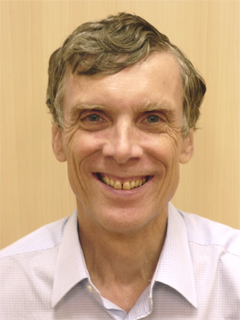
Richard Corlett: In the final chapter I consider sources of funding for conservation, including P.E.S. The success of PES schemes has been difficult to evaluate because "pure" PES is rare – there is usually another objective too, usually provision of income to the rural poor. I think that many – probably most – protected areas in the tropics should be receiving payments for water, from downstream farmers, industry or towns, but using PES to protect habitat outside protected areas has in practice proved difficult. PES makes most sense at the margins of profitability, when small payments can tip the balance in favor of conservation. China has two major schemes that could be considered PES: the Natural Forest Conservation Program, which pays forest enterprises to stop logging natural forests and to increase the plantation area, and the Grain to Green Program (also known as the Sloping Land Conversion Program), which pays farmers in key river catchments to convert cropland on steep slopes to grassland or forest. Both schemes have apparently already had large impacts on vegetation cover and the biodiversity benefits are likely to increase as more encouragement is given to the use of diverse native species in forest rehabilitation.
Carbon offset are a separate issue, with potentially huge amounts of money available, but also huge problems. At present we are all waiting to see where the post-Kyoto talks end up with this. Will REDD – the best option for conservation – be in any future international agreement? The ideal would be an international carbon scheme linked with some form of regional 'biodiversity offset' scheme, which gives greater value to biodiversity-rich carbon and stops the world being converted to fast-growing eucalyptus plantations.
The Ecology of Tropical East Asia
Amazon.com | Amazon-UK | Oxford University Press
Copyright mongabay 2009
Read more... Sphere: Related Content02 June 2009
History may help us survive climate change
UPI.com, June 1, 2009 at 5:40 PM
LEICESTER, England, June 1 (UPI) -- British scientists say history might help people mitigate the worst effects of climate change by teaching how our ancestors adapted to similar occurrences.
Research led by the University of Leicester suggests people today and in future generations should look to the past to determine how our ancestors coped with the dangers of rising sea levels, crop failures and extreme weather conditions.
Jago Cooper of the university's School of Archaeology and Ancient History led researchers from Britain, Cuba and Canada in studying the archeology of climate change in the Caribbean.
"Populations in the Caribbean, from 5000 BC to AD 1492 successfully lived through a (16-foot) rise in relative sea levels, marked variation in annual rainfall and periodic intensification of hurricane activity," Cooper said.
"This research examines the archaeological lessons that can inform current responses to the impacts of climate change in the Caribbean," Cooper added. "A key focus of the research has been to investigate past mitigation of the impacts of climate change through the analysis of changes in settlement structures, food procurement strategies and household architecture."
The research is detailed in New Scientist magazine.
© 2009 United Press International, Inc. All Rights Reserved.
Read more... Sphere: Related Content31 May 2009
Positive Feedback Hint Between Tropical Cyclones And Global Warming
ScienceDaily, May 29, 2009
Tropical cyclones could be a significant source of the deep convection that carries moist air upward to the stratosphere, where it can influence climate, according to Harvard University researchers David M. Romps and Zhiming Kuang.
Using 23 years of infrared satellite imagery, global tropical cyclone best-track data, and reanalysis of tropopause temperature, the authors found that tropical cyclones contribute a disproportionate amount of the tropical deep convection that overshoots the troposphere and reaches the stratosphere.
Their findings appear in a recent issue of Geophysical Research Letters.
Tropical cyclones account for only 7 percent of the deep convection in the tropics, but 15 percent of the convection that reaches the stratosphere, the researchers found. They conclude that tropical cyclones could play a key role in adding water vapor to the stratosphere, which has been shown to increase surface temperatures.
Because global warming is expected to lead to changes in the frequency and intensity of tropical cyclones, the authors believe their results suggest the possibility of a feedback mechanism between tropical cyclones and global climate.
Journal reference:
-
David M. Romps and Zhiming Kuang. Overshooting convection in tropical cyclones. Geophysical Research Letters, 2009; 36 (9): L09804 DOI: 10.1029/2009GL037396
Adapted from materials provided by American Geophysical Union, via EurekAlert!, a service of AAAS.
Copyright © 1995-2009 ScienceDaily LLC — All rights reserved
Read more... Sphere: Related Content18 May 2009
Capitalism in Wonderland: Why mainstream economists can't deal with the ecological crisis
By Richard York, Brett Clark and John Bellamy Foster (posted at Links International Journal of Socialist Renewal with permission)

In a recent essay, “Economics Needs a Scientific Revolution”, in one of the leading scientific journals, Nature, physicist Jean-Philippe Bouchaud, a researcher for an investment management company, asked rhetorically, “What is the flagship achievement of economics?” Bouchaud’s answer: “Only its recurrent inability to predict and avert crises”.[1]
Although his discussion is focused on the current worldwide financial crisis, his comment applies equally well to mainstream economic approaches to the environment — where, for example, ancient forests are seen as non-performing assets to be liquidated, and clean air and water are luxury goods for the affluent to purchase at their discretion. The field of economics in the United States has long been dominated by thinkers who unquestioningly accept the capitalist status quo and, accordingly, value the natural world only in terms of how much short-term profit can be generated by its exploitation. As a result, the inability of received economics to cope with or even perceive the global ecological crisis is alarming in its scope and implications.
* * *
John Bellamy Foster, editor of Monthly Review, has just released his latest book, The Ecological Revolution: Making Peace with the Planet. The roots of the present ecological crisis, John Bellamy Foster argues in The Ecological Revolution, lie in capital’s rapacious expansion, which has now achieved unprecedented heights of irrationality across the globe. Foster compellingly demonstrates that the only possible answer for humanity is an ecological revolution: a struggle to make peace with the planet. Foster details the beginnings of such a revolution in human relations with the environment which can now be found throughout the globe, especially in the periphery of the world system, where the most ambitious experiments are taking place.

* * *
Bouchaud penetratingly observes, “The supposed omniscience and perfect efficacy of a free market stems from economic work done in the 1950s and 1960s, which with hindsight looks more like propaganda against communism than plausible science”. The capitalist ideology that undergirds economics has led the profession to be detached from reality, rendering it incapable of understanding many of the crises the world faces. Mainstream economics’ obsession with the endless growth of GDP — a measure of “value added”, not of human well-being or the intrinsic worth of ecosystems and other species — and its failure to recognise the fundamental ecological underpinnings of the economy, has led to more than simply an inability to perceive the deterioration of the global environment. In fact, the problem goes much deeper. Orthodox economics, like the capitalist system that it serves, leads to an “Après moi le déluge!” philosophy that is anything but sustainable in orientation. As Naomi Klein has said, there is something perversely “natural” about disaster capitalism.[2]
Economists in Wonderland
The inherent incapacity of orthodox or neoclassical economics to take ecological and social costs into account was perhaps best exemplified in the United States by the work of Julian Simon. In articles and exchanges in Science andSocial Science Quarterly and in his book The Ultimate Resource published at the beginning of the 1980s, he insisted that there were no serious environmental problems, that there were no environmental constraints on economic or population growth, and that there would never be long-term resource shortages. For example, he infamously claimed that copper (an element) could be made from other metals and that only the mass of the universe, not that of the Earth, put a theoretical limit on how much copper could be produced. The free market if left unfettered, he contended, would ensure continuous progress into the distant future. These and other dubious assertions led ecologist Paul Ehrlich to refer to Simon as “an economist in Wonderland”.[3]
Apologists for capitalism continue to occupy Wonderland, because it is only in Wonderland that environmental problems either do not really exist or can be solved by capitalism, which can also improve the quality of life for the mass of humanity. Bjørn Lomborg, a Danish statistician and political scientist (now an adjunct professor at the Copenhagen Business School), picked up Simon’s torch, publishing his salvo aimed at environmentalism, The Skeptical Environmentalist, in 2001. Lomborg argued, for example, that attempting to prevent climate change would cost more and cause more harm than letting it happen. Lomborg’s book was immediately praised to the skies by the mass media, which was looking for a new anti-environmental crusader. Soon after the publication of The Skeptical Environmentalist, environmental scientists documented the countless flaws (not all of them inadvertent) in Lomborg’s reasoning and evidence. Scientific American devoted part of an issue to four articles by leading scientists sharply criticising Lomborg. As a result of its serious flaws, the book was rejected by the scientific community. Yet, despite the adamant rejection of The Skeptical Environmentalist by natural scientists, all of this seemed only to add to Lomborg’s celebrity within the corporate media system. The Economist touted the book and its conclusions, proclaiming it to be “one of the most valuable books on public policy”, having dispelled the notion of “looming environmental disaster” and “the conviction that capitalism is self-destructive”.[4] Time magazine in 2004 designated Lomborg as one of the 100 most influential people in the world; while in 2008, Britain’s Guardian newspaper labeled him as one of the “50 people who could save the planet”.
In 2003 Lomborg organised what he called the “Copenhagen Consensus” to rank the world’s leading problems. This was carried out through the writing of a number of reports on various global priorities by a group of hand-picked, mainly economic authorities, and then the subsequent ranking of these problems by eight “experts” — all economists, since economists were declared to be the only experts on “economic prioritisation”, i.e., decisions on where to put society’s resources. The eight Copenhagen Consensus economists not surprisingly all ranked climate change at or near the bottom of the world’s agenda, backing up Lomborg’s position.[5]
Lomborg’s 2007 book Cool It: The Skeptical Environmentalist’s Guide to Global Warming was an extended attack on the Kyoto Protocol and all attempts to carry out substantial cuts in greenhouse gas emissions. For Lomborg the essential point was that, “all major peer-reviewed economic models agree that little emissions reduction is justified”. He relied particularly on the work of Yale economist William Nordhaus, a leading economic contributor to the discussion of global warming, who has opposed any drastic reductions in greenhouse gases, arguing instead for a slow process of emissions reduction, on the grounds that it would be more economically justifiable.[6]
Economists versus natural scientists
Needless to say, establishment economists, virtually by definition, tend to be environmental skeptics. Yet they have an outsized influence on climate policy as representatives of the dominant end of capitalist society, before which all other ends are subordinated. (Social scientists other than economists either side with the latter in accepting accumulation as the appropriate goal of society or are largely excluded from the debate.) In sharp contrast, natural and physical scientists are increasingly concerned about the degradation of the planetary environment, but have less direct influence on social policy responses.
Mainstream economists are trained in the promotion of private profits as the singular “bottom line” of society, even at the expense of larger issues of human welfare and the environment. The market rules over all, even nature. For Milton Friedman the environment was not a problem since the answer was simple and straightforward. As he put it: “ecological values can find their natural space in the market, like any other consumer demand”.[7]
Natural scientists, as distinct from economists, however, typically root their investigations in a materialist conception of nature and are engaged in the study at some level of the natural world, the conditions of which they are much more disposed to take seriously. They are thus much less inclined to underrate environmental problems.
The conflict between economists and natural scientists on global warming came out in the open as a result of an article by Nordhaus that appeared in the leading natural science journal, Science, in 1993. Nordhaus projected that the loss to gross world output in 2100 due to continuation of global warming trends would be insignificant (about 1 per cent of GDP in 2100). His conclusion clearly conflicted with the results of natural science since these same business-as-usual trends could lead, according to the UN Intergovernmental Panel on Climate Change (IPCC) scenarios at the time, to as much as a 5.8°C (10.4°F) increase in average global temperature, which for scientists was nothing less than catastrophic for civilisation and life itself. Nordhaus had concluded in his article that attempts at emissions stabilisation would be worse than inaction. This led to a number of strong replies by noted natural scientists (in letters to Science), who viewed Nordhaus’s analysis as patently absurd.
Nordhaus subsequently defended his views by surveying a number of influential economists and scientists, asking them for their best guesstimates, publishing his results in the American Scientist in 1994. The economists he chose to survey agreed with him that climate change would have little effect on the economy. Yet, the natural scientists saw the consequences as potentially catastrophic. One physical scientist responded by claiming that there was a 10 per cent chance under present trends of the complete destruction of civilisation — similar views would likely be even more common today. Nordhaus observed that those who knew most about the economy were optimistic. Stephen Schneider, a Stanford biologist and climate scientist (and a leading critic of both Lomborg and Nordhaus), retorted that those who knew most about the environment were worried. As Schneider summed up the debate in 1997 in hisLaboratory Earth: “Most conventional economists...thought even this gargantuan climate change [a rise in average global temperature of 6°C] — equivalent to the scale of change from an ice age to an interglacial epoch in a hundred years, rather than thousands of years — would have only a few per cent impact on the world economy. In essence, they accept the paradigm that society is almost independent of nature”.[8]
Orthodox economists, it is true, often project economic costs of global warming in 2100 to be only a few percentage points and therefore hardly significant, even at levels of climate change that would endanger most of the “higher” species on the planet and human civilisation itself, costing hundreds of millions, if not billions, of human lives.
The failure of economic models to count the human and ecological costs of climate change should not surprise us. Bourgeois economics has a carefully cultivated insensitivity to human tragedy (not to mention natural catastrophe) that has become almost the definition of “man’s inhumanity to man”. Thomas Schelling, a recipient of the Bank of Sweden’s Nobel Memorial Prize in Economic Sciences, and one of Lomborg’s eight experts in the Copenhagen Consensus, is known for arguing that since the effects of climate change will fall disproportionately on the poorer nations of the global South, it is questionable how much in the way of resources the rich nations of the global North should devote to the mitigation of climate trends. (Schelling in his Copenhagen Consensus evaluation ranked climate change at the very bottom of world priorities.)[9] Here one can’t help but be reminded of Hudson Institute planners, who in the process of proposing a major dam on the Amazon in the early 1970s contended in effect — as one critic put it at the time — that “if the flooding drowns a few tribes who were not evacuated because they were supposed to be on higher ground, or wipes out a few forest species, who cares?”[10]
Similarly, while chief economist of the World Bank, Lawrence Summers, now Obama’s top economic advisor, wrote an internal World Bank memo in which he stated: “the economic logic behind dumping a load of toxic waste in the lowest-wage country is impeccable and we should face up to that”. He justified this by arguing: “The measurement of the costs of health-impairing pollution depends on the foregone earnings from increased morbidity and mortality. From this point of view a given amount of health-impairing pollution should be done in the country with the lowest cost, which will be the country of the lowest wages”.[11]
Discounting the future
Nordhaus — who ranks as one of the most influential mainstream economists on global warming today and is a cut above figures like Simon and Lomborg — has proposed, in his 2008 book A Question of Balance: Weighing the Options on Global Warming Policies, a go-it-slow strategy on combating greenhouse emissions.[12] Nordhaus demonstrates here that despite impressive credentials he remains hobbled by the same ideology that has crippled other mainstream economists. In essence this comes down to the belief that capitalism offers the most efficient response to questions of resource use, and indeed a sufficient answer to the world’s problems.
A Question of Balance presents a fairly standard economic argument about how to address global climate change, although it is backed by Nordhaus’s own distinctive analyses using sophisticated modeling techniques. He acknowledges that global climate change is a real problem, and is human generated, arguing that it is necessary slowly to move away from carbon-emitting energy sources. Nevertheless, the central failures of his approach are that it assigns value to the natural environment and human well-being using standard economic measures that are fundamentally inadequate for this purpose, and that it fails properly to incorporate the possibility that an ecological collapse could utterly undermine the economy, and indeed the world as we know it. These failures, which are those of mainstream economics, are clearly apparent in his approach to discounting for purposes of estimating how much effort should be put into reducing carbon emissions. Roughly speaking, Nordhaus argues we should only invest a modest amount of effort in reducing carbon emissions in the short term and slowly increase this over time, because he favours a high discount rate.
The issue of discounting may seem esoteric to most people, but not to economists, and deserves some examination. Discounting is fundamentally about how we value the future relative to the present — insofar as it makes any sense at all to attach numbers to such valuations. The “discount rate” can be thought of as operating in inverse relation to compound interest. While “compounding measures how much present-day investments will be worth in the future, discounting measures how much future benefits are worth today”.[13] Estimation of the discount rate is based on two moral issues. First, there is the issue of how we value the welfare of future generations relative to present ones (the time discount rate). As Nordhaus states, “A zero discount rate means that all generations into the indefinite future are treated the same; a positive discount rate means that the welfare of future generations is reduced or ‘discounted’ compared with nearer generations”. A catastrophe affecting humanity fifty years from now, given a discount rate of 10 per cent, would have a “present value” less than 1 per cent of its future cost. Second, there is the issue of how wealthy future generations will be relative to present ones and whether it is appropriate to shift costs from the present to the future. If we assume a high rate of economic growth into the indefinite future, we are more likely to avoid investing in addressing problems now, because we assume that future generations will be wealthier than we are and can better afford to address these problems, even if the problems become substantially worse.[14]
The difficulty of the discount rate, as environmental economist Frank Ackerman has written, is that, “it is indeed a choice; the appropriate discount rate for public policy decisions spanning many generations cannot be deduced from private market decisions today, or from economic theory. A lower discount rate places a greater importance on future lives and conditions of life. To many, it seems ethically necessary to have a discount rate at or close to zero, in order to respect our descendants and create a sustainable future”.[15] Indeed, the very notion of sustainability is about maintaining the environment for future generations.
Economic growth theorist Roy Harrod argued in the 1940s that discounting the future based on a “pure time preference” (the myopic preference for consumption today apart from all other considerations) was a “polite expression for rapacity”. A high discount rate tends to encourage spending on policies/projects with short-term benefits and long-term costs as opposed to ones with high up-front costs and long paybacks. It therefore encourages “wait-and-see” and “go-it-slow” approaches to impending catastrophes, such as climate change, rather than engaging in strong preventive action.[16]
Nordhaus, like most mainstream economists, through his support of a high discount rate, places a low value on the welfare of future generations relative to present ones, and assumes, despite considerable uncertainty in this regard, that future generations will be much wealthier than present ones. This leads him to argue against large immediate investments in curtailing climate change. He advocates putting a tax on carbon of $30 to $50 per ton and increasing this to about $85 by mid-century. Taxing carbon at $30 a ton would increase the price of gasoline by a mere seven cents a gallon, which gives one a sense of the low level of importance Nordhaus places on curtailing climate change as well as the future of humanity and the environment. Nordhaus has tripled his estimate of the loss to global economic output due to climate change in 2100, moving from his earlier estimate of almost 1 per cent to nearly 3 per cent in his latest study.[17] Still, such losses are deemed insignificant, given a high discount rate, in comparison to the costs that would be incurred in any attempt to curtail drastically climate change today, leading Nordhaus to advocate a weak-kneed response.
Nordhaus is particularly interested in countering the arguments presented in The Economics of Climate Change(commonly known as The Stern Review), the report written by Nicholas Stern (former chief economist of the World Bank) for the British government, which advocates immediate and substantial investments aimed at reducing carbon emissions. Stern, deviating from the practice of most orthodox economists, uses a low discount rate, arguing that it is morally inexcusable to place low value on the welfare of future generations and to impose the costs of the problems we generate on our descendants. Nordhaus discounts the future at roughly 6 per cent a year; Stern by 1.4 per cent. This means that for Stern having a trillion dollars a century from now is worth $247 billion today, while for Nordhaus it is only worth $2.5 billion.[18] Due to this, Stern advocates imposing a tax on carbon of greater than $300 per ton and increasing it to nearly $1000 before the end of the century.[19] Lomborg in the Wall Street Journal characterised theStern Review as “fear-mongering”, and referred to it in Cool It! as a “radical report”, comparing it unfavourably to Nordhaus’s work.[20]
The unworldly economists
It is important to recognise that the difference displayed here between Nordhaus and Stern is fundamentally a moral, not a technical, one. Where they primarily differ is not on their views of the science behind climate change but on their value assumptions about the propriety of shifting burdens to future generations. This lays bare the ideology embedded in orthodox neoclassical economics, a field which regularly presents itself as using objective, even naturalistic, methods for modeling the economy. However, past all of the equations and technical jargon, the dominant economic paradigm is built on a value system that prizes capital accumulation in the short term, while de-valuing everything else in the present and everything altogether in the future.
Some of the same blinders are in fact common in varying degrees to both Nordhaus and Stern. Nordhaus proposes what he calls an “optimal path” in economic terms aimed at slowing down the growth of carbon emissions. In his “climate policy ramp” emissions reductions would start slow and get bigger later, but would nonetheless lead eventually (in the next century) to an atmospheric carbon concentration of nearly 700 parts per million (ppm). This would present the possibility of global average temperature increases approaching 6°C (10.8°F) above preindustrial levels — a level that Mark Lynas in his Six Degrees compares to the sixth circle of hell in Dante’s Inferno.[21]
Indeed, with a level of carbon concentration much less than this, 500 ppm (associated with global warming on the order of 3.5°C or 6.3°F), the effects both on the world’s biological diversity and on human beings themselves would be disastrous. “A conservative estimate for the number of species that would be exterminated (committed to extinction)” at this level, according to James Hansen, director of NASA’s Goddard Institute for Space Studies, “is one million”. Moreover, rising sea levels, the melting of glaciers, and other effects could drastically affect hundreds of millions, conceivably even billions, of people. Hansen, the world’s most famous climatologist, argues that in order to avoid catastrophic change it is necessary to reduce atmospheric carbon to a level of 350 ppm.[22]
Yet, the Stern Review itself, despite being designated as a “radical” and “fear-mongering” report by Lomborg, targets an atmospheric carbon concentration stabilisation level of 480 ppm (550 ppm in carbon equivalent), which — if never reaching Nordhaus’s near 700 ppm peak (over 900 ppm carbon equivalent) — is sure to be disastrous, if the analysis of Hansen and most other leading climatologists is to be believed.[23] Why such a high atmospheric carbon target?
The answer is provided explicitly by the Stern Review itself, which argues that past experience shows that anything more than a 1 per cent average annual cut in carbon emissions in industrial countries would have a significant negative effect on economic growth. Or as the Stern Review itself puts it, “it is difficult to secure emission cuts faster than about 1 per cent a year except in instances of recession”.[24] So the atmospheric carbon target is determined not according to what is necessary to sustain the global environment, protect species, and ensure the sustainability of human civilisation, but by what is required to keep the capitalist economy itself alive.
The starting point that led to Summers’s conclusion in his 1992 World Bank memo is in fact the same that underlies the analyses of both Nordhaus and Stern. Namely, human life in effect is worth only what each person contributes to the economy as measured in monetary terms. So, if global warming increases mortality in Bangladesh, which it appears likely that it will, this is only reflected in economic models to the extent that the deaths of Bengalis hurt the economy. Since Bangladesh is very poor, economic models of the type Nordhaus and Stern use would not estimate it to be worthwhile to prevent deaths there since these losses would show up as miniscule in the measurements. Nordhaus, according to his discount analysis, would go a step beyond Stern and place an even slighter value on the lives of people if they are lost several decades in the future. This economic ideology, of course, extends beyond just human life, such that all of the millions of species on Earth are valued only to the extent they contribute to GDP. Thus, ethical concerns about the intrinsic value of human life and of the lives of other creatures are completely invisible in standard economic models. Increasing human mortality and accelerating the rate of extinctions are to most economists only problems if they undermine the “bottom line”. In other respects they are invisible: as is the natural world as a whole.
From any kind of rational perspective, i.e., one not dominated exclusively by the narrow economic goal of capital accumulation, such views would seem to be entirely irrational, if not pathological. In order to highlight the peculiar mindset at work it is useful to quote a passage from Lewis Carroll’s Through the Looking Glass:
The prettiest are always further!” [Alice] said at last, with a sigh at the obstinacy of the rushes in growing so far off, as, with flushed cheeks and dripping hair and hands, she scrambled back into her place, and began to arrange her new-found treasures.
What mattered it to her just then that the rushes had begun to fade, and to lose all their scent and beauty, from the very moment that she picked them? Even real scented rushes, you know, last only a very little while — and these, being dream-rushes, melted away almost like snow, as they lay in heaps at her feet — but Alice hardly noticed this, there were so many other curious things to think about.[25]
A society that values above all else the acquisition of abstract value-added, and in the prospect lays waste to nature, in an endless quest for further accumulation, is ultimately an irrational society. What matters to it what it leaves wasted at its feet, as it turns elsewhere in its endless pursuit of more?
Mainstream economics, ironically, has never been a materialist science. There is no materialist conception of nature in what Joseph Schumpeter called its “preanalytic vision”.[26] It exists in almost complete ignorance of physics (constantly contravening the second law of thermodynamics), and of the degradation of the biosphere. It sees the world simply in terms of an endless, enlarging “circular flow” of economic relations.
The ecological blinders of neoclassical economics, which excludes the planet itself from its vision, are well illustrated by a debate that took place within the World Bank, related by ecological economist Herman Daly. As Daly tells the story, in 1992 (when Summers was chief economist of the World Bank and Daly worked for the World Bank) the annual World Development Report was to focus on the theme Development and the Environment:
An early draft contained a diagram entitled “The Relationship Between the Economy and the Environment”. It consisted of a square labeled “economy”, with an arrow coming in labeled “inputs” and an arrow going out labeled “outputs” — nothing more. I suggested that the picture failed to show the environment, and that it would be good to have a large box containing the one depicted, to represent the environment. Then the relation between the environment and the economy would be clear — specifically, that the economy is a subsystem of the environment both as a source of raw material inputs and as a “sink” for waste outputs.The next draft included the same diagram and text, but with an unlabeled box drawn around the economy like a picture frame. I commented that the larger box had to be labeled “environment” or else it was merely decorative, and that the text had to explain that the economy is related to the environment as a subsystem within the larger ecosystem and is dependent on it in the ways previously stated. The next draft omitted the diagram altogether.[27]
To be sure, not all economics is as resolutely unworldly as this. Nicholas Georgescu-Roegen, an economist critical of the anti-ecological orientation of economics — and the founder of the heterodox tradition known as ecological economics, which builds into its pre-analytic vision the notion that the economy is in fact materially limited by physics and ecology — explained that the drive for continuous social wealth and economic profit increased the ecological demands placed on nature, expanding the scale of environmental degradation. He highlighted the error of pretending that the economy could be separated from ecology. Others, like Herman Daly, and Paul Burkett in the Marxist tradition, have pushed forward this notion of ecological economics.[28] Yet, these ecological economists remain on the margins, excluded from major policy decisions and academic influence.
The juggernaut of capital
Mainstream economists see themselves as engaged in the science of economic growth. Nevertheless, the assumption of endless economic growth, as if this were the purpose of society and the way of meeting human needs, seems naïve at best. As Daly says, “an ever growing economy is biophysically impossible”.[29] The Wonderland nature of such an assumption is particularly obvious in light of the fact that the very underpinning of the economy, the natural environment itself, is being compromised.
Marx did not miss the importance of this social-ecological relationship. He pointed out that humans are dependent upon nature, given that it provides the energy and materials that make life possible. While capitalists focused on exchange value and short-term gains, Marx explained that the earth is the ultimate source of all material wealth, and that it needed to be sustained for “successive generations”. The “conquest of nature” through the endless pursuit of capital, which necessitated the constant exploitation of nature, disrupted natural cycles and processes, undermining ecosystems and causing a metabolic rift. Engels warned that such human actions left a particular “stamp … upon the earth” and could cause unforeseen changes in the natural conditions that exact the “revenge” of nature.[30]
Today carbon dioxide is being added to the atmosphere at an accelerating rate, much faster than natural systems can absorb it. Between 2000 and 2006, according to Josep G. Canadell and his colleagues, in their article in theProceedings of the National Academy of Sciences, the emissions growth rate increased as the global economy grew and became even more carbon intensive, meaning that societies emitted more carbon per unit of economic activity at the beginning of the new millennium than they did in the past. At the same time, the capacity of natural sinks to absorb carbon dioxide has declined, given environmental degradation such as deforestation. This contributed to a more dramatic upswing in carbon accumulation in the atmosphere than was anticipated.[31] The juggernaut of capital overexploits both the resource taps and waste sinks of the environment, undermining their ability to operate and provide natural services that enhance human life.
There are many good reasons to think that the patterns and processes which held for the past one hundred years — e.g., economic growth — may not hold for the next one hundred, a point on which the present economic crisis should perhaps focus our attention. Justifying shifting costs from the present to the future based on the assumption that future generations will be richer than present ones is highly dubious. In relation to the economy as well as the ecology the future is highly uncertain, though current trends clearly point to disaster. If global climate change, not to mention the many other interconnected environmental problems we face, has some of the more catastrophic effects that scientists predict, economic growth may not only be hampered, but the entire economy may be undermined, not to mention the conditions of nature on which we depend. Therefore, future generations may be much poorer than present ones and even less able to afford to fix the problems we are currently creating.
In addition, the growth mania of neoclassical economists focuses on the kinds of things, mainly private goods reflecting individual interests, which comprise GDP, while collective goods and the global commons are devalued in comparison. It therefore encourages an economic bubble approach to the world’s resources that from a deeper and longer perspective cannot be maintained.
For all of these reasons, the current economic order tends to mismeasure the Earth and human welfare. Capitalism, in many respects, has become a failed system in terms of the ecology, economy, and world stability. It can hardly be said to deliver the goods in any substantive sense, and yet in its process of unrestrained acquisition it is undermining the long-term prospects of humanity and the Earth.[32]
If we cannot rely on orthodox economists to avert crises in financial markets, an area that is supposedly at the core of their expertise, why should we rely on them to avert ecological crises, the understanding of which requires knowledge of the natural environment that is not typically covered in their training? Nor is such an awareness compatible with the capitalist outlook that is embedded in received economics. Ehrlich has noted that, “Most economists are utterly ignorant of the constraints placed upon the economic system by physical and biological factors”, and they fail to “recognise that the economic system is completely and irretrievably embedded in the environment”, rather than the other way around. Due to these problems, he has stated pointedly that, “it seems fair to say that most ecologists see the growth-oriented economic system and the economists who promote that system as the gravest threat faced by humanity today”. Furthermore, “the dissociation of economics from environmental realities can be seen in the notion that the market mechanism completely eliminates the need for concern about diminishing resources in the long run”.[33]
Plan B: The technofix Wonderland
The demonstrated failure of received economics to offer a solution to the environmental problem compatible with a capitalist economy has recently resulted in a Plan B to save the system through the proliferation of technological silver bullets for carrying out a “green revolution”, without altering the social and economic relations of the system. Often this is presented in terms of an “investment strategy” geared to new Schumpeterian epoch-making innovations of an environmental nature that will somehow save the day for both the economy and ecology, while restoring US empire. Orthodox economists assume that the resource problems of today will force prices up tomorrow and that these higher prices will force the creation of new technology. The new army of environmental technocrats claims that the new innovations that will solve all problems are simply there waiting to be developed — if only a market is created, usually with the help of the state. Such views have been promoted in the last couple of years by figures like Thomas Friedman, Newt Gingrich, Fred Krupp of the Environmental Defense Fund, and Ted Nordhaus and Michael Shellenberger of the Breakthrough Institute. Krupp and Miriam Horn present this as a question of a competitive race between nations to be first in the green technologies and markets that will save the world. “The question”, they write, “is no longer just how to avert the catastrophic impacts of climate change, but which nations will produce — and export — the green technologies of the twenty-first century”.[34]
These analyses tend to be big on the wonders of technology and the market, while setting aside issues of physics, ecology, the contradictions of accumulation, and social relations. They assume that it mostly comes down to energy efficiency (and other technical fixes) without understanding that in a capitalist system, growth of efficiency normally leads to an increase in scale of the economy (and further rifts in ecological systems) that more than negates any ecological gains made (a problem known as the Jevons Paradox).[35]
Like the establishment economists, with whom they are allied, the technocrats promise to solve all problems while keeping the social relations intact. The most ambitious schemes involve massive geoengineering proposals to combat climate change, usually aimed at enhancing the Earth’s albedo (reflectivity). These entail schemes like using high-flying aircraft, naval guns, or giant balloons to launch reflective materials (sulfate aerosols or aluminum oxide dust) into the upper stratosphere to reflect back the rays of the sun. There are even proposals to create “designer particles” that will be “self-levitating” and “self-orienting” and will migrate to the atmosphere above the poles to provide “sunshades” for the polar regions.[36] Such technocrats live in a Wonderland where technology solves all problems, and where the Sorcerer’s Apprentice has never been heard of. All of this is designed to extend the conquest of the Earth rather than to make peace with the planet.
Ecological revolution
If there was a definite beginning to the modern ecological revolution, this can be traced back to Rachel’s Carson’sSilent Spring. In attempting to counter what she called the “sterile preoccupation with things that are artificial, the alienation from the sources of our strength”, that has come to characterise the capitalist Wonderland, Carson insisted that it was necessary to cultivate a renewed sense of wonder toward the world and living beings. Yet, it was not enough, as she was to demonstrate through her actions, merely to contemplate life. It was necessary also to sustainit, which meant actively opposing the “gods of profit and production” — and their faithful messengers, the dominant economists of our time.
[Richard York is coeditor of Organisation & Environment and associate professor of sociology at the University of Oregon. Brett Clark is assistant professor of sociology at North Carolina State University. They are coauthors with John Bellamy Foster of Critique of Intelligent Design: Materialism versus Creationism from Antiquity to the Present(Monthly Review Press, 2008). John Bellamy Foster is editor of Monthly Review and professor of sociology at the University of Oregon. He is the author of The Ecological Revolution: Making Peace with the Planet (Monthly Review Press, 2009) among numerous other works.]
Notes
Read more... Sphere: Related Content1. Jean-Philippe Bouchaud, “Economics Needs a New Scientific Revolution”, Nature 455 (October 30, 2008): 1181.
2. See Naomi Klein, The Shock Doctrine: The Rise of Disaster Capitalism (New York: Henry Holt, 2007). “Après moi le déluge! is the watchword of every capitalist and every capitalist nation. Capital therefore takes no account of the health and length of life of the workers unless society forces it to do so”. Karl Marx, Capital, vol. 1 (New York: Vintage, 1976), 381.
3. Paul R. Ehrlich, “An Economist in Wonderland”, Social Science Quarterly 62 (1981): 44-49; Julian L. Simon, “Resources, Population, Environment: An Oversupply of False Bad News”, Science 208 (June 27, 1980): 1431-37, “Bad News: Is It True?” Science 210 (December 19, 1980): 1305-8, “Environmental Disruption or Environmental Improvement?” Social Science Quarterly 62 (1981): 30-43, The Ultimate Resource (Princeton, NJ: Princeton University Press, 1981), “Paul Ehrlich Saying It Is So Doesn’t Make it So”, Social Science Quarterly 63 (1982): 381-5. For the rest of Ehrlich and colleagues’ side of the exchanges, see: Ehrlich, “Environmental Disruption: Implications for the Social Sciences”, Social Science Quarterly 62 (1981): 7-22, “That’s Right — You Should Check It For Yourself”, Social Science Quarterly 63 (1982): 385-7, John P. Holdren, Paul R. Ehrlich, Anne H. Ehrlich, and John Harte, “Bad News: Is It True?” Science 210 (December 19, 1980): 1296-1301.
4. Bjørn Lomborg, The Skeptical Environmentalist (Cambridge: Cambridge University Press, 2001); Stuart Pimm and Jeff Harvey, review of The Skeptical Environmentalist, Nature 414 (November 8, 2001): 149-150; Stephen Schneider, John P. Holdren, John Bogaars, and Thomas Lovejoy in Scientific American 286, no. 1 (January 2002), 62-72; “Defending Science”, The Economist, January 31, 2002, 15-16.
5. Bjørn Lomborg, Global Crises, Global Solutions (Cambridge: Cambridge University Press, 2004), 6.
6. Bjørn Lomborg, Cool It: The Skeptical Environmentalist’s Guide to Global Warming (New York: Alfred A. Knopf, 2007), 37. See also Frank Ackerman, “Hot, It’s Not: Reflections on Cool It, by Bjørn Lomborg”, Climatic Change 89 (2008), 435-46.
7. Milton Friedman in Carla Ravaioli, Economists and the Environment (London; Zed Press, 1995), 32, 64-65.
8. Stephen H. Schneider, Laboratory Earth (New York: Basic Books, 1997), 129-35; William D. Nordhaus, “An Optimal Transition Path for Controlling Greenhouse Gases”, Science 258 (November 20, 1992): 1318; Stephen Schneider, “Pondering Greenhouse Policy”, Science 259 (March 5, 1993): 1381. The discussion here borrows from the introduction to John Bellamy Foster, The Ecological Revolution (New York: Monthly Review Press, 2009), 24-25.
9. Thomas C. Schelling, “The Greenhouse Effect”, The Concise Encyclopedia of Economics,http://www.econlib.org/library/Enc1/GreenhouseEffect.html; Schelling in Lomborg, Global Crises, Global Solutions, 630. Schelling is often “credited” with having been the leading “strategist” of the Vietnam War.
10. Gordon Rattray Taylor, The Doomsday Book (Greenwich, CT: Fawcett Publications, 1970), 32-33.
11. After the memo was leaked Summers claimed that he was being “ironic” but the fact that his position conformed to both mainstream economic analysis and other statements that he had argued explicitly and publicly belied that claim. See Summers’s memo and its critique in John Bellamy Foster, Ecology Against Capitalism (New York: Monthly Review Press, 2002), 60-68.
12. William Nordhaus, A Question of Balance: Weighing the Options on Global Warming Policies (New Haven: Yale University Press, 2008).
13. Coastal Services Center, National Oceanic and Atmospheric Association, “Restoration Economics: Discounting and Time Preference”, http://www.csc.noaa.gov/coastal/economics/discounting.htm.
14. William Nordhaus, “Critical Assumptions in the Stern Review on Climate Change”, Science 317 (2007): 201-202; Coastal Services Center, National Oceanic and Atmospheric Association, “Restoration Economics”.
15. Ackerman, “Hot, It’s Not”, 443.
16. Roy Harrod, Towards a Dynamic Economy (New York: St. Martin’s Press, 1948), 40; Stern, The Economics of Climate Change, 35-36; William Cline, “Climate Change”, in Lomborg, Global Crises, Global Solutions, 16.
17. Nordhaus, A Question of Balance, 13-14.
18. John Browne, “The Ethics of Climate Change: The Stern Review”, Scientific American 298, no. 6 (June 2008): 97-100.
19. Nicholas Stern, The Economics of Climate Change: The Stern Review (Cambridge: Cambridge University Press, 2007).
20. Bjørn Lomborg, “Stern Review: The Dodgy Numbers Behind the Latest Warming Scare”, Wall Street Journal, November 2, 2006, and Cool It!, 31.
21. Nordhaus, A Question of Balance, 13-14; Simon Dietz and Nicholas Stern, “On the Timing of Greenhouse Gas Emissions Reductions: A Final Rejoinder to the Symposium on ‘The Economics of Climate Change: The Stern Review and its Critics,’” Review of Environmental Economics and Policy 3, no. 1 (Winter 2009), 138-40; Intergovernmental Panel on Climate Change (IPCC), Summary for Policymakers in Climate Change 2007: Mitigation(Cambridge: Cambridge University Press, 2007), 15; Mark Lynas, Six Degrees (Washington, D.C.: National Geographic, 2008), 241.
22. James and Anniek Hansen, “Dear Barack and Michelle: An Open Letter to the President and the First Lady from the Clintion’s Top Climate Scientist”, Gristmill, January 2, 2009, http://www.grist.org; IPCC, Summary for Policymakers in Climate Change 2007, 15; Stern, The Economics of Climate Change, 16.
23. IPCC, Summary for Policymakers in Climate Change 2007, 15; Dietz and Stern, “On the Timing”, 139; Stern, The Economics of Climate Change, 16. Rather than using atmospheric carbon dioxide concentration, like Hansen and Nordhaus, the Stern Review focuses on carbon dioxide equivalent concentration, which includes the six Kyoto greenhouse gases (carbon dioxide, methane, nitrous oxide, hydrofluorocarbons, perfluorocarbons, and sulfur hexafluoride) all expressed in terms of the equivalent amount of carbon dioxide. For the sake of consistency, we present here the carbon dioxide concentration and then in parentheses the corresponding carbon dioxide equivalent concentration.
24. Stern, The Economics of Climate Change, 231. See John Bellamy Foster, Brett Clark, and Richard York, “Ecology: Moment of Truth — An Introduction”, Monthly Review 60, no. 3 (July-August 2008), 1-11.
25. Lewis Carroll, The Annotated Alice: The Definitive Edition, ed. Martin Gardner (New York: Norton, 2000), 204.
26. Joseph A. Schumpeter, A History of Economic Analysis (New York: Oxford University Press, 1951), 41-42.
27. Herman Daly, Beyond Growth (Boston: Beacon Press, 1996), 5-6. Summers himself, Daly explains, later denied that the economy should be seen as a subset of the biosphere.
28. In addition to Daly’s book cited above see Paul A. Burkett, Marxism and Ecological Economics (Boston: Brill, 2006).
29. Herman Daly, “Economics in a Full World”, Scientific American 293, no. 3 (September 2005), 102.
30. Karl Marx, Capital, vol. 1 (New York: Vintage, 1976), 134, 637-638 and Capital, vol. 3 (New York: Vintage, 1981), 754; Frederick Engels, The Dialectics of Nature (Moscow: Progress Publishers, 1966), 179-180. See also John Bellamy Foster, Marx’s Ecology (New York: Monthly Review Press, 2000), 141-77.
31. Josep G. Canadell, Corinne Le Quéré, Michael R. Raupach, Christopher B. Field, Erik T. Buitenhuis, Philippe Ciais, Thomas J. Conway, Nathan P. Gillett, R. A. Houghton, and Gregg Marland, “Contributions to Accelerating Atmospheric CO2 Growth from Economic Activity, Carbon Intensity, and Efficiency of Natural Sinks”, Proceedings of the National Academy of Sciences 104, no. 47 (2007): 18866-18870.
32. See John Bellamy Foster, “A Failed System”, Monthly Review 60, no. 10 (March 2009): 1-23.
33. Paul Ehrlich, “Environmental Disruption”, 12-14.
34. Fred Krupp and Miriam Horn, Earth: The Sequel (New York: W.W. Norton, 2009), 261. For a treatment of the views of Friedman, Gingrich, and the Breakthrough Institute see the introduction to Foster, The Ecological Revolution.
35. See Brett Clark and John Bellamy Foster, “William Stanley Jevons and The Coal Question: An Introduction to Jevons’s ‘Of the Economy of Fuel,’” Organisation and Environment 14, no. 1 (March 2001): 93-98; Brett Clark and Richard York, “Rifts and Shifts: Getting to the Root of Environmental Catastrophe”, Monthly Review 60, no. 8 (November 2008): 13-24.
36. David G. Victor, M. Granger Morgan, Jay Apt, John Steinbruner and Katharine Ricke, “The Geoengineering Option”,Foreign Affairs 88, no. 2 (March-April 2009), 64-76.
08 January 2009
The layman's finance crisis glossary
BBC News, 8 January 2009

The current financial crisis has thrown terminology from the business pages onto the front page of newspapers, with jargon now abounding everywhere from the watercooler to the back of a taxi.
Here is a guide to many of the business terms currently cropping up regularly, as well as some of the more exotic words coined to describe some of the social effects of the credit crunch.
Readers can send any terms they need explaining using the form at the bottom.
AAA-rating
Administration
Assets
Basis point
Bear market
Bond
Bull market
Capital
Carry trade
Chapter 11
Capitulation
Chapter 11
Collateralised debt obligation
Commercial paper
Commodities
Correction
Credit crunch
Credit default swap
Currency peg
Dead cat bounce
Deflation
Derivatives
Dividends
Equity
FTSE-100
Fundamentals
Futures
Futures
GDP
Hedge fund
Hedging
Inflation
Investment bank
Junk bond
Keynesian economics
Limited liability 
Leveraging
Libor
Liquidity
Loans to deposit ratio
Mark-to-market
Money markets
Monoline insurance
Mortgage-backed securities
Naked short selling
Nationalisation
Negative equity
Ponzi scheme
Preference shares
Prime rate
Profit warning
Quantitative easing
Rating
Recapitalisation
Recession
Retained earnings
Rights issue
Securities lending
Securitisation
Security
Short selling
Spiv
Stagflation
Sub-prime mortgages
Swap
Tier 1 capital
Toxic debts
Underwriters
Unwind
Warrants
Write-down
Yield spread
A-C
The best credit rating that can be given to a corporation's bonds, effectively indicating that the risk of default is negligible.
A rescue mechanism for UK companies in severe trouble. It allows them to continue as a going concern, under supervision, effectively to try to trade out of difficulty.
A firm in administration cannot be wound up without permission from a court.
Things that have earning power or some other value to their owner.
Fixed assets (also known as long-term assets) are things that have a useful life of more than one year, for example buildings and machinery; there are also intangible fixed assets, like the good reputation of a company or brand.
Current assets are the things that can easily be turned into cash and are expected to be sold or used up in the near future.
One hundred basis points make up a percentage point, so an interest rate cut of 25 basis points might take the rate, for example, from 3% to 2.75%.
In a bear market, prices are falling and investors, anticipating losses, tend to sell. This can create a self-sustaining downward spiral.
A debt security - or more simply an IOU. The bond states when a loan must be repaid and what interest the borrower (issuer) must pay to the holder. Banks and investors buy and trade bonds.
A bull market is one in which prices are generally rising and investor confidence is high.
The wealth - cash or other assets - used to fuel the creation of more wealth. Within companies, often characterised as working capital or fixed capital.
Used of the stock markets, the point when a flurry of panic selling induces a bottoming out of prices.
Typically, the borrowing of currency with a low interest rate, converting it into currency with a high interest rate and then lending it. One common carry trade currency is the yen, as traders seek to benefit from Japan's low interest rates. The element of risk is in the fluctuations in the currency market.
The term for bankruptcy protection in the US. It postpones a company's obligations to its creditors, giving it time to reorganise its debts or sell parts of the business, for example.
Collateralised debt obligations (CDOs)
A collateralised debt obligation is a financial structure that groups individual loans, bonds or assets in a portfolio, which can then be traded.
In theory, CDOs attract a stronger credit rating than individual assets due to the risk being more diversified. But as the performance of some assets has fallen, the value of many CDOs have also been reduced.
Unsecured, short-term loans issued by companies. The funds are typically used for working capital, rather than fixed assets such as a new building.
Commodities are products that, in their basic form, are all the same so it makes little difference from whom you buy them.
That means that they have a market price. You would be unlikely to pay more for iron ore from a particular mine, for example.
A short-term drop in stock market prices. The term comes from the notion that, when this happens, overpriced stocks are returning back to their "correct" values.
The situation created when banks hugely reduced their lending to each other because they were uncertain about how much money they had.
This in turn resulted in more expensive loans and mortgages for ordinary people.
A swap designed to transfer credit risk, in effect a form of financial insurance. The buyer of the swap makes periodic payments to the seller in return for protection in the event of a default on a loan.Currency peg A commitment by a government to maintain its currency at a fixed value in relation to another currency. Typically this is done by the government buying its own currency to force the value up, or selling its own currency to lower the value. One example of a peg was the fixing of the exchange rate of the Chinese yuan against the dollar.
D-F
A phrase long used on trading floors to describe a short-lived recovery of share prices in a falling stock market.
The downward price movement of goods and services.
Derivatives are a way of investing in a particular product or security without having to own it. The value can depend on anything from the price of coffee to interest rates or what the weather is like.
Derivatives can be used as insurance to limit the risk of a particular investment.
Credit derivatives are based on the risk of borrowers defaulting on their loans, such as mortgages.
A payment by a company to its shareholders, usually linked to its profits.
In a business, equity is how much all of the shares put together are worth.
In a house, your equity is the amount your house is worth minus the amount of mortgage debt that is outstanding on it.
An index of the 100 companies listed on the London Stock Exchange with the biggest market capitalisation - the share price multiplied by the number of shares. The index is revised every three months.
Fundamentals determine a company, currency or security's value. A company's fundamentals include its assets, debt, revenue, earnings and growth.
A futures contract is an agreement to buy or sell a commodity at a predetermined date and price. It could be used to hedge or to speculate on the price of the commodity.
Gross domestic product. A measure of economic activity in a country, namely of all the services and goods produced in a year. There are three main ways of calculating GDP - through output, through income and through expenditure.
H-K
A private investment fund with a large, unregulated pool of capital and very experienced investors.
Hedge funds use a range of sophisticated strategies to maximise returns - including hedging, leveraging and derivatives trading.
Making an investment to reduce the risk of price fluctuations to the value of an asset.
For example, if you owned a stock and then sold a futures contract agreeing to sell your stock on a particular date at a set price. A fall in price would not harm you - but nor would you benefit from any rise.
The upward price movement of goods and services.
Investment banks provide financial services for governments, companies or extremely rich individuals. They differ from commercial banks where you have your savings or your mortgage.
A bond (or loan to a company) with a high interest rate to reward the lender for a high risk of default.
The economics of John Maynard Keynes. In modern political parlance, the belief that the state can directly stimulate demand in a stagnating economy. For instance, by borrowing money to spend on public works projects like roads, schools and hospitals.
L-P
Leveraging, or gearing, means using debt to supplement investment.
The more you borrow on top of the funds (or equity) you already have, the more highly leveraged you are. Leveraging can maximise both gains and losses.
Deleveraging means reducing the amount you are borrowing.
London Inter Bank Offered Rate. The rate at which banks lend money to each other.
Confines an investor's loss in a business to the amount of capital they invested. If a person invests £100,000 in a company and it goes under, they will lose only their investment and not more.
The liquidity of something is how easy it is to convert it into cash. Your current account, for example, is more liquid than your house.
If you needed to sell your house quickly to pay bills you would have drop the price substantially to get a sale.
For financial institutions, the sum of their loans divided by the sum of their deposits.
Currently important because using other sources to fund lending is getting more expensive.
Recording the value of an asset on a daily basis according to current market prices.
So for a futures contract, what it would be worth if realised today rather than at the specified future date. Also marked-to-market.
Global markets dealing in borrowing and lending on a short-term basis.
Monolines were set up in the 1970s to insure against the risk that a bond will default. Companies and public institutions issue bonds to raise money. If they pay a fee to a monoline to insure their debt that in turn helps to raise the credit rating of the bond which in turn means the institutions can raise the money more cheaply.
These are securities made up of mortgage debt or a collection of mortgages. Banks repackage debt from a number of mortgages which can be traded. Selling mortgages off frees up funds to lend to more homeowners. See securities.
A version of short selling, illegal or restricted in some jurisdictions, where the trader does not first establish that he is able to borrow the relevant asset.
The act of bringing an industry or assets like land and property under state control.
Refers to a situation in which the value of your house is below the amount of the mortgage that still has to be paid off.
Similar to a pyramid scheme, an enterprise where - instead of genuine profits - funds from new investors are used to pay high returns to current investors. Named after the Italian fraudster Charles Ponzi, such schemes are destined to collapse as soon as new investment tails off or significant numbers of investors simultaneously wish to withdraw funds.
A class of shares that usually do not offer voting rights, but do offer a superior type of dividend, paid ahead of dividends to ordinary shareholders. Preference shareholders often also have superior status in the event of a liquidation.
A term used primarily in North America to describe the standard lending rate of banks to most customers. The prime rate is usually the same across all banks, and higher rates are often described as "x percentage points above prime".
When a company issues a statement indicating that its profits will not be as high as it had expected. Also profits warning.
Central banks flood the economy with money by printing new notes, in order to increase the supply of money. The idea is to add more money into the system to avert deflation and encourage banks/people to borrow and spend.
One of the dangers of this tactic is hyperinflation.
R-T
Bonds are rated according to their safety from an investment standpoint - based on the ability of the company or government that has issued it to repay.
Ratings range from AAA, the safest, down to D, a company that has already defaulted.
To inject fresh money into a firm, thus reducing the debts of a company.
For example, when a government intervenes to recapitalise a bank, it might give cash in exchange for some form of guarantee, such as a stake in the company. Taxpayers can then benefit if the bank recovers.
A period of negative economic growth.
In most parts of the world a recession is technically defined as two consecutive quarters of negative economic growth - when real output falls.
In the United States, a larger number of factors are taken into account, like job creation and manufacturing activity. However, this means that a US recession can usually only be defined when it is already over.
Money not paid out as dividend and held awaiting investment in the company.
When a public company issues new shares to raise cash. The company might do this for a number or reasons - because it is running short of cash, or because it wants to make an expensive investment. By putting more shares on the market, a company dilutes the value of its existing shares.
Security lending is when one broker or dealer lends a security to another for a fee. This is the process that allows short selling.
Turning something into a security. For example, taking the debt from a number of mortgages and combining them to make a financial product which can then be traded.
Banks who buy these securities receive income when the original home-buyers make their mortgage payments.
Essentially, a contract that can be assigned a value and traded. It could be a stock, bond or mortgage debt, for example.
A technique used by investors who think the price of an asset, such as shares, currencies or oil contracts, will fall. They borrow the asset from another investor and then sell it in the relevant market.
The aim is to buy back the asset at a lower price and return it to its owner, pocketing the difference. Also shorting.
A term popularised in World War II for flashily-dressed chancers involved in black market dealings. A fictional spiv is ladies' man Private Joe Walker in Dad's Army.
Newspaper headline writers use "spiv" as shorthand for traders who play for high stakes.
The dreaded combination of inflation and stagnation - an economy that is not growing while prices continue to rise.
These carry a higher risk to the lender (and therefore tend to be at higher interest rates) because they are offered to people who have had financial problems or who have low or unpredictable incomes.
An exchange of securities between two parties. For example, if a firm in one country has a lower fixed interest rate and one in another country has a lower floating interest rate, an interest rate swapcould be mutually beneficial.
A calculation of the strength of a bank in terms of its capital, defined by the Basel Accords, typically comprising ordinary shares, disclosed reserves, retained earnings and some preference shares.
Debts that are very unlikely to be recovered from borrowers. Most lenders expect that some customers cannot repay; toxic debt describes a whole package of loans where it is now unlikely that it will be repaid.
U-Z
When used of a rights issue, the institution pledging to purchase a certain number of shares if not bought by the public.
To unwind a deal is to reverse it - to sell something that you have previously bought, or vice versa.
When administrators are called in to a bank, they must do the unwinding before creditors can get any money back.
A document entitling the bearer to receive shares, usually at a stated price.
Reducing the book value of an asset to reflect a fall in its market value. For example, the write-down of a company's value after a big fall in share prices.
The difference in the rate of return in two different investments. If Bond A earns a return of 10% and Bond B 7%, the yield spread would be three percentage points.
 © MMIX
Read more...
Sphere: Related Content
Subscribe to:
Posts (Atom)


 Posts
Posts