Showing posts with label energy. Show all posts
Showing posts with label energy. Show all posts
08 April 2012
Read more... Sphere: Related Content
 Photo Credit: Goldman Environmental Prize
07 April 2012
Growing Food Demand Strains Energy, Water Supplies
The northern region of Gujarat State in western India (map) is semi-arid and prone to droughts, receiving almost all of its rain during the monsoon season between June and September. But for the past three decades, many crop and dairy farms have remained green—even during the dry season
Jeff Smith | National Geographic News | April 6, 2012
 A man irrigates his field with an electric water pump east of Gauhati, in northern India. Excessive water pumping has strained both water and energy supplies in India, China and other hot spots around the world. Photograph by Anupam Nath, Associated Press
Read more...
Sphere: Related Content
03 April 2012
A Tour of the New Geopolitics of Global Warming
Climate change is already shaping conflicts around the world--and not for the better
By Joshua Zaffos and Daily Climate | Scientific American | April 2, 2012
 ARCTIC ICE: Earth's northern hemisphere with sea ice and cloudsImage: Wikimedia Commons/Tryphon
Read more...
Sphere: Related Content

31 March 2012
Indonesia opposition parties block fuel price hike
Leading Indonesian political parties said on Friday they will oppose a government plan to raise fuel prices unless oil prices climb further, dealing a blow to the ruling party's efforts to control a swelling budget deficit in Southeast Asia's largest economy
Reuters | Mar 30, 2012
Read more... Sphere: Related Content28 March 2012
Global oil risks in the early 21st century
The Deepwater Horizon incident demonstrated that most of the oil left is deep offshore or in other locations difficult to reach. Moreover, to obtain the oil remaining in currently producing reservoirs requires additional equipment and technology that comes at a higher price in both capital and energy. In this regard, the physical limitations on producing ever-increasing quantities of oil are highlighted, as well as the possibility of the peak of production occurring this decade
by Dean Fantazzini, Mikael Höök, and André Angelantoni | Mar 27 2012 by The Oil Drum in Energy Bulletin | Mar 27 2012
Read more... Sphere: Related Content26 March 2012
Japan left with one nuclear reactor after shutdown
Japan has shut down another nuclear power station, bringing it a step closer to suspending atomic energy, following the Fukushima disaster
BBC News Asia | 26 March 2012
 The Kashiwazaki-Kariwa power station is not currently in operation
Read more...
Sphere: Related Content
24 March 2012
Report: Water likely to cause conflicts
Water problems in the next decade will contribute to instability in countries important to U.S. national security interests, an intelligence report says
United-Press International | March. 23, 2012
 Children sit with water jugs at a refugee camp near Mardan, in northwest Pakistan on May 9, 2009. (UPI Photo/Aajjad Ali Qureshi)
Read more...
Sphere: Related Content
21 March 2012
Access to energy - necessary but not sufficient to cut poverty
The UN estimates that 1.4 billion people have no access to electricity, hurting their ability to earn a living or educate their children. But connecting to an electric grid may not be the only solution
By Rachel Cernansky | Dowser.org in Christian Science Monitor | March 20, 2012
 A worker speaks on a cell phone as he sits under the solar panels of a new solar farm in the western Indian state of Gujarat. The solar farm is Asia's largest, according to its developer Moser Baer Clean Energy: 305 acres and expected to generate 52 million kilowatt hours of energy annually. A new report suggests that access to energy is a key to economic development in impoverished areas. Amit Dave/Reuters/File
Read more...
Sphere: Related Content

The oil price is the new eurozone crisis
No sooner has the pressure on markets from the eurozone crisis begun to ease than investors have found something else to worry about – the oil price
By Tom Stevenson | The Telegraph | 17 Mar 2012
 An oil price spike is never welcome but it would be particularly damaging with the global economy in such a weak state Photo: AP
Read more...
Sphere: Related Content
Drought spreads to Brazil, crop yields hit
Drought has spread from Argentina and Paraguay to Brazil and is hitting soy yields at a time of growing concerns that regional growth may suffer as pressures mount on commodity prices
United Press International | March. 20, 2012
Read more... Sphere: Related Content17 March 2012
World energy consumption since 1820 in charts
With energy consumption rising as rapidly it is hard to see what is happening when viewed at the level of the individual
by Gail Tverberg | Mar 16 2012 by The Oil Drum in Energy Bulletin | Mar 16 2012
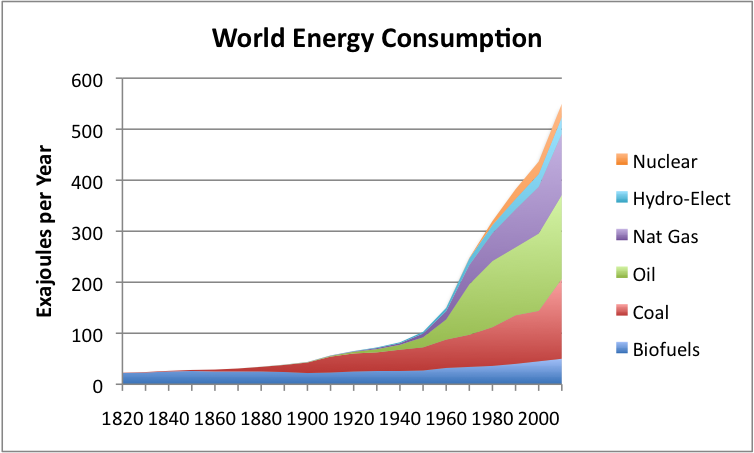 Figure 1. World Energy Consumption by Source, Based on Vaclav Smil estimates from Energy Transitions: History, Requirements and Prospects together with BP Statistical Data for 1965 and subsequent
Read more...
Sphere: Related Content
16 March 2012
Coal-reliant Poland increasingly out of step with Europe on climate change
Frustrations with Poland are growing in the European Union after the coal-powered nation for a second time blocked the EU’s long-term plans for cutting carbon emissions
By Associated Press | The Washington Post | March 14, 2012
 Coal is transported at the Zeran Heating Plant in Warsaw, Poland, Wednesday, March 14, 2012. Frustrations with Poland are growing in the EU after the coal-powered nation blocked for a second time last week. (Alik Keplicz/Associated Press)
Read more...
Sphere: Related Content
11 March 2012
Energy in East Africa
Poverty refers not only to one’s economic situation, but also to other factors that influence life. Especially in the past years the term “energy poverty” has become more common
by Kristin Kretszchmar | Mar 10 2012 by Glopolis in Energy Bulletin | Mar 20 2012

Nuclear Industry Upbeat Despite Fukushima
One year after Fukushima, industry leaders remain optimistic on the future of nuclear power in coming decades, partly because of the high priority that has been placed on identifying and addressing potential weaknesses such as were revealed last year at Fukushima Daiichi, Japan
By Richard Johnson | IDN-InDepth NewsReport | March 10, 2012

10 March 2012
Knowledge, technology, and the politics of rice
The current financial crisis in Europe brings out politics as we know it. The political leaders of nation states deliberate lessons from the past and negotiate solutions for a new future
by Harro Matt | Mar 9 2012 by Common Voices in Energy Bulletin | Mar 9 2012

03 March 2012
Iran in the crosshairs again
Sabre rattling against Iran is nothing new, but that doesn’t mean the threat of war isn’t real. Phyllis Bennis analyses the situation in the wider Middle East
Phyllis Bennis | RedPepper | March 2012

Water, Energy, Food Security Nexus Conference Publishes Policy Recommendations
The results of the “Bonn2011 Conference: The Water, Energy and Food Security Nexus – Solutions for a Green Economy” have been published in the form of a conference synopsis and set of policy recommendations
Climate Change Policy & Practices | 29 February 2012

01 March 2012
Imperial leftovers
You probably don’t know it, but Réunion Island has been racked by riots about the price of gas last week. For those of you who happen not to be specialists of African geography, Réunion Island is a French département, roughly half the size of Rhode Island, located in the Ocean Indian, not far from Madagascar. It is officially a part of France, even if, of course, Frenchmen care about it only when it affects the mainland, such as when a chikungunya epidemic threatened to spill over Southern France
by Damien Perrotin | Feb 29 2012 by The View from Brittany in Energy Bulletin | Feb 29 2012
Read more... Sphere: Related ContentFarming and energy: lessons from collapsed civilisations
Renewable energy technologies and agro-ecological farming represent opportunities to avoid the mistakes of the past
Andrew Simms | guardian.co.uk | 1 March 2012
 We are more aware now of the likely consequences of our choices than any society in history. Photograph: Martin Bernett/ AFP
Read more...
Sphere: Related Content
29 February 2012
China Tightens Energy Targets
China is calling for energy-intensive industries such as steel and textile manufacturing to reduce their energy consumption more sharply compared with targets set last year, in a move intended to help cull obsolete capacity to contribute to efforts to reduce its carbon footprint
By Chun-Wei Yap | The Wall Street Journal | February 28, 2012
Read more... Sphere: Related Content
Subscribe to:
Posts (Atom)


 Posts
Posts