Showing posts with label mitigation. Show all posts
Showing posts with label mitigation. Show all posts
13 January 2012
19 November 2011
Indonesia Loaned $100 Million to Reduce Greenhouse Emissions
The Asian Development Bank is providing Indonesia with a $100 million loan to support Indonesia’s drive to reduce greenhouse gas emissions and strengthen its resilience against climate change
Jakarta Globe | November 10, 2011
Read more... Sphere: Related ContentNorway: Saving rainforests with one hand, destroying with the other
“It has long been a fact: Norway is saving rainforest with one hand and destroying the rainforest with the other,” wrote Lars Løvold of Rainforest Foundation Norway recently. The problem is that while Norway has promised billions to save the rainforest, the Government Pension Fund Global (GPFG) is investing in companies that are destroying the rainforests
By Chris Lang | REDD-Monitor | 16th November 2011
Read more... Sphere: Related Content“Is Norway paying for ‘hot air’?”: Three articles about Guyana by Janette Bulkan in the Commonwealth Forestry Association newsletter
In this series of articles, published in the newsletter of theCommonwealth Forestry Association, Janette Bulkan looks at the issue of governance and illegal logging in the forest sector in Guyana, in the context of the REDD agreement with Norway
By Chris Lang | REDD-Monitor | 15th November 2011
Read more... Sphere: Related Content11 November 2011
World Bank’s Benoit Bosquet on REDD: “It’s probably good to take the time to get things right”
The “ultimate goal is to jump-start a forest carbon market”, the World Bank announced in 2007, at the launch of the Forest Carbon Partnership Facitily. A “jump-start” is a way of starting a car with a flat battery. After four years of trying, perhaps it’s time to accept the fact that there’s no point jump-starting the forest carbon car when the wheels have fallen off
By Chris Lang | REDD-Monitor | 9th November 2011
Read more... Sphere: Related ContentCarbon Fund Risks Undermining REDD Readiness
Last month, 29 NGOs and indigenous peoples organisations from 14 countries wrote to the World Bank’s Forest Carbon Partnership Facility expressing their concern that the World Bank is rushing through its REDD readiness process
By Chris Lang | REDD-Monitor | 2nd November 2011
Read more... Sphere: Related Content25 October 2011
China 'won't follow US' on carbon emissions
China will not allow its carbon dioxide emissions per person to reach levels seen in the US, according to the minister in charge of climate policy
By Richard Black | BBC News Science & Environment | 25 October 2011
Read more... Sphere: Related Content
Hydro is China's dominant low-carbon technology
Setback for Green Climate Fund
The launch of the Green Climate Fund, expected to be a highlight of the Durban Climate Conference, suffered a setback when the committee assigned to design it could not reach a consensus
By MARTIN KHOR | The Star Online | October 24, 2011
THE Green Climate Fund, which developing countries are relyi
Read more... Sphere: Related ContentCarbon cuts of 8.5% needed by 2020 to meet Copenhagen goal
Ahead of COP17 in Durban, a study has revealed that to meet goals mitigating climate change, carbon emissions will have drop 8.5% by 2020
Mail & Guardian | Oct 24 2011
Read more... Sphere: Related Content07 April 2010
Nigeria’s Climate Change Policy Takes Shape
A roundtable of professionals convened by the House of Representatives Committee on Climate Change to chat a way for the nation’s Climate Change Policy and Legislation has produced a draft document
By Bennett Oghifo | This Day Online | 5 April 2010
The experts, who worked with the principle behind the United Kingdom’s Climate Change Act, determined that Nigeria’s policy should ensure cut down of greenhouse gas emission and set the best target and institutional framework for doing so.
They also recommended that it includes a carbon target budgeting, which sets clear cut budget within a short term and long term time frame, be Reviewed every year to ascertain progress; establish a committee on climate change, which agrees on how much, should be emitted and finalises discussions on the trading scheme and make provision of trading schemes, which describes the best way to offset carbon through trading.
The group of experts resolved that the National Climate Change Policy should adopt a development approach by indicating the activities that the country should engage in to reduce emission or be low in emission, that implementation must be monitor-able, reportable and verifiable (MRV) and backed with specific detailed activities.
The policy should take cognizance of the nation’s circumstances to address vulnerability and adaptation to the impact of climate change; would be useful to Nigeria in accessing the Copenhagen fund, the Global Environmental Facility Fund and reduce climate risk insurance and stimulate the carbon market.
They said the policy should have an ecosystem based approach to climate change adaptation and mitigation so that the protection of sensitive ecosystem vulnerability to climate change would be integrated in the policy framework. It should also have a policy document and a separate document that concentrates on the activities/strategies of implementing the policy.
The aim of the roundtable, attended by over 80 participants in attendance from Federal Ministry of Environment, CSO, media, HOR and the academia, was to examine issues and to propose a work plan for delivering a National Climate Change Policy and Legislation; provide Nigeria with a policy framework that tackles climate change, one that is based on strong scientific evidence. The Executive Director, International Centre for Energy, Environment and Development, (ICEED), Mr. Ewah Otu Eleri stated that much of the information required to develop a climate change policy is already being collected for the finalization of the Second National Communication.
He said the Second National Communication (SNC) provides scientific evidence for developing plans to reduce greenhouse gas, overview of financial resources, technology acquisition, capacity building and so on. It provides the evidence-base to engage in policy. That the Vulnerability Impact and Adaptation component of the SNC was to assess the subsisting and potential impacts of Climate Change on Nigeria’s ecological system; evaluate the country’s vulnerability to the actual and potential impacts of Climate Change and identifies, evaluate and recommend relevant adaptation options; that the final report would have seven Chapters namely: including Chapter 1- Background to the study; Chapter 2- Situation Analysis; Chapter 3- Methodology; Chapter 4- Results and Discussions of Vulnerability Analysis; Chapter 5- Adaptation Options; Chapter 6- Technology Transfer; Chapter 7- Best Practices from Various Zones
That outstanding issues in the SNC included the completion of the discussion of vulnerability assessment; Preparation of the executive summary; Collation of best practices from the various geopolitical zones; Table of contents and appendices; and the Delivery of first draft by first week in April, 2010; that the SNC covers only sectors that are relevant to the development due to time bound and fund limitation; therefore, a range of parameters are clustered together to enable the team assess the vulnerability.
It also recommended that the Thematic Group Inventory of Greenhouse for the SNC have the objective to produce National Inventory Report in accordance with IPCC and UNFCCC reporting formats and prepare Green House Gases inventory/Mitigation Options manual and national strategy for ensuring the sustainable inventory/Mitigations Assessment Processes; that the SNC report focuses on the agricultural, Land Use and Land Use Change and Forestry (LULUCF), Energy and Industrial waste sector. The final draft write-up would be April 23, 2010 and a final draft would be submitted in May, this year.
© Copyright 2000-2010 Leaders & Company Limited
Read more... Sphere: Related Content28 March 2010
IMF Proposes 100-Billion-Dollar Climate Fund
The International Monetary Fund (IMF) has published the first details of a proposed financing framework, dubbed the 'Green Fund', intended to mobilise 100 billion dollars a year by 2020 to help developing countries cope with the consequences of climate change and mitigate further emissions
By Adam Robert Green | Inter-Press Service | Mar 25, 2010
Outlined in a staff paper by IMF economists Hugh Bredenkamp and Catherine Pattillo, the Green Fund could launch from a capital injection by developed countries, in the form of Special Drawing Rights (SDRs), a currency issued by the IMF to member countries.
The facility would eventually combine resources from investors, raised through 'green bonds' in global capital markets, with developed country subsidies. Contributors could scale their equity stakes in proportion to their IMF quota share.
Aid would then be extended in the form of grants or highly concessional loans to developing countries but the IMF would not finance or manage the Fund, according to the authors.
The IMF began working on the concept of a Green Fund following the talks at the United Nations Copenhagen Conference (COP15) in December because, while finance was discussed and various figures pledged, it was not clear where the money was going to come from.
"The risk is that, without a credible framework for delivering financing on the scale necessary, soon enough, and on the right terms, developing countries' response to climate change will be either insufficient or delayed, thereby endangering sustainable growth and increasing ultimate costs, or financed in ways that are inconsistent with maintaining fiscal and broader macroeconomic stability," the authors write.
IMF officials told IPS the Fund could enable faster and more reliable disbursement than uncoordinated aid pledges from rich countries, which often fail to materialise.
Thursday's report is the first time the IMF has directly implicated itself in the issue of climate-related financing efforts. However, the authors stress that the proposal is not a formal announcement by the IMF to create the facility.
Ilana Solomon, policy analyst at ActionAid, told IPS that she welcomed the IMF paper as "an interesting contribution to the debate", and that she supports the use of SDRs in climate financing and believes this proposal has broken through the barrier of using SDRs for finance.
"A consolidated, centralised Fund, as long as there is transparency, will also facilitate the tracking of commitments," she said.
But Solomon expressed concerns about "lack of clarity regarding where the Fund would sit, and the implicated role of the World Bank" in terms of funding management.
"ActionAid wants to see an explicit endorsement of the United Nations Framework Convention on Climate Change (UNFCCC) as the medium through which resources should flow," she told IPS.
Solomon also questioned the 100-billion-dollar per annum benchmark against which the Fund is framed, suggesting 200 billion dollars per year in public financing as a more appropriate figure, and pointed out that climate finance should consist entirely of grants, not loans, because the developed countries are responsible for the majority of emissions.
Peter Chowla, programme manager at the Bretton Woods Project, told IPS he was also pleased that the issue of using SDRs in climate finance was being raised, but that the IMF was stepping beyond its mandate.
"No institution other than the UNFCCC should run climate finance. That is the only legitimate forum where everyone has a say," he said. He added that before they can play a constructive role in climate financing, IFIs needed to undergo radical reform.
"You cannot take an institution with a lop-sided governance structure and expect it to be trusted," he said. "To base any new institutional arrangement on the IMF quota formula is backward looking."
The IMF paper is published just days before the first meeting of the newly formed U.N. High-Level Advisory Group on Climate Change Financing, which takes place on Monday, Mar. 29 in London.
The advisory group is chaired by British Prime Minister Gordon Brown and Ethiopia's Prime Minister Minister Meles Zenawi, along with other heads of state including Jens Stoltenberg, prime minister of Norway. Trevor Manual, South Africa's respected minister for national planning, the philanthropist George Soros and Nicholas Stern, the climate change economist, are also members of the group.
Copyright © 2010 IPS-Inter Press Service. All rights reserved
Read more... Sphere: Related Content25 March 2010
Indonesia joins top rank of climate action leadership
One of the first international meetings to focus on climate finance since the Copenhagen summit last December ended here in Manila this week with plans to allocate some US$1.1 billion from the new multilateral Climate Investment Funds (CIF) for country-led, low-carbon growth in the Asia and Pacific region
Ursula Schaefer-Preuss and Katherine Sierra | The Jakarta Post | March 25, 2010
Indonesia features prominently in these plans.
Some $400 million in support from the Clean Technology Fund (CTF), approved in Manila on Monday, will help mobilize some $2.7 billion in public and private sector financing to help Indonesia nearly double its geothermal capacity and transform the country’s use of renewable energy, ultimately supporting the government’s objective of meeting its goal of reducing greenhouse gas emissions by 26% by 2020.
In further support to achieving this target, Indonesia is also among the countries named this week that will receive funding for pilot programs to reduce emissions from deforestation under the Forest Investment Program (FIP).
Both programs for Indonesia were approved in advance of the CIF Partnership Forum. It is fitting that this meeting was held in Asia, for this is the region where more people — especially women and the poor — are vulnerable to climate change impacts than in any other part of the world.
On top of that, Asia’s energy demand is projected to almost double by 2030, which means that unless development and consumption patterns shift the region will soon become the largest source of new greenhouse gas emissions.
The CTF plan for Indonesia is designed to transform the country’s development pattern while supporting its continued economic growth.
It will help unlock geothermal power resources to expand people’s energy access while avoiding greenhouse gas emissions, to green urban areas, and to make it financially attractive to tap into the sun’s power.
Indonesia has the world’s largest geothermal power potential, and the plan allocates extensive co-financing to expand large-scale geothermal electricity generation.
It will also accelerate initiatives to promote energy efficiency and use of renewable energy sources by creating risk-sharing facilities and addressing financing barriers to small- and medium-scale
investments.
The low-carbon growth investments in Indonesia are an example of similar programs now approved to receive CTF financing in Kazakhstan, the Philippines, Thailand and Vietnam.
Taken together, these programs will demonstrate how future energy demands can be satisfied in ways that will not generate excessive levels of greenhouse gases.
From our vantage point as multilateral development bank partners in helping countries implement these CTF-funded plans, this bold action on the part of Indonesia and other Asian nations is a harbinger of a fundamental shift in climate action around the globe.
And the same sorts of actions are moving forward in developing countries in every region of the world.
While developing countries have not been the primary source of climate-altering greenhouse gas emissions from the past burning of fossil fuels, they are taking positive actions to help achieve a global solution to the common challenge posed by climate change.
As they continue on a path to improved economic prosperity for their citizens, they are making a wise choice to do so in a climate-friendly way that will also help ensure their energy security and improve their quality life.
This climate-smart approach offers lessons which all, including those in developed countries, can look to emulate in coming years.
The CTF is founded on partnerships between policymakers, indigenous peoples, private sector entities, civil society and others.
Its unique governance structure provides equal voice to contributor and recipient countries and it also ensures that the programs it supports are embedded in national development plans.
The CIF’s were created in response to the Bali Action Plan, which resulted from the 2007 climate change talks in Indonesia, and called for commitment of new and additional financial resources from developed countries for developing countries to help address the climate change challenge.
A group of developed nations then pledged over $6 billion to the CIFs — a powerful signal of their serious support for developing countries, in helping them to respond to climate change.
Without measures to build resilience to climate change impacts, we know that the 60% of the working population in Asia and the Pacific who rely on agriculture for their livelihoods will suffer tremendously.
Fresh-water availability will fall, irrigation will become more difficult, and millions more children will go home hungry.
The CIFs expect to pilot measures that will support better water and forest management and agricultural adaptation measures that can ensure food security for Asia and the world.
The potential to replicate alternative approaches to energy and food production can transform development, placing us all on a more stable and sustainable footing.
As developing countries pick up the climate reins, we must all stand together to ensure their commitment to climate action is supported at the global level.
The need is enormous, and so is the funding and knowledge gap.
Developed countries must continue to provide financing for investments and knowledge, and a new regime for climate action must emerge. Without such actions, the progress achieved so far cannot be sustained.
Together, the global community must test and apply effective ways to combine reducing poverty, providing economic growth, and building a climate-smart greener future.
The meetings in Manila, buoyed by Indonesia’s climate action, offer an important and welcome glimpse into such a future.
At the Asian Development Bank and World Bank, along with our fellow development banks with whom we have joined in a first-time alliance on this issue, we pledge our support to make this future a
reality.
Ursula Schaefer-Preuss is vice president for knowledge management and sustainable development at the Asian Development Bank. Katherine Sierra is vice president for sustainable development at the World Bank.
Copyright © 2008 The Jakarta Post - PT Bina Media Tenggara. All Rights Reserved
Read more... Sphere: Related Content13 March 2010
Sarkozy: more funds needed to fight deforestation
Rich nations must contribute more to a climate change fund and help fight deforestation, French President Nicolas Sarkozy said at a conference Thursday on saving the world's forests - a key defense against global warming
News Observer | MAR 11, 2010
French President Nicolas Sarkozy, right, takes leave of Armenia President Serge Sarkissian, following their working lunch at the Elysee Palace in Paris, Wednesday March 10, 2010. AP PHOTO
Ministers from some 64 nations attended the one-day Paris meeting, including Indonesia and other heavily wooded countries in the Amazon and Congo river basins.
Efforts to halt deforestation, one of the culprits in climate change, have been bogged down along with the wider goal of reaching a legally binding global agreement to limit greenhouse gas emissions while helping poor nations adapt to and cope with climate change.
Thursday's meeting, to be followed by a May conference in Oslo, was focused on how to implement forest-preserving measures agreed on in principle at the last U.N. climate conference in December in Copenhagen, Denmark.
Specifically, nations need to work out how to disburse the $30 billion pledged by rich countries over the next three years. In total, world leaders agreed to spend $100 billion by 2020 to help poor nations preserve forests, protect coasts, adjust drought-threatened crops, build water supplies and irrigation systems, and adopt low-carbon energy options such as solar and wind power. French officials said they expected 20 percent of that to go to fighting deforestation.
Sarkozy said he wanted the Paris conference to bring more funding pledges for forests while working out how to organize the aid and find mechanisms to guarantee transparency. He said he wanted the private sector join in, too.
Deforestation - through the burning of woodlands or the rotting of felled trees - is thought to account for up to 20 percent of carbon dioxide released into the atmosphere - as much as that emitted by all the world's cars, trucks, trains, planes and ships combined.
Due to deforestation from logging, crop-growing and cattle grazing, Indonesia and Brazil have become the world's third- and fourth-largest carbon emitters, after China and the United States.
Sarkozy said defending the world's forests demanded more aggressive funding.
"Those who don't want to do anything are those who don't want to pay," he said in an opening address.
He reiterated his appeal for a tax on financial market transactions worldwide that could be earmarked for a global climate fund.
Several African ministers complained that not enough money has been committed to the enormous and long-term task of fighting deforestation, and they said funds already pledged should be quickly released.
Numerous funding programs are in the works and individual countries are moving ahead with their own programs to fight deforestation and educate local populations who live off forests - estimated at more than 1 billion worldwide - to do so in a sustainable way.
"Lots of things are happening everywhere, but there is no visibility, no transparency, there is no pilot," said France's environment minister, Jean-Louis Borloo. "We need to know who is doing what and how."
Managing and protecting forests must involve the people who live off them, Gabon Environment Minister Martin Mabala said.
"Forests are a planetary asset and no longer the concern of individual countries," Mabala said.
Delegates to the Copenhagen conference did agree on a forest program known as REDD, for Reducing Emissions from Deforestation and Degradation, but a parallel program to protect tropical forests by having rich countries pay other nations concerned fell apart.
Thursday's conference delegates were looking at an aspect of the REDD program, called REDD Plus, based on reducing emissions through good forest governance, protecting biological diversity and respect for the rights of indigenous people.
Six countries, including France and the other European leader on deforestation, Norway, have pledged $3.5 billion to the program through 2012, and Paris meeting hoped to increase that fund.
Calling the Copenhagen conference "frustrating" in failing to reach a final deal, Sarkozy said the Paris delegates needed to advance what was agreed there to "give the world confidence" and "open the way to progress on other points" at the next global U.N. climate summit scheduled for December in Cancun, Mexico.
© Copyright 2010, The News & Observer Publishing Company
Read more... Sphere: Related Content10 March 2010
Climate forest deal in sight: Indonesia
Wealthy and developing nations should be able to seal an agreement this year on deforestation, unlocking a key part of the next treaty on global warming, Indonesian negotiators said Monday
AFP in Yahoo! News | Mar 8, 2010
At December's Copenhagen climate summit, six nations pledged a total of 3.5 billion dollars to help developing countries fight the loss of forests, seen as a leading cause of global warming along with industrial pollution.
Basah Hernowo, a senior official in Indonesia's forestry ministry, said he hoped that a system would be finalized by the next climate summit at the end of this year in Mexico.
"I think everybody sees a convergence compared with other sectors. So we are optimistic. Hopefully in Mexico we can complete it," Hernowo told AFP on a visit to Washington.
The Copenhagen summit, attended by more than 120 leaders, ended with a vague agreement that saved the talks from collapse but triggered criticism from all sides.
Wandojo Siswanto, Indonesia's climate negotiator handling forest issues, said that key players in Copenhagen agreed on deforestation but lacked details.
"We were not far away from each other. We were already there, but we didn't want to push more otherwise it would break," Siswanto said.
"Many people would just say okay, there's the money. But we don't know how to access it or how to distribute it," he said.
Siswanto and Hernowo are holding talks this week in Washington to flesh out the plan. They said Indonesiaalso recently invited officials from Brazil and the Democratic Republic of Congo to coordinate strategy on tropical forests.
Due to forest destruction, Indonesia is the world's third largest carbon emitter after the United States and China, with Brazil coming fourth.
Brazil signed an agreement last week with Secretary of State Hillary Clinton on US support for the Amazon forests. But Brazil and Indonesia insist that wealthy nations also set ambitious targets to lower their own emissions.
Indonesia -- the host of a major 2007 climate conference in Bali -- has been among the most ambitious developing nations, saying it will curb emissions by 26 percent by 2020 compared with the level if it did nothing.
In one key project, Indonesia plans to protect at least 800,000 hectares (3,000 square miles) of its Berau forest in Borneo by 2015.
Copyright © 2010 Agence France Presse. All rights reserved
Copyright © 2010 Yahoo! Inc. All rights reserved
Read more... Sphere: Related Content22 February 2010
Sh2 Billion Grant to Fight Changes in Climate
Prime Minister Raila Odinga on Sunday announced that the Japanese Government has extended a Sh2.24 billion grant to support Kenya's efforts in mitigating effects of climate change
Oliver Mathenge | Daily Nation in AllAfrica.com | 21 February 2010
He said the Japanese have also pledged a further Sh385 million grant to help in the restoration of the Mau Forest Complex. The PM spoke at the Jomo Kenyatta International Airport when he arrived from a week-long tour of Japan and Thailand.
"We went to seek trade and investment opportunities as opposed to the old habit of begging for aid. But to cope with the impact of global warming, we encourage promotion of green energy and reforestation projects," he said.
Mr Odinga unveiled some projects foreign companies planned to undertake and encouraged investors to fully exploit opportunities in green energy production towards reduction of carbon emission, largely blamed for the global warming.
The PM said that the Japanese wanted to assist Kenya develop a nuclear energy reactor to bridge the power deficit. He said that car manufacturer, Toyota, expressed interest in investing in geothermal and solar energy production especially now that it intends to open a regional assembly plant in the country.
Mr Odinga said that Totoya top executives sanctioned plans for the construction of an oil pipeline and export terminal from the proposed Lamu Port to Juba Town in Southern Sudan. "The company has confirmed plans to make Kenya a logistic hub by September this year and also put up 30 megawatt solar energy generation plant in Garissa Town," he said.
The Thai Government, he said, pledged to promote bilateral ties with Kenya through investment in the energy, Agro and Fruit processing industries. Mr Odinga expressed optimism that the country was likely to make major strides in mitigating the effects of climate change now that main players like Japan had made efforts to bail out vulnerable countries.
Copyright © 2010 The Nation
Read more... Sphere: Related Content29 January 2010
Bangkok pursues low-carbon strategy
Bangkok Post | 28/01/2010
One million people in Bangkok are expected to feel the catastrophic impacts of climate change by 2050, prompting concerned government agencies to introduce measures to cope, says the National Economic and Social Development Board (NESDB).
The temperature increase is forecast to be 1.9 degrees Celsius in 2020 compared with today, with a 3% increase in precipitation and a 29-centimetre rise in sea level. Flooded areas will expand by 25% or 200 square kilometres, state planning agency officials told a seminar on pursuing a low-carbon society, held yesterday by the National Science, Technology and Innovation Policy Office.
Current patterns of energy consumption pose mitigation challenges, said Thanin Pa-Em, senior adviser in policy and planning at the NESDB. Thailand aspires to take the regional lead in moving toward a low-carbon economy.
According to Mr Thanin, diversification of power production is required for Thailand to avoid reliance on coal and gas and reduce imports of petroleum products for power generation.
Relieving the severe traffic congestion and reducing air pollution in Bangkok are also recommended. To achieve these targets, creating urban jobs with better and more affordable transport services for low-income households is critical.
The action plan on global warming mitigation attempts to reduce Bangkok's emissions by 15% or 6.4 million tonnes of carbon dioxide equivalent per year by 2012, he said. In addition, the 15-year plan for renewable energy development aims to increase the share of renewable energy to 20% by 2012 from 5.8% in 2008, cutting CO2 emissions by 42 million tonnes per annum.Thailand has voluntarily reduced greenhouse gas emissions through the Clean Development Mechanism (CDM). So far, 30 CDM projects from Thailand have been registered with the United Nations Framework Convention on Climate Change (UNFCCC) with estimated emissions reduction of about 2 million tonnes of CO2 equivalent, according to the Thailand Greenhouse Gas Management Organisation.
At present, Thailand ranks tenth in the world in CDM projects registered with the UNFCCC, lower than Malaysia (fifth), the Philippines (sixth) and Indonesia (ninth). China is first with 715 CDM projects followed by India's 477.
According to Emergent Ventures International (EVI), an Indian consultancy specialising in global warming, the renewable energy market in Asia-Pacific is very attractive because power supply shortages are likely and marginal cost may remain at the high level of 20 cents per kilowatt-hour.
Technological progress will continue to bring down costs. For example, the cost of electricity from solar power has fallen 6-7% annually for the past 15 years while wind-powered electricity cost has fallen 80% over the past two decades, said Jatin Kapoor, who is in charge of EVI operations in Southeast Asia.
Citing McKinsey research, Mr Kapoor said overall savings from reducing energy use will be $900 billion by 2020. Annual investments of US$170 billion from now to 2020 may halve global energy demand.
© Copyright 1996-2009 The Post Publishing Public Company Limited
Read more... Sphere: Related Content17 January 2010
Fidel Castro: The lesson of Haiti
By Fidel Castro Ruz | LINKS | January 15, 2010

Two days ago, at almost six o’clock in the evening Cuban time and when, given its geographical location, night had already fallen in Haiti, television stations began to broadcast the news that a violent earthquake -– measuring 7.3 on the Richter scale -– had severely struck Port-au-Prince. The seismic phenomenon originated from a tectonic fault located in the sea just 15 kilometres from the Haitian capital, a city where 80% of the population inhabit fragile homes built of adobe and mud.
The news continued almost without interruption for hours. There was no footage, but it was confirmed that many public buildings, hospitals, schools and more solidly constructed facilities were reported collapsed. I have read that an earthquake of the magnitude of 7.3 is equivalent to the energy released by an explosion of 400,000 tons of TNT.
Tragic descriptions were transmitted. Wounded people in the streets were crying out for medical help, surrounded by ruins under which their relatives were buried. No one, however, was able to broadcast a single image for several hours.
The news took all of us by surprise. Many of us have frequently heard about hurricanes and severe flooding in Haiti, but were not aware of the fact that this neighbouring country ran the risk of a massive earthquake. It has come to light on this occasion that 200 years ago, a massive earthquake similarly affected this city, which would have been the home of just a few thousand inhabitants at that time.
At midnight, there was still no mention of an approximate figure in terms of victims. High-ranking United Nations officials and several heads of government discussed the moving events and announced that they would send emergency brigades to help. Given that MINUSTAH (United Stabilization Mission in Haiti) troops are deployed there -– UN forces from various countries –- some defence ministers were talking about possible casualties among their personnel.
It was only yesterday morning when the sad news began to arrive of enormous human losses among the population, and even institutions such as the United Nations mentioned that some of their buildings in that country had collapsed, a word that does not say anything in itself but could mean a lot.
For hours, increasingly more traumatic news continued to arrive about the situation in this sister nation. Figures related to the number of fatal victims were discussed, which fluctuated, according to various versions, between 30,000 and 100,000. The images are devastating; it is evident that the catastrophic event has been given widespread coverage around the world, and many governments, sincerely moved by the disaster, are making efforts to cooperate according to their resources.
Why is Haiti so poor?
The tragedy has genuinely moved a significant number of people, particularly those in which that quality is innate. But perhaps very few of them have stopped to consider why Haiti is such a poor country. Why does almost 50% of its population depend on family remittances sent from abroad? Why not analyse the realities that led Haiti to its current situation and this enormous suffering as well?
The most curious aspect of this story is that no one has said a single word to recall the fact that Haiti was the first country in which 400,000 Africans, enslaved and trafficked by Europeans, rose up against 30,000 white slave masters on the sugar and coffee plantations, thus undertaking the first great social revolution in our hemisphere. Pages of insurmountable glory were written there. Napoleon's most eminent general was defeated there. Haiti is the net product of colonialism and imperialism, of more than one century of the employment of its human resources in the toughest forms of work, of military interventions and the extraction of its natural resources.
This historic oversight would not be so serious if it were not for the real fact that Haiti constitutes the disgrace of our era, in a world where the exploitation and pillage of the vast majority of the planet's inhabitants prevails.
Billions of people in Latin American, Africa and Asia are suffering similar shortages although perhaps not to such a degree as in the case of Haiti.
Situations like that of that country should not exist in any part of the planet, where tens of thousands of cities and towns abound in similar or worse conditions, by virtue of an unjust international economic and political order imposed on the world. The world population is not only threatened by natural disasters such as that of Haiti, which is a just a pallid shadow of what could take place in the planet as a result of climate change, which really was the object of ridicule, derision and deception in Copenhagen.
Real and lasting solutions needed
It is only just to say to all the countries and institutions that have lost citizens or personnel because of the natural disaster in Haiti: we do not doubt that in this case, the greatest effort will be made to save human lives and alleviate the pain of this long-suffering people. We cannot blame them for the natural phenomenon that has taken place there, even if we do not agree with the policy adopted with Haiti.
But I have to express the opinion that it is now time to look for real and lasting solutions for that sister nation.
In the field of healthcare and other areas, Cuba –- despite being a poor and blockaded country -– has been cooperating with the Haitian people for many years. Around 400 doctors and healthcare experts are offering their services free of charge to the Haitian people. Our doctors are working every day in 227 of the country’s 337 communes. On the other hand, at least 400 young Haitians have trained as doctors in our homeland. They will now work with the reinforcement brigade which traveled there yesterday to save lives in this critical situation. Thus, without any special effort being made, up to 1000 doctors and healthcare experts can be mobilised, almost all of whom are already there willing to cooperate with any other state that wishes to save the lives of the Haitian people and rehabilitate the injured.
Another significant number of young Haitians are currently studying medicine in Cuba.
We are also cooperating with the Haitian people in other areas within our reach. However, there can be no other form of cooperation worthy of being described as such than fighting in the field of ideas and political action in order to put an end to the limitless tragedy suffered by a large number of nations such as Haiti.
The head of our medical brigade reported: "The situation is difficult, but we have already started saving lives." He made that statement in a succinct message hours after his arrival yesterday in Port-au-Prince with additional medical reinforcements.
Later that night, he reported that Cuban doctors and ELAM’s Haitian graduates were being deployed throughout the country. They had already seen more than 1000 patients in Port-au-Prince, immediately establishing and putting into operation a hospital that had not collapsed and using field hospitals where necessary. They were preparing to swiftly set up other centers for emergency care.
We feel a wholesome pride for the cooperation that, in these tragic instances, Cuba doctors and young Haitian doctors who trained in Cuba are offering our brothers and sisters in Haiti!
[Fidel Castro Ruz is the former president of Cuba.]
Read more... Sphere: Related Content15 January 2010
Forest carbon conservation projects top $100 million
New report documents billions of dollars in losses from Indonesia's reforestation fund between 1989 and 2009
mongabay.com | January 14, 2010
The market for carbon credits generated through forest conservation topped $100 million from 2007 through the first half of 2009, despite a global recession and plunging carbon prices in regulated markets, reports a new assessment by Ecosystem Marketplace.
The study, State of the Forest Carbon Markets 2009: Taking Root & Branching Out, found that the market for forestry-based carbon credits has "matured substantially" over the past three years, transacting 20.8 million MtCO2 at rising prices [average voluntary over-the-counter [OTC] prices rose from $7.12/tCO2 in 2008 to $8.44/tCO2 by June 2009; prices in compliance markets increased from $10.24/tCO2 [weighted average over the period] to $12.31/tCO2 in June 2009]. The trend may be a sign that investors are expecting a post-Kyoto Protocol framework to include market-based mechanisms for mitigating climate change via forest conservation and restoration. A U.N. scheme known as Reducing Emissions from Deforestation and Degradation in developing countries [REDD] — wide won wide support at December's climate conference in Copenhagen — may include carbon-trading as a means to finance forest conservation. Until then, most forest carbon credits will be traded in voluntary, rather than compliance markets. The report found that OTC projects made up 90 percent of the total number of projects, 6 percent came under the Chicago Climate Exchange (CCX), and 4 percent were from regulated markets (CDM afforestation/reforestation projects and the New South Wales Greenhouse Gas Reduction Scheme, launched by Australia in 2003].
The report, which surveyed more than 100 market participants accounting for 230 projects across 40 countries, found that in 2008 North America accounted for 42 percent of the volume of forest carbon credits transacted that year, followed by Africa (26 percent) and Latin America (21 percent).
The report will be available for download the afternoon of Jan 14.
Copyright mongabay 2009
Read more... Sphere: Related Content22 July 2009
Are we on the brink of saving rainforests?
Until now saving rainforests seemed like an impossible mission. But the world is now warming to the idea that a proposed solution to help address climate change could offer a new way to unlock the value of forest without cutting it down.
Rhett A. Butler | mongabay.com | July 22, 2009
Deep in the Brazilian Amazon, members of the Surui tribe are developing a scheme that will reward them for protecting their rainforest home from encroachment by ranchers and illegal loggers.
The project, initiated by the Surui themselves, will bring jobs as park guards and deliver health clinics, computers, and schools that will help youths retain traditional knowledge and cultural ties to the forest. Surprisingly, the states of California, Wisconsin and Illinois may finance the endeavor as part of their climate change mitigation programs.
Deforestation in southern Laos (January 2009). Photos by Rhett A. Butler
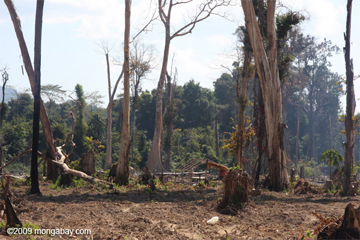
As unlikely as it may sound, this collaboration could become a reality under a far-reaching initiative to reduce emissions from deforestation and degradation (REDD), a climate change mitigation mechanism currently under consideration by U.S. legislators and in international discussions for a "framework" on climate change. Supporters say REDD could send billions of dollars a year to developing nations for conserving their rainforests, while preserving biodiversity; protecting ecosystem services like rainfall regulation, watershed functions, and erosion control; promoting rural development in some of the world's poorest, and in some cases, least, governed regions; and breaking a deadlock that has stalled international climate negotiations for over a decade, since the Kyoto Protocol in 1997.
The premise of REDD is straightforward: tropical forests store roughly 25 percent of the planet's terrestrial carbon, more than 300 billion tons. When forests are cut—their vegetation burned and timber converted into wood products—much of this carbon is released in the atmosphere as carbon dioxide. The clearing of 50,000 square miles of tropical forest annually accounts for roughly 20 percent of global emissions from human activities—a share larger than all the world's planes, ships, cars, and trucks combined. In other words, despite the attention given to the fuel efficiency of cars and the number of flights taken by celebrities, parking all the world's jets and cars still wouldn't offset the annual emissions from global deforestation.
Tropical deforestation rates from 2000-2005, ranked in descending order by the highest amount of average annual forest loss for 25 countries based on data from the U.N. Food and Agriculture Organization (FAO). Click to enlarge
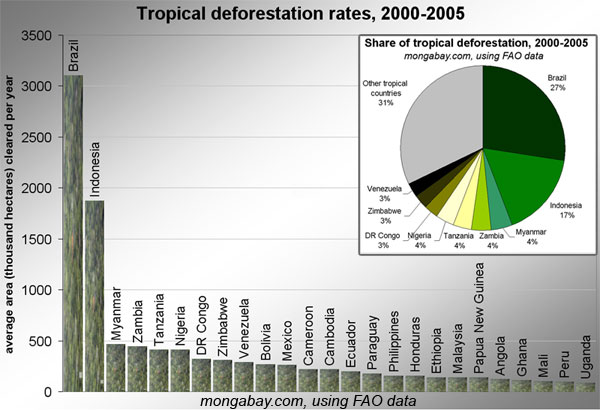
But reducing deforestation is no simple effort. Forests are being destroyed as a consequence of global economic forces—demand for timber, pulpwood, beef, soybeans, and palm oil—as well as subsistence farming. Slowing or eliminating deforestation means addressing these underlying drivers by making forests valuable as living entities, rather than solely for what can be produced when they're cut. And the issue goes beyond economics. Good governance, including law enforcement, recognition of land rights, and fair distribution of benefits, is the issue that will make or break REDD.
Thinking REDD
The idea of forestalling climate change by saving forests is not new, but it has had to win its way slowly. The Kyoto Protocol went a different direction, and critics of REDD fear it would be too complex to manage in a world economic scheme for climate rescue. (Some critics also think most plans don't do enough to address overconsumption by developed nations.)
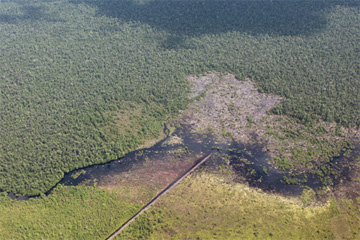
Draining and clearing of peat forest in Central Kalimantan (May 2009). Photo by Rhett A. Butler.
REDD suffers, like all such schemes, from the difficulty of explaining itself in terms non-specialists can understand. Carbons markets, offsets, cap-and-trade—all these have been in the language for years now, but the topics still seem esoteric to many. This "my-eyes-glaze-over" syndrome may be especially acute in the United States, whose government declined to join the Kyoto Protocol. But still, there are the Surui people—and if an Amazonian tribe can get help in saving its home forests by partnering with U.S. states, maybe the rest of us can get some handle on the idea.
What's more, the whole subject of climate change and its mitigation has gotten a renewed boost with the Obama administration's support of cap-and-trade—the concept of legally limiting a region's greenhouse-gas emissions and encouraging trade in the "credits" earned by industries that meet or exceed the standards. (A debate continues, however, over cap-and-trade vis-a-vis what are sometimes seen simply as "pay-to-pollute" offsets.)
The Birth—and death—of forest carbon
Protecting forests as a climate mitigation strategy has a history in the United States. American power companies—including American Electric Power (AEP), PacificCorp, BP Amoco, and others—spent millions of dollars in the 1990s to protect at-risk forests in Belize, Bolivia, and Brazil in hopes of getting early-action credit for "offsetting" their greenhouse gas emissions by preventing deforestation.
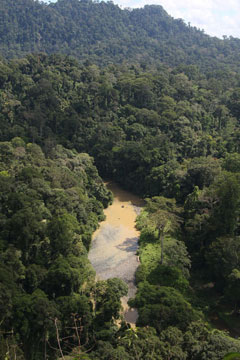
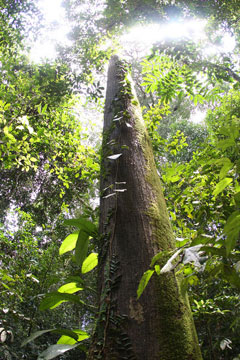
Rainforest in Borneo (April 2008). Photos by Rhett A. Butler
The Noel Kempff Mercado Climate Action Project, as the Bolivian initiative was known, would become model for "avoided deforestation." Project designers carefully calculated a baseline deforestation rate using business-as-usual scenarios; set up monitoring and verification systems; accounted for leakage—deforestation that would be displaced to other areas by the protected status of the park; and set up a system of incentives for people in and around the protected area.
Tia Nelson, daughter of the late Gaylord Nelson, the governor and senator who founded Earth Day, is now co-chairwoman of the Governor's Task Force on Global Warming and executive secretary of the Wisconsin Board of Commissioners of Public Lands. She was a key participant in the development of early forest-protection mechanisms as a deputy director of the Climate Change Program at the Nature Conservancy (TNC), a conservation group based in Washington D.C., which provided technical and scientific support for the projects.
"I was fascinated by the idea that companies would pay to conserve forests as a climate change mitigation strategy," she said. "Noel Kempff was particularly well-designed."
But the utility of Noel Kempff and other forest conservation projects was limited by the exclusion of forest conservation from the climate agreement reached in Kyoto in 1997. For many environmental groups, forest carbon was at best a distraction from the key issues of Kyoto, and at worst an insidious way for polluting industries to continue emitting greenhouse gases by paying poor countries to reduce their own emissions. When the United States pushed for inclusion in the Protocol of carbon sinks like forests, opponents saw it as an attempt by the world's largest polluter to avoid emissions cuts.
Stuart Eizenstat, a prominent attorney at Covington & Burling, former U.S. ambassador to the European Union, and the lead U.S. negotiator during the Kyoto talks, said that while justifications for conserving forests seemed strong, bigger concerns loomed over Kyoto, including emissions trading and contributions of developing countries to mitigation.

Deforestation-induced erosion in Madagascar (October 2004)
"We pushed for sinks because we were looking for every conceivable way to both engage developing countries and reduce costs. We knew that cost was going to be the most critical issue as it is today," Eizenstat said.
In the end, the rancor over offsets led to the exclusion of forest conservation from Kyoto. Forests were included in the Clean Development Mechanism (CDM)—Kyoto's attempt to involve developing countries in a climate solution. CDM allowed for afforestation (planting of new lands) and reforestation projects, but not for "avoided deforestation," although the provision was short-lived. Afforestation and reforestation was relegated to temporary credits in the Marrakesh Accords in 2001 and completely excluded from the Emissions Trading System (ETS), the European Union's compliance market for carbon. All this greatly limited the value of forestry credits.
Nelson said the decision not to include forest conservation in Kyoto came as a disappointment, but not a surprise. A lot of environmentalists argued that offsets were not a solution to reducing industrial emissions, a sentiment that remains strong today.
"It was a pretty lonely battle at the time," Nelson said. "I was hopeful that we had a good case but there were only a few voices arguing for avoided deforestation then."
The decision to exclude forests from Kyoto was a controversial one, producing shouting matches and bitter rifts between environmental groups. It would also prove costly to tropical forests and their inhabitants.
Oil palm plantations and logged over forest in Malaysian Borneo (April 2008). While much of the forest land converted for oil palm plantations in Malaysia has been logged or otherwise been zoned for logging, expansion at the expense of natural and protected forest does occur in the country. Reserve borders are sometimes redrawn to facilitate logging and conversion to plantations. Photo by Rhett Butler.
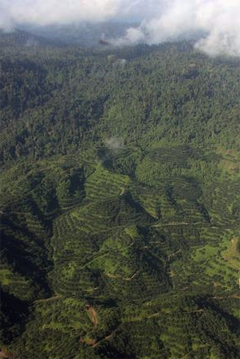
The years following Kyoto saw a surge in deforestation, particularly in two countries with the most extensive forest cover: Brazil and Indonesia. In Brazil, deforestation increased nearly year by year between 1997 and 2004, peaking at 10,600 square miles in 2004, an area the size of Massachusetts. The story in Indonesia was even worse. The collapse of the Suharto regime in 1997 ushered in a period of chaos, resulting in unprecedented destruction of forests. Loggers and oil palm plantation developers cleared and burned vast areas, facilitated by one of the strongest el Niño events on record. When the smoke cleared, more than 25,000 square miles had burned in Indonesian Borneo alone, unleashing upward of 2 billion tons of carbon. All told, since Kyoto's exclusion, the two countries have lost more than 160,000 square miles of forest, an area nearly the size of California, releasing billions of tons of carbon into the atmosphere and placing the two countries among the top emitters in the world—a position far outpacing their industrial output.
But deforestation wasn't limited to Brazil and Indonesia. With no incentives to keep forests standing, deforestation accelerated around the planet, especially in primary forests, the richest biologically and most carbon-dense form of forest and the most irreplaceable. Centuries-old rainforests were cleared for cattle pasture, oil palm plantations, mechanized soy farms, and industrial pulpwood. Environmentalists continued to sound the alarm, perhaps failing to realize their own role in the rising carnage. Meanwhile, supporters of avoided deforestation regrouped, expanded their reach, and explored new ways to include forests in a global climate deal. To be workable, a proposal would need to overcome serious technical, political, and ideological obstacles.
Rebirth of the forest initiative
A breakthrough came from an unlikely source: an academic paper. A team of American and Brazilian researchers analyzed the issues that kept forests out of the Kyoto Protocol and came up with a solution that addressed the most pressing concern, "leakage"—the idea that project-based schemes like CDM couldn't guarantee that shutting down deforestation in one area wouldn't simply shift it to another. The authors, including Márcio Santilli, Paulo Moutinho, Stephan Schwartzman, Daniel Nepstad, and Carlos Nobre, proposed a system of national accounting, meaning that countries would have to commit to national-level, rather than project-level, reductions in deforestation. The concept suggested a mechanism that would look a lot like trading between two capped systems, rather than just offsetting emissions.
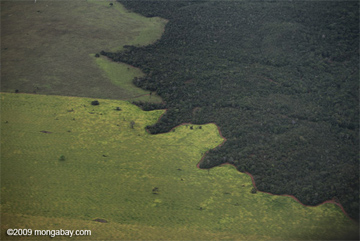
Pastureland and transition forest in Mato Grosso, Brazil (April 2009). Since 2003 Brazil has set aside 523,592 square kilometers of protected areas, accounting for 74 percent of the total land area protected worldwide during that period. Photo by Rhett Butler.
"The publication of ‘Tropical deforestation and the Kyoto Protocol" was a very important development because it created a scientific space—and a policy space—where you could actually talk about reducing emissions from deforestation and put the leakage question to one side. It didn't completely resolve the leakage question but it greatly tempered it." Annie Petsonk, a policy expert at the Environmental Defense Fund (EDF), said.
A crucial parallel development was the emergence of a negotiating block—later to become known as the Coalition for Rainforest Nations—that would enable developing countries to participate meaningfully in reducing emissions and would help quiet complaints that Kyoto didn't do enough to include all countries.
In 2005 Papua New Guinea joined forces with other forest countries to form the Coalition of Rainforest Nations with Kevin Conrad as executive director. A key member of the coalition was Costa Rica, a country lauded by the international community for transforming itself from a high deforester to a model of conservation.
"One of my first official delegations was to Costa Rica to find out how they turned their deforestation rate around," Conrad said. "They said, 'Yes, we did it, but we've been taxing ourselves. No one's been helping us with it.' Well, we knew Costa Rica might be able to do that but for most of us, there was no way. We would need a source of funding."
The Coalition went to the U.N. Conference of the Parties (COP) meeting in Montreal in 2005 and immediately met opposition from the United States, which was content doing nothing on climate. The U.S. delegation told Conrad it would kill the Coalition's proposal, fearing that if developing countries put forth a plan committing to robust and meaningful reductions in greenhouse gases, the United States would no longer have an excuse not to take action on climate.
"The U.S. was going to block us simply for that," Conrad said.
Conrad engineered a strategy for delaying U.S. action during the Montreal talks, persuading dozens of countries supportive of the proposal to push their voting buttons ahead of the United States.
"If the U.S. went first, all the naysayers would pile on," he said. "But if they were fortieth following a long trail of positives I was hoping they wouldn't be able to kill the proposal."
Sure enough the United States agreed to give the proposal two years, sending it out to committee with the expectation that it would collapse under the technical challenges of measuring, verifying, and monitoring emissions from deforestation. Should the proposal make it to COP 13 in Bali in December 2007, the U.S. delegation promised to kill the measure then.
History took a different turn, though.

Lowland rainforest in Costa Rica (March 2009). Photo by Rhett Butler.
By 2007 advancements in science had shown that not only were verification and monitoring of forest carbon possible, but that emissions from deforestation and degradation were so significant that they couldn't be excluded and keep atmospheric carbon dioxide levels under 450 parts-per-million, a level seen by many scientists as a critical climate tipping point. The Rainforest Coalition had a strong case that actions on forests by tropical countries could make a substantial contribution to the battle against climate change. But the Coalition still had to go up against the United States In Bali, where the U.S. delegation was attempting to block progress towards a post-Kyoto agreement. Conrad issued a direct challenge:
"We ask for your leadership, but if for some reason you're not willing to lead, leave it to the rest of us. Please get out of the way."
Minutes later the U.S. delegation capitulated, paving the way for the Bali Action Plan, which recognized the critical role tropical forests play in regulating climate.
Bali proved to be a watershed moment for REDD. During the meeting, Norway unveiled its International Climate and Forests Initiative, a plan to commit some 3 billion krone ($500 million at the time) per year to rainforest conservation, a sum still unmatched by any other donor. The World Bank announced a $300-million fund, the Forest Carbon Partnership Facility (FCPF), to jumpstart REDD projects in developing countries, and several other countries voiced support for the concept of REDD. Since Bali, momentum has only grown. In 2008, Britain and Norway put $200 million towards the Congo Basin Forest Fund to fund forest conservation activities in Central Africa; the U.N. has launched it own REDD fund; and Prince Charles made saving rainforests his signature cause, developing the Prince's Rainforest Project to bring business and political leaders around to supporting conservation. His efforts culminated in a historic meeting between heads of state to discuss rainforest conservation ahead of the G20 summit in April 2009.
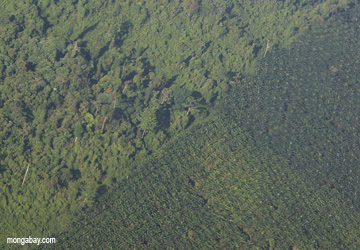
Oil palm plantation and logged-over forest in Borneo (April 2008).
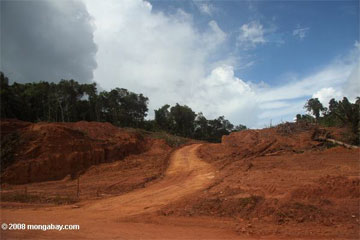
Mining road in Suriname (June 2008). Photos by Rhett Butler.
Developing countries have also become involved. Ecuador offered up a large tract of rainforest in the eastern Amazon as a giant forest carbon offset, while a group of 26 African countries in East, Central and Southern Africa announced the African Climate Solution, a plan to seek carbon financing for forest conservation, rural development, and poverty alleviation. Meanwhile, dozens of other countries have applied to the U.N. REDD program and the FCPF to begin receiving funds for REDD readiness activities. But the biggest news came from Brazil, which announced the formation of a $21 billion fund to reduce deforestation in the Amazon by 70 percent within 10 years, preventing an estimated 4.8 billion tons of carbon that would have been emitted under a business-as-usual scenario.
Owning to its lack of a climate policy, the United States has been slow to move on the concept of avoided deforestation, but a broad base of interests, including conservationists, development experts, scientists, and industry groups, has helped pushed it to the front of the climate agenda. Groups like Forest Carbon Dialog and Avoided Deforestation Partners, have played a critical role in working through difficult policy questions, fostering partnerships and strategic alliances between sometimes adversarial parties, helping draft legislative language, and informing policymakers of the multiple benefits of REDD.
"Having a dialog among companies, NGOs, and other stakeholders about how to get forest carbon on the table in a U.S. policy context have been very important," said Petsonk of EDF.
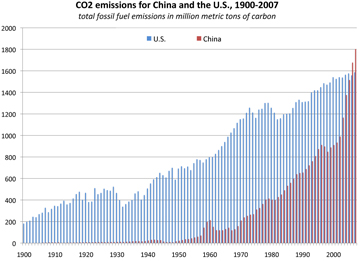
Emissions from fossil fuels for the U.S. and China, 1900-2007
The efforts have paid off, with REDD figuring into last year's failed Lieberman‐Warner Senate Bill and the American Climate and Energy Security Act (ACES) narrowly passed by the House of Representatives in June. The current version of ACES, which is now in the Senate, seeks to achieve supplemental emissions reductions of at least 720 million tons of carbon dioxide in 2020 and a cumulative amount of at least 6 billion tons carbon dioxide by the end of 2025 through avoided deforestation. The proposal is equivalent to the United States conserving 34,000 square miles of rainforests in developing countries and would boost U.S. emissions reductions targets from 17 percent below 2005 levels by 2020 to 27 percent if fully exploited.
U.S. climate legislation is particularly important for progress on REDD. Without it, the U.S. delegation to the December 2009 Conference of Parties (COP15) in Copenhagen will not be able to bring much to the negotiating table, Eizenstat said.
"It is impossible for the U.S. delegation to go beyond the emissions targets that Congress will set in legislation," he said. "The administration cannot go further than Congress will allow. Congressional legislation will thus be a very important step."
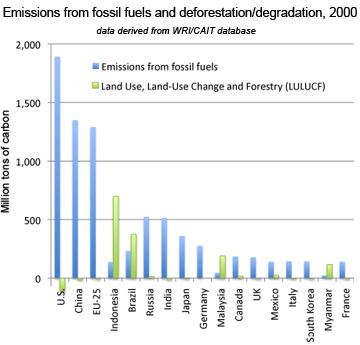
National GHG emissions from industrial sources (electricity generation, transportation, buildings, etc) and LULUCF, 2000. Note that some countries have negative emissions from LULUCF meaning they these sources are a net carbon sink. Also note that the E.U. is listed in addition to its individual member countries.
Supporters say that beyond the environmental benefits of REDD, there are good reasons for the U.S. Congress to include REDD provisions in climate legislation, including reducing compliance costs for American business under a cap-and-trade system, engaging developing countries in a climate framework, and bolstering security in potentially worrisome areas through sustainable development and climate change mitigation.
"Climate change impacts could include crop failures and drought, creating instability and the potential mass movement of ‘eco-migrants,'" Eizenstat said. "But strong forest provisions would offer multiple co-benefits."
Tracy Johns, a forest policy expert who is co-leader of the Woods Hole Research Center's REDD Initiative, agrees.
"From a domestic standpoint one of the things that makes REDD a really attractive policy option is that it is a mechanism to encourage developing countries to take on emissions reductions goals," she explained. "At the same time it offers to these developing countries a potential pathway to use forests in a sustainable matter for development. Finally REDD offers a very interesting and potentially very effective cost containment measure U.S. businesses under cap-and-trade program. REDD will make it easier for the U.S. to reduce emissions further at a lower cost."
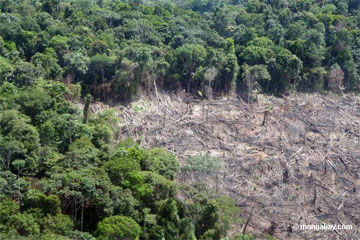
Clearcutting in the Peruvian Amazon (October 2005). Photo by Rhett Butler.
While still evolving, the U.S. position appears to be leaning towards a financing mechanism for REDD that includes both fund-based and market-based financing mechanism for REDD, a position shared by the Coalition for Rainforest Nations and by Australia. Financing remains one of the most contentious issues for REDD, with Brazil calling for an aid-based fund and Europe hesitant to allow forest carbon into its compliance market for fear it could cause the price of carbon to fall. Market advocates say that fund-based approaches will be subject to political whims and won't generate the kind of money needed to reduce deforestation at the scale and pace necessary to meet emission reduction targets.
But the critical issue in the market debate really is the fungibility of credits—whether countries can count carbon credits against their emissions. ("Fungibility" means that economic assets are exchangeable in the satisfaction of obligations.) Some Europeans countries are worried that the REDD credits will undermine low-carbon technologies without meaningfully reducing emissions, while Brazil doesn't like the idea of letting industrialized countries off the hook for their emissions. Environmental groups are split. Some call any sort off offsetting a "false solution" to climate changes; others say strong caps will greatly reduce the risk of the market for carbon credits being flooded.
"The central issue that is a critical impediment to progress on REDD and really to anything dealing with global warming is that the United States is not in the international game," Stephan Schwartzman, co-author of the seminal paper on compensated reduction of emissions from deforestation, said. "The U.S. has not actually begun to reduce its emissions nor created a cap-and-trade system. As long as that's the case, European policymakers are justifiably concerned about guarding the integrity of their carbon market."
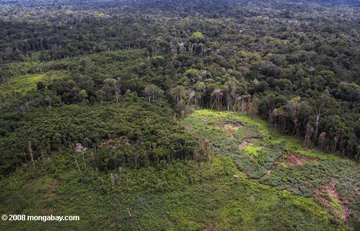
Small-holder deforestation in Suriname (June 2008). Photo by Rhett Butler.
"In the international discussion, among some NGOs there's still a sense that we can somehow avoid the risks of the market funding all of this with one version or another of public funding. But government priorities change and public funds are limited," Schwartzman said.
"A robust market mechanism is going to be critical to having this work. If there are too many good, real reductions from avoided deforestation out there, then tighten the cap. How hard is that?"
William Boyd, a professor at the University of Colorado Law School who has worked closely on REDD policy issues, agrees that a capped system can help avoid market flooding. A Greenpeace study, released at Bonn, has warned that in an unlimited market, carbon prices could drop by up to 75 percent.
"This isn't an extension of pure project-based offsets," Boyd said "The system is moving towards a national accounting framework where a country only get credits if it reduces emissions below a baseline that could progressively ratchet down over time—it might go to zero deforestation at some point. At that point you're trading between two capped sectors or two capped systems. Very different than the idea of offsets."

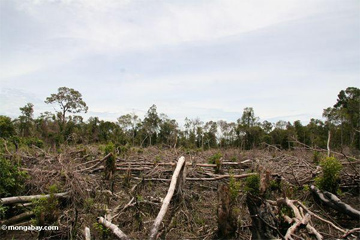
Healthy forest and recently cleared forest adjacent to Tanjung Puting National Park in Kalimantan (Indonesian Borneo) (February 2006). Photos by Rhett Butler
Regardless of the eventual source of funding, there is no question that considerable funds need to be generated to effectively reduce deforestation. A recent report from the Meridian Institute on behalf of the Norwegian government estimates that to achieve a 50 percent reduction in deforestation by 2020, REDD will need a commitment of 2 billion per year in 2010, increasing to 10 billion per year in 2014 for capacity building, readiness activities, and demonstration projects. The report suggests financing could come through a global fund, financed through donations generated by auctioning of emission allowances, fuel surcharges, or development aid. Prince Charles has suggested a different approach: a rainforest bond issue to provide emergency funding.
Beyond the money
Beyond the issue of financing, there are other points of contention, including how to establish baselines, especially in countries and regions that have managed to maintain forest cover or have already reduced deforestation rates dramatically. Some countries—like Costa Rica—want credit for early action, while others are pushing for elevated baselines to account for potential deforestation, positions that raise eyebrows among those concerned about the integrity of REDD. But as Kevin Conrad of the Coalition for Rainforest Nations puts it, "If we don't provide incentives for countries that have so far maintained their forests, but otherwise have land suitable for conversion, then those forests are going to fall."
Negotiators must further work out whether to include emissions from degradation of other carbon-dense ecosystems like peatlands, which in some years may contribute more than 2 billion tons in emissions. Wetlands International is adamant that peatlands be part of a climate pact—especially in light of Indonesia's recent announcement that it will open millions of hectares of swampy wetlands to oil palm cultivation. The move—ostensibly to expand production of palm oil, which can be used as a feedstock for biofuels—could trigger millions of tons of emissions and destroy habitat critical for endangered species, including the orangutan and Sumatran tiger.
Another issue—known as permanence—stems from the integrity of forest carbon stocks and the capacity of a forest to retain carbon in the future. Critics ask how it can be assured that a forest protected for REDD won't be logged, accidentally burned, or damaged by a storm, flood, or drought, reducing its capacity to store carbon. The issue is a significant one given the forecast impacts of climate change in places like the Southern Amazon. The 2005 drought—caused by abnormally high temperatures in the Atlantic, rather than el Niño—killed millions of trees and turned large expanses of the Amazon into a tinderbox. Thousands of square miles of forest went up in smoke, releasing more than 100 million metric tons of carbon into the atmosphere.

Eroded hillsides in Madagascar (October 2004). Photo by Rhett Butler
REDD advocates say this issue can be addressed partly through safeguard required under criteria like the Voluntary Carbon Standard (VCS) and the Climate, Community, and Biodiversity Standards (CCB) as well as emerging insurance products and national reserve accounts proposed by the Coalition for Rainforest Nations. But the best protection may be the forests themselves. Studies suggest that reducing deforestation can be one of the most important factors in increasing forests' resistance to the effects of climate change.
New technology, including a new class of remote sensing applications, will help scientists and forest managers monitor forests for degradation. Satellites and high-altitude aircraft equipped with lasers and high-resolution sensors can map the structure of the forest, greatly increasing the accuracy of carbon estimates as well as documenting changes in carbon stock. CLASLite, an advanced processing application for monitoring tropical deforestation, and Google Earth are greatly expanding the availability of forest cover data to scientists, policymakers, and the general public.
An issue of payment
But great satellite imagery won't resolve a thorny issue arising from the need to directly address drivers of deforestation. Given that industrial activities today account for the bulk of deforestation, a successful REDD mechanism may mean paying agents of deforestation—forestry firms and agribusiness—to cease their activities. The concept doesn't sit well many environmentalists, but in cases where landowners are within the law, REDD becomes a way to encourage loggers, oil palm plantation developers, large-scale farmers, and ranchers to leave their forests standing.
"Without economic incentives, standing forest will always lose out to pressures from the market," explained John Carter, an American rancher in the Brazilian Amazon, who heads Alianca da Terra, an NGO that works to encourage environmental stewardship among beef producers in the Amazon. "Land appreciation and production value are at the end of the day what determine land use. In order for REDD to work, all landowners—whether they be Indians, ranchers, or farmers—should be allowed to participate."
Carter believes that forest reserves—required under Brazilian law for landowners in the Amazon—should be eligible for payments under REDD.
Some environmentalists worry that REDD could become a tool for "greenwashing," whereby firms mask their environmental damage by buying REDD credits. This concern touches on the entire debate about "offsets," a concept that activist groups like the World Rainforest Movement and the Rainforest Foundation UK find deeply troubling. Buying REDD credits, however, will not offer environmental transgressors sanctuary from environmental campaigns and freely accessible satellite imagery. Green groups are already putting Google Earth to use for monitoring deforestation and other activities.
Forestry remains a controversial issue in REDD discussions. Some environmental activists complain that REDD may allow selective logging in old-growth forests, the most biodiverse and carbon-dense ecosystems. Others argue conversely that sustainable logging should be allowed as a source of income for forest holders, including indigenous communities. Recent reports of the International Panel on Climate Change (IPCC) highlight the value of reduced-impact logging as a mitigation strategy. But the impact of logging depends largely on forestry rules and governance structures, an area of particular concern to the Ecosystems Climate Alliance (ECA), a coalition of eight environmental and rights groups.
Issues of consumerism, governance
The Environmental Investigation Agency (EIA), a member of the ECA that works on international trade and demand issues, believes REDD should incorporate rules for demand in consuming countries, since deforestation is as much driven by market demand in industrialized nations as it is by poverty in developing nations.
"My major concern is that until we talk about these demand issues in a meaningful way, we aren't talking about a real solution," EIA Forest Campaigns Director Andrea Johnson said.
Johnson believes funds for supplemental activities under the Waxman-Markey bill could be directed towards joint implementation of demand-side laws like the U.S. Lacey Act, which is used to fight illegal logging by requiring companies to respect environmental laws in the countries from which they obtain plant and wildlife products.
Jihan Gearon of the Indigenous Environmental Network, an indigenous rights coalition, said, "Offset mechanisms, including REDD, do not address the real problem causing climate change. The major driver of climate change is the historical and current burning of fossil fuels—coal, oil, and gas—to feed the unsustainable consumption needs of industrialized countries, like the United States. We have to prioritize and focus on changing these unsustainable consumption patterns, which are responsible for not only climate change but also a host of other issues including pollution to land, water, air, animals, and people."
Governance also is a critical issue for the success of REDD—it ranks among the top priorities among REDD designers, but good governance is difficult in frontier areas where most deforestation is occurring. Development agencies are positioning REDD as a vehicle to deliver services and protections that vast amounts of aid have so far failed to provide—a tall order for a conservation initiative. Still, REDD has at least two advantages over prior mechanisms: it offers a wide range of benefits and will be performance-based. If a country fails to reduce deforestation by meaningfully addressing drivers of deforestation, it won't collect.
But this new governance regime raises other questions, especially in areas where rights are poorly defined. This is particularly important for forest-dwelling communities and indigenous people, who despite having occupied lands for years or generations may still lack formal title, or even basic rights, to land and resources. Many groups fear that regulation could cause them to be further disadvantaged, depriving them of their land as well as leaving them out of carbon payments. Some paint a nightmare scenario of forced displacement at the hands of carbon speculators.
"REDD projects do not help indigenous peoples and forest peoples," Gearon said. "In fact they hurt these communities and take away access and rights to forests, traditional territories, and medicines. Our principal hope and concern for the REDD mechanism, as well as other market-based solutions to climate change, is they be rejected because they are false solutions to climate change."
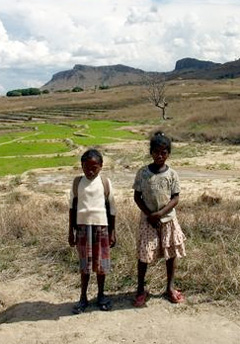
School children in Madagascar (October 2004). Half of Madagascar's children under five years of age are malnourished. Photo by Rhett A. Butler
The Indigenous Environmental Network and other groups have called for the inclusion of the U.N. Declaration on the Rights of Indigenous Peoples, a treaty signed by the majority of the world's countries in 2007, in REDD. But REDD designers say the stipulation is unlikely because negotiators from countries that haven't signed the Declaration (Canada, Australia, New Zealand, and the United States) can't sign an agreement that binds them to a treaty their countries have not ratified. Many native leaders are lobbying for a mandate that all REDD programs seek the "free, prior, and informed consent" of local people.
But in spite of these concerns, the consensus among coalitions representing forest people is that forest conservation should be included in a climate framework. Some groups are even supportive of a market mechanism, recognizing that a well-designed mechanism is better than the status quo.
The Surui are an example. The tribe actively sought out its own carbon project, first focusing on reforestation of areas that had been illegally logged, but then exploring REDD as a means to generate income to defend its forest home. Almir Surui, a Surui chief who has become the public face of the tribe, said forest conservation is also a way to maintain culture in a place where there are strong bonds between land and society.
But in pioneering their REDD project, the Surui have run up against some obstacles, indicating that the forest carbon initiative hasn't been designed with indigenous issues in mind. For example, by virtue of being good stewards of their forests the Surui encounter the same problem faced by countries with high forest cover and low deforestation rates: the REDD process doesn't reward them for their success in maintaining their forest cover even as forests around their reservation fell to bulldozers and loggers.
"REDD should enhance recognition that indigenous people have maintained the state of their forests, not penalize them for this stewardship," said Vasco van Roosmalen, director of the Amazon Conservation Team-Brazil, an NGO that has helped the Surui develop an indigenous park-guards program and biocultural maps of their territories. "The Surui are guardians of forest carbon."
And while the debate continues, participants aren't sitting on the sidelines – REDD projects are sprouting around the world. Although these projects are limited to voluntary markets (like the Chicago Climate Exchange) where carbon fetches a fraction of the price seen in compliance markets (E.U. ETS), the number is nonetheless increasing due to the appetite of corporations to appear environmentally responsible. After all protecting habitat for endangered species and providing health and education to forest-dwelling communities is perhaps more compelling to consumers than projects to capture emissions from agricultural waste.
"If you had a choice between carbon credits generated when a commercial factory pig farm reduces its toxic methane emissions, or carbon credits from a threatened natural forest that brings with them protection of elephants, lions, cheetah, giraffe and 54 other large mammal species which one would you prefer?" said Mike Korchinsky, Founder and President of Wildlife Works, a firm that just signed the first REDD deal in Kenya.
The Nhambita project in Mozambique has won acclaims for its levels of transparency and the benefits it is delivering to people in a desperately poor area. The project was initiated by Envirotrade, a London-based carbon finance outfit.
Philip Powell, founder of Envirotrade, explains: "The Nhambita project employs more than 150 people and compensates thousands of farmers who voluntarily sign agreements to confront destructive forest fires, conserve forest and replant trees on their lands. Our greatest long-term challenge is to deliver equitable and significant benefits directly to individuals and communities that are the forest custodians. We believe the best way to advance this is through transparent reporting and a commitment to fair compensation for measured changes in forest and land management."
Meanwhile, the Juma project in the Amazonas state of Brazil, which is the first project in the world to attain the Climate, Community and Biodiversity Alliance's Gold Standard for its safeguards, is compensating 6,000 families who voluntarily agree to limit forest cutting. The project is expected to reduce emissions in an at-risk forest area by 190 million tons of carbon dioxide by 2050.
John O. Niles, a REDD expert with the Tropical Forest Group, a forest policy think tank, said that REDD offers the potential to make the world a lot more aware of indigenous issues.
"REDD will put a microscope on these issues and will be infinitely better than the status quo," he said. "For decades, capitalists, socialists, private companies, governments and local operators have blasted into tropical communities, razed forests and moved on with little concern for the fact that they just denuded the land. I think a UN-driven system of incentives for keeping forests, a system of oversight with some transparency, and the strong voice of critical observers will lead to more positive outcomes more of the time. Anything via the UNFCCC is likely to be an improvement over plantation forestry, industrial logging, large infrastructure projects or commercial agriculture."
Dan Nepstad, an ecologist formerly of the Woods Hole Research Institute but now with the Moore Foundation, agrees.
"We have heads of state listening to indigenous leaders – that is unheard of."
Moving forward
Given myriad issues, will REDD designers be able to develop a workable framework? People involved in REDD discussions think so.
"I think the chances are very strong that if we get a climate agreement in Copenhagen that REDD will be a part of it," said Tracy Johns of the Woods Hole Research Center. "All of the stakeholders that have been involved in the REDD process in recent years—governments, NGOs, the private sector, indigenous peoples—have done a lot of work and made a lot of progress on the issues and challenges for REDD. I think in many ways the REDD negotiation process is more advanced than many of the other lines of negotiation that are under way for Copenhagen."
While the details for REDD are far from settled and obstacles remain, there is growing support for the phased approach proposed by the Coalition for Rainforest Nations and presented in the Meridian report for the Norwegian government. In the first phase, countries would receive funds—as they would through the World Bank's FCPF, the UN REDD Program, or another voluntary mechanism—to develop a national REDD strategy including consultation with indigenous peoples and local communities, capacity building, and pilot projects.
Phase 2 would support reform of land tenure and forestry laws, sustainable forest management initiatives, and payments for environmental services to local communities, indigenous peoples, and other parties. Funding would be performance-based and come from a global fund financed by voluntary donations, auctioning of emissions allowances, and possibly fuel and carbon taxes in some countries.

Rainforest pool in Belize (May 2008). Photo by Rhett Butler.
Phase 3 would include compliance-grade monitoring, reporting, and verification of emissions against agreed reference levels. It would likely be financed by the sale of REDD units within global compliance markets or a non-market compliance mechanism. Supporters of the phased approach say it accommodates both fund- and market-based mechanisms, includes provisions for indigenous people, offers flexibility allowing countries at different levels of capacity to participate, and considers many of the outstanding concerns for REDD.
For conservationists REDD offers the best hope that rainforests—including their biodiversity, ecosystem services, and resident peoples—can be saved.
"REDD is being asked to do a lot of things—improving governance, promoting sustainable development, and mitigating climate change, but the potential benefits are so great, it's a chance worth taking," said Schwartzman, whose paper helped get things started.
"As long as forests are worth more dead than alive, it's going to be extremely difficult, and probably ultimately impossible, to preserve more than fragments of the world's forests. Creating that positive economic value for living forests is a key part of the solution to the global warming crisis."
Box 1: The Coalition for Rainforest Nations
The Coalition for Rainforest Nations was born out of a conflict between the World Bank and Papua New Guinea (PNG), a country better known for its cultural diversity (more than 800 languages are spoken across its rugged mountainous terrain) than its political acumen. But the dispute over a $50 million payment could someday lead to billions of dollars in payments for protecting global rainforests. PNG could be one of the largest beneficiaries.
In 2001 the World Bank came to PNG with a loan proposal: around $50 million over 10 years for the country to cease all logging and transition to sustainable forest management. But PNG turned it down, arguing that the offer was too low to meet the needs of the forest communities that had signed the logging contracts. The loan rejection triggered a standoff between PNG and the bank, leading to damaging accusations and an ugly fight.
"These communities want to save the forests, which are the basis for society and culture in New Guinea," said Kevin Conrad, an American born to parents living in Papua New Guinea and now a lead climate negotiator for the G-77 and China. "But at the same time these communities need schools, health and access to markets to develop."
Conrad went to graduate school at Columbia University with the intention is exploring ways for PNG to capitalize on its forests without destroying them. In New York he met with the World Bank and was surprised to find that it was the world's largest carbon trader. He asked the bank how one of its departments could be demanding that New Guinea stop logging, while another was trading carbon.
"I asked the World Bank, 'Why not put your efforts together and give us something we can work with?'"
The World Bank told Conrad the idea was a non-starter because the Kyoto Protocol didn't allow forest conservation projects.
"So I asked, 'what if we change the Kyoto Protocol?'
The World Bank told him that if he changed the Kyoto Protocol then all options would be open.
"So that was the basis of our submission in 2005."
Box 2: National vs. Sub-National
There is heated debate over the scale and scope of REDD projects. Because few countries are expected to have national REDD programs up-and-running anytime soon, developers are first starting with individual projects within countries—a sub-national approach—that are ready for market-based compensation now. But eventually these projects will need to be integrated into a national system to avoid leakage and other issues. The process of integration remains contentious and some fear that early stage projects will never be recognized in national level accounting, depriving them of access to lucrative compliance markets.
Copyright mongabay 2009
Read more... Sphere: Related Content14 June 2009
Footprint. Handprint. Blueprint: How Business Can Tackle Climate Change
By Neville Isdell, ClimateBiz, June 12, 2009
To tackle a problem like climate change, we will need new partnerships among business, government and civil society -- what I call the "Triangle of Sustainability."

Bringing these three institutions together is the only way to achieve the scale and the speed that climate change requires.
I am cautiously optimistic about the progress we can make this year. The political climate has changed. There is a new urgency among governments to address climate change. Leading organizations like The Climate Group are helping bring stakeholders together to move the agenda forward toward Copenhagen and beyond.
And the business community is stepping up. It recognizes the problem, is taking action and is working with policymakers.
I'm reminded of a phrase from the North of England that our previous speaker, Tony Blair, who represented Sedgefield as a Member of Parliament, will be familiar with: "Where there's muck, there's brass."
For the rest of you, it means waste can be profitable.
More and more companies are finding -- as we have -- that the business case for sustainability is more than philanthropic. It is an imperative for business survival and profit in the future.
My optimism is tempered with realism, however, because the latest science tells us that the steps envisioned by business so far are inadequate. The mindset of business needs to move from "should" to "must." The level of business action needs to move from "incremental steps in isolation" to "step_change collaboration." And it must happen during this global economic crisis, which limits our flexibility. The crisis also pressures executives to focus on the quarter, not the decade -- on survival, not sustainability.
In what may be a small benefit, the crisis is also separating the wheat from the chaff. It is separating the businesses that are serious about sustainability from the "greenwashers," who will cut back as they look for savings.
That means NGOs, customers and consumers can see which businesses are investing in sustainability for the long term.
Given the scientific urgency and the economic reality, what should we expect and what must we demand from business?
I would define the proper role of business as threefold:
• Address our footprint;
• Extend our handprint; and
• Help shape the regulatory blueprint.
Let's look at each of those, starting at the macro level and then moving to the micro level.
1. ADDRESS YOUR FOOTPRINT
First, addressing your footprint is necessary, but not sufficient. Collectively, even if every business reduces its footprint significantly, we will not have made the progress that the latest science says is needed.
For our company, addressing our footprint means:
• Using the best mix of energy sources;
• Improving the energy efficiency of our manufacturing process;
• And reducing the potential climate impact of the products we sell.
Let me share a few examples.
Our Water Footprint. To reduce our water footprint, we have set the goal of returning to nature an amount of water equal to what we use in our beverages and their production. We call it becoming "water neutral."
One part of that is that by the end of 2010, all of the water that leaves every one of our nearly 1,000 facilities will be returned to the environment in a nature-identical form -- able to support aquatic life.
Our Packaging Footprint. We're also addressing our packaging footprint. We're engaged with The Climate Group in a new program called "Recycle Together." It will help us increase the amount of empty bottles and cans that reach recycling facilities. Kate Krebs is leading that effort, and she joined us in January when we opened the world's largest plastic bottle-to-bottle recycling facility in Spartanburg, South Carolina.
Here is one of the bottles produced at that plant. Thirty-percent of the plastic comes from recycled bottles. It's an example of how we're trying to create a closed loop recycling system. There's a climate benefit too. Over the next 10 years, the plant will prevent the release of 1 million metric tons of CO2 emissions, the equivalent of removing 215,000 cars from the road.
Communicating Our Work. As companies address their footprints, it is important to communicate their work. Just last week, the Coca-Cola Company released to the Securities and Exchange Commission our latest 10-K. With it, we became one of the first companies to include a climate-specific risk factor in our 10-K.
Again, I don't want to dwell on the footprint because it's really the bare minimum we should expect from companies.
2. EXTEND YOUR HANDPRINT
The second role business must play is to extend our handprint. Others have used the idea of a handprint in the climate discussion, so let me define it as I see it. Our handprint is what we can do that goes far beyond what we directly affect. They are interventions that allow us to have a larger impact on society by acting as a catalyst, partnering with others, and frankly, by leading. It is how you reach scale.
For me, the most creative and exciting part of our handprint is finding and exploiting "pivot points."
A pivot point is a step that one company can take which can leverage others to take similar steps. The Coca-Cola Company has a global presence and reputation. If we help pioneer an innovation, it can give that innovation credibility and spur others to adopt it. Ultimately, you can pivot a whole industry to a more sustainable future.
Let me share two examples.
Pivot Point: Refrigerant Gas. Our coolers and vending machines have used HFCs in two ways. We removed them from the insulation foam in all our new coolers. That eliminated 75 percent of the direct emissions attributable to our coolers.
That leaves a second area, the refrigerant gas, which traditionally has been HFCs. Today, we are buying coolers that use a much safer gas, CO2. Acting alone, however, we will not have a very big impact. Coca-Cola is responsible for only 1 percent of the world's compressor purchases.
Fortunately, we have found a pivot point. We believe we can help move not just the beverage industry, but the entire commercial refrigeration industry to climate-friendly systems.
In Beijing last year, I spoke at a Greenpeace conference to an audience that included 100 major Chinese businesses. I announced that the Coca-Cola Company and our bottlers will purchase and deploy 100,000 CO2 coolers by the end of 2010. And I challenged the rest of the industry to join us, so that the price will come down and they can be deployed even more broadly.
That's a pivot point. It's how 1 percent can influence 25 percent.
Pivot Point: Energy Management. Let me share another pivot point. We have developed a unique technology that cuts the energy use of a cooler by up to 35 percent. So far, we have deployed that technology in more than 1 million coolers. It helps our retail customers who enjoy lower energy bills, and it helps our climate because less energy means fewer emissions.
We own the patents, but we're sharing this innovation. That makes it a pivot point because this technology can be deployed far and wide -- reaching well beyond the bounds of our Company and our industry.
3. HELP SHAPE THE REGULATORY BLUEPRINT
Finally, business should engage in public policy to help shape the regulatory blueprint. In 2007, we endorsed the Caring for Climate Leadership platform of the UN Global Compact. We also expressed our views by signing the Bali Communiqué before COP13 [The 13th Conference of Parties to the U.N. Framework Convention on Climate Change], and we're looking forward to the World Business Summit in May to help unify the voice of business.
Looking ahead to December, we are in the process of shaping our role for COP15 [The 15th Conference of Parties to the U.N. Framework Convention on Climate Change]. We know that the business community needs to have a clear and strong voice there. We need to support a clear regulatory framework that prices the externality of greenhouse gases. We need to make markets work for climate protection by getting the economics and externalities right. Price signals are absolutely essential. They are the only way to drive and sustain meaningful change. We can help by engaging in the regulatory blueprint.
I've discussed efforts to mitigate climate change. I'd like to close with a final thought about adapting to the effects of a changed climate.
Agriculture will be severely impacted by climate, and it also affects climate. I was taken by a study that estimated that as much as 50 percent of the calories grown globally never make it to the table. In many developing countries, there is no way to store crops out of season or transport them to markets. In developed countries, a lot of food is thrown out -- up to 30 percent in the United States alone.
We know that over 70 percent of the world's water use comes from agriculture. It leads me to ask: If we could invest in crop storage, transportation and capacity building, wouldn't it allow us to feed so many who go hungry and require less water for agriculture? Perhaps that's an overlooked part of the climate solution.
In conclusion, the role of business is urgent and clear:
• Address our footprint;
• Extend our handprint; and
• Help shape the regulatory blueprint.
In closing, I am cautiously optimistic. I am realistic. We have mountains to climb, but even more, I feel that working together synergistically we can do what this moment requires of us.
Neville Isdell former chairman and CEO of the Coca-Cola Company. The preceding was adapted from remarks by Isdell at the Gathering of One Hundred Leaders conference in Washington, D.C., presented by The Climate Group.
© Greener World Media, Inc. All rights reserved
Read more... Sphere: Related Content
Subscribe to:
Posts (Atom)


 Posts
Posts