Showing posts with label science. Show all posts
Showing posts with label science. Show all posts
15 April 2012
Read more... Sphere: Related Content
 A scientist examines an ice core sample in Iceland. Photo: ALAMY
26 March 2012
Do you believe in climate change?
This may seem like an odd question for a climate scientist to ask, but it is one I am constantly asked now. The typical discussion starts: “I know that the climate is changing, but hasn’t it always changed through natural cycles?” Then they will often give an example, such as the medieval warm period to prove their point
by Vicky Pope | OurWorld 2.0 | March 26, 2012

18 February 2012
Heartland Institute leak shows climate change skeptics are playing the public
The nation’s leading skeptics of climate change science were dealt a blow this week when hundreds of private internal documents — detailing donors, spending and the group’s anti-science strategy — were leaked to the public
By Star-Ledger Editorial Board | nj.com | February 17, 2012
 An iceberg is seen in Disko Bay, Greenland above the arctic circle in this 2005 file photo. Scientists meeting in the area said global warming has an increasing effect on the Arctic region with glaciers shrinking, temperatures of the arctic waters warming, and permafrost softening and that nations must take action against global warming. AP Photo/John McConnico
Read more...
Sphere: Related Content
The inside story on climate scientists under siege
Michael Mann reveals his account of attacks by entrenched interests seeking to undermine his 'hockey stick' graph
Suzanne Goldenberg | guardian.co.uk | 17 February 2012
 Expanding desert in China’s Gansu province. Michael Mann in his new book, The Hockey Stick and the Climate Wars, describes the campaign by the fossil fuel industry against his science. Photograph: Peter Parks/AFP
Read more...
Sphere: Related Content
03 February 2012
Setting the record straight: Climate change experts respond
Do you consult your dentist on your heart condition? In science, as in any area, reputations are based on knowledge and expertise in a field, and on published, peer-reviewed work
ABC.net.au | 3 February 2012

26 January 2012
The scientist: Jim Hansen risks handcuffs to make his research clear
NASA's chief climate scientist built his career studying Earth's atmosphere and modeling humans' potential impacts on climate. Then he realized that laboratory work was only part of the equation
Interview conducted and condensed by Douglas Fischer | DailyClimate.org | Jan. 24, 2012

08 December 2011
The Science Is Dire on Carbon Emissions. The Politics Are Worse
However you slice it, the scientific news has not been good on the pace of greenhouse gas emissions and climate change. The weekend saw a pair of new studies that confirmed the fact that—far from curbing greenhouse gas emissions—we’re warming the atmosphere faster than ever, even as the slow-moving U.N. climate talks underway now at Durban underscores how difficult the political challenge of cutting carbon emissions is proving to be
By BRYAN WALSH | Time | December 5, 2011
Read more... Sphere: Related Content
AFP / GETTY IMAGES
19 November 2011
Science wants to save us from ourselves
I just took a geography class. Geography is nowadays technically described as a “physical science”. My geography class had a laboratory component. A lab? I haven’t boiled anything in a beaker, over a Bunsen burner, since I was in high school
by Belinda Waymouth | Nov 15 2011 by Our World 2.0 in Energy Bulletin | Nov 15 2011
Read more... Sphere: Related Content10 April 2010
Forests at a Climate Crossroads
Billions of dollars are being mobilised to protect and increase the world's forests under a climate protection mechanism known as REDD (Reduced Emissions from Deforestation and Degradation). But many experts are unsure that it will work, and some fear it could end in disaster
By Stephen Leahy* | Tierramérica in Inter-Press Service | Apr 7, 2010
Measuring a tree trunk in the Guarayos forest in eastern Bolivia.

According to Anne Larson, who works in Nicaragua as an associate at the Indonesia-based Centre for International Forestry Research (CIFOR), "REDD presents lots of risks."
"Most countries are simply not ready. They do not have policies to protect the rights of local and indigenous peoples, to determine land tenure or even work out who owns the 'carbon rights' to a forest," Larson told participants at an international conference on smallholder and community forestry in Montpellier, France, in late March.
Under the REDD initiative, richer countries would pay to maintain forests in tropical regions to offset their own carbon emissions. Carbon dioxide from human activities is one of the main gases that produce the greenhouse effect.
They wealth countries would be granted "carbon credits" towards achieving their carbon reduction commitments to combat climate change.
About 20 percent of global greenhouse gas emissions come from deforestation - more than the entire transportation sector worldwide.
At the United Nations-sponsored Copenhagen climate talks in December, six countries, including the United States and France, announced 2.6 billon euros (3.5 billion dollars) of financing for REDD+ programmes for 2010-2012, including conservation and the enhancement of carbon stocks in existing forests.
In late March another billion dollars was promised and a 10-nation steering group established to drive the implementation of a REDD+ global programme. It could be approved at the next annual United Nations climate conference, to take place in Cancun, Mexico.
That may be too soon in Larson's estimation, based on a three-year study in 10 countries documenting the evolution of granting of land rights to smallholder forest communities throughout tropics over the last 20 to 25 years.
"Even when states grant land tenure to local people, it often happens that the states do not support or respect those rights," she told Tierramérica.
The study "Forests for People: Community Rights and Forest Tenure Reform" was presented at the Montpellier conference, organised by CIFOR and two French entities.
Despite various land reform policies in recent decades that officially acknowledged local people's rights and tenure, it made little difference in many regions due to legal loopholes, lack of enforcement, corruption and government bureaucracy, Larson said.
"Yes, there are new opportunities for some communities, but the granting of rights is not something we can say has solved the problem," she said.
There are big questions regarding designing and implementing REDD, according to Larson. Most countries are only looking at it from a national level and are not taking impacts on local communities into account.
States have not worked out fair and equitable mechanisms for sharing the revenue and benefits from such programmes, leading Larson to wonder: "Who is going to decide who gets all this money?"
On the other hand, deforestation has been relentless, eating up 13 to 16 million hectares every year for the last few decades. Although the UN Food and Agriculture Organisation (FAO) reported at the end of March that the deforestation rate over the past decade has been at the low end of the scale, averaging 13 million hectares per year.
"Nothing else has stopped deforestation - perhaps REDD will," says Larson. That makes REDD both a huge opportunity and a huge risk, in her opinion.
There is a great deal of speculation about REDD, according to David Bray, professor in the Department of Earth and Environment at Florida International University.
REDD is a very complex undertaking and "the carbon markets want verifiable credits," Bray told Tierramérica.
Verification of how much carbon is in a forest and how much carbon is retained over 40, 60 or 80 years is very technical, "and it will be very difficult for local communities to do," Bray said.
Several REDD pilot projects are under way as part of the 50-million-dollar UN-REDD programme designed to assist developing countries determine how they can be implemented to benefit nations, forests and forest communities.
One such project is in the Budongo Forest, a tropical forest in northwestern Uganda.
Glenn Bush, an environmental economist at Woods Hole Research Centre in the U.S., conducted research in the forest communities to determine if revenues from REDD would offset the costs for local people giving up their traditional use of the forests.
"It is a very complex at the local level. It depends on the local situation and even the time of year," Bush told the Montpellier conference, Mar. 24-26.
"There are times of the year, such as during droughts, when no amount of money can provide what people really need, such as the food and water they get from the forest," he said.
(*This story was originally published by Latin American newspapers that are part of the Tierramérica network. Tierramérica is a specialised news service produced by IPS with the backing of the United Nations Development Programme, United Nations Environment Programme and the World Bank.)
Copyright © 2010 IPS-Inter Press Service. All rights reserved
Read more... Sphere: Related Content04 April 2010
Missing link between man and apes found
The new species of hominid, the evolutionary branch of primates that includes humans, is to be revealed when the two-million-year-old skeleton of a child is unveiled this week
By Richard Gray | Telegraph.co.uk | 03 Apr 2010
Homo habilis lived 2.0-1.6 million years ago and had a wide distribution in Africa Photo: SPL
Scientists believe the almost-complete fossilised skeleton belonged to a previously-unknown type of early human ancestor that may have been a intermediate stage as ape-men evolved into the first species of advanced humans, Homo habilis.
Experts who have seen the skeleton say it shares characteristics with Homo habilis, whose emergence 2.5 million years ago is seen as a key stage in the evolution of our species.
The new discovery could help to rewrite the history of human evolution by filling in crucial gaps in the scientific knowledge.
Most fossilised hominid remains are little more than scattered fragments of bone, so the discovery of an almost-complete skeleton will allow scientists to answer key questions about what our early ancestors looked like and when they began walking upright on two legs.
Palaeontologists and human evolutionary experts behind the discovery have remained silent about the exact details of what they have uncovered, but the scientific community is already abuzz with anticipation of the announcement of the find when it is made on Thursday.
The skeleton was found by Professor Lee Berger, from the University of the Witwatersrand, while exploring cave systems in the Sterkfontein region of South Africa, near Johannesburg, an area known as "the Cradle of Humanity".
The find is deemed to be so significant that Jacob Zuma, the South African president, has visited the university to view the fossils and a major media campaign with television documentaries is planned.
Professor Phillip Tobias, an eminent human anatomist and anthropologist at the university who was one of three experts to first identify Homo habilis as a new species of human in 1964, described the latest discovery as "wonderful" and "exciting".
Although not directly involved in the excavation and subsequent research on the fossils, he is one of the select few scientists outside the research group who have been able to see the skeletons.
He said: "To find a skeleton as opposed to a couple of teeth or an arm bone is a rarity.
"It is one thing to find a lower jaw with a couple of teeth, but it is another thing to find the jaw joined onto the skull, and those in turn uniting further down with the spinal column, pelvis and the limb bones.
"It is not a single find, but several specimens representing several individuals. The remains now being brought to light by Dr Berger and his team are wonderful."
The new fossil skeleton was found along with a number of other partially-complete fossils, encased within breccia sedimentary rock inside a limestone cave known as Malapa cave.
The protection from the elements provided by the cave is thought to have played a large part in keeping the fossils so well preserved.
The fossil record of early humans is notoriously patchy and scientists now hope that the that the new remains will provide fresh clues about how our species evolved.
Scientists believe that a group of apelike hominids known as Australopithicus, which first emerged in Africa around 3.9 million years ago, gradually evolved into the first Homo species.
Over time the Australopithicus species lost their more apelike features as they started to stand upright and their brain capacity increased.
Around 2.5 million years ago Homo habilis, the first species to be described as distinctly human, began to appear, although only a handful of specimens have ever been found.
It is thought that the new fossil to be unveiled this week will be identified as a new species that fits somewhere between Australopithicus and Homo habilis.
If it is confirmed as a missing link between the two groups, it would be of immense scientific importance, helping to fill in a gap in the evolutionary history of modern man.
Dr Simon Underdown, an expert on human evolution at Oxford Brookes University, said the new find could help scientists gain a better understanding of our evolutionary tree.
He said: "A find like this could really increase our understanding of our early ancestors at a time when they first started to become recognisable as human."
The discovery is the most important find from Sterkfontein since an almost-complete fossil of a 3.3 million year old Australopithecus, nicknamed Little Foot, was found in 1994.
Another major discovery was the well-preserved skull of a 2.15 million year oldAustralopithecus africanus, nicknamed Mrs Ples, in 1947.
Finding almost complete fossilised skeletons of human ancestors is particularly prized by the scientific community.
The presence of a pelvis and complete limb bones would allow scientists to unravel the posture and method of walking used by the extinct species.
If the specimen also contains hand bones, it could provide clues about the species' dexterity and such evidence will prove crucial in determining when the ability of modern humans to handle stone tools first emerged.
Dr Kevin Kuykendall, a palaeoanthropologist at Sheffield University, said such finds were essential in helping to fill in the gaps in our knowledge about human ancestors.
He said: "The information we have right now is probably only based on a few hundred individuals through out the whole world, but some of these are single isolated teeth.
"If this new specimen is more complete and provides better information, all those models about locomotive behaviour will have a chance to really go under scrutiny and refined."
© Copyright of Telegraph Media Group Limited 2010
Read more... Sphere: Related Content01 April 2010
Climategate’s culture
British MPs are concerned about the way climate scientists have worked, but not about their results
The Economist | Mar 31st 2010
The University of East Anglia’s climate scientists, and indeed the results of climate science in general, are OK. The practice and culture of climate science, and the procedures of the university, are not. That is the conclusion of a report on the “climategate” e-mails by the MPs on the Science and Technology Committee of Britain’s House of Commons, the first of three different reports on the subject expected over the next few months. The e-mails, apparently stolen, have been seized on as evidence of various types of dishonesty and skulduggery in climate science since their release onto the internet late last year.
The MPs’ most striking prescription is that climate science should hold itself, and be held to, a higher standard than heretofore when it comes to openness and transparency. When giving evidence to the committee, Phil Jones, the head of the UEA’s Climatic Research Unit (CRU), from which the e-mails came, said that freely disclosing data and the computer codes used to work with them “has not been standard practice” in the field. “If it is not standard practice how can the science progress?” asked Graham Stringer, a member of the committee. “Maybe it should be standard practice,” replied Dr Jones, “but it is not standard practice across the subject.” The MPs concluded that in a field as significant and important to policy as climate change this was not good enough. They are calling for data and methodological workings to be made openly available. On occasions when data are provided to scientists on the basis that they will not be further promulgated (as with some of the data Dr Jones used from meteorological agencies in other countries) that should be made clear, with all requests redirected to the relevant data-holders.

Many climate scientists will claim that the field is already highly transparent in these regards, and it is true that much data is freely available. But Dr Jones’s position on what has, in the past, constituted standard practice suggests that such claims to transparency have to be judged case by case.
In remarks he made at the launch of the report, the committee’s chairman, Phil Willis, said the current “culture of non-disclosure” was “reprehensible”. Evan Harris, another member of the committee, was quick to point out that that is not a word used in the report proper, which is supportive of Dr Jones and his colleagues: Dr Harris himself successfully moved an amendment to the report which said that, on the basis of the evidence seen, “the scientific reputation of Professor Jones and CRU remains intact”, a conclusion that the university particularly welcomed. The report says that on the evidence the MPs saw no reason to think the scientists dishonest or their science besmirched, or to doubt the consensus among climate scientists that humans are warming the world and will warm it further. The MPs accepted that the much-blogged-about use of “trick”, when applied to a way of representing data, and “hide the decline”, as applied to a set of data in which tree rings that were held to be useful at some times were held to be useless at others, were in no way evidence of obfuscation. And it sympathised with the scientists’ frustration at having to deal with numerous freedom of information requests from people who the scientists believed wanted to obstruct their work.
Frustration aside, the committee deemed the approach which CRU took to at least some of these requests made under the Freedom of Information Act (FOIA) unacceptable. But its criticisms over prima facie evidence that the act had been breached were aimed more at the university authorities than at the scientists. The university, it found, had supported the scientists in non-disclosure, rather than helping them follow the act’s procedures. If a small number of FOIA requests had been dealt with properly early on, it seems possible that the large number of requests last year (over 100) might have been averted, or could, perhaps, have been rejected as vexatious. The committee also chided the office of the information commissioner for going beyond what it could say for sure when it told theSunday Times that the act had been broken but that it could do nothing about it because six months had elapsed. And it took the opportunity for a dig at the government, which said last summer that there was no reason to see that six-month limit as posing problems. It does here.
A full account of whether the terms of the act were actually broken, the MPs said, should come from either the information commissioner or from the “Independent Climate Change Email Review” that the university has set up, and which will produce one of the next two reports on the matter. The other will be from a “Scientific Appraisal Panel” with members chosen by the Royal Society. The e-mail review panel will look further at evidence for manipulation or suppression of data, for poor practice with respect to peer review, at attempts to circumvent FOIA and at how the e-mails got out in the first place. The appraisal panel will look to see whether any of the issues raised invalidate the scientific papers produced at CRU over the past decades.
The membership of both panels has been criticised for partiality by various blogs taking a close and unfriendly interest in the matter, pointing out, for example, that the chairman of the appraisal panel, Lord Oxburgh, has investments in clean energy companies (he was also, briefly, the chairman of Shell), and that some of the panels’ members have pre-existing commitments to the consensus view among climate scientists, or academic links to the CRU scientists. Their criticisms were taken up by Mr Stringer, who in the end voted against the report as released.
Mr Stringer moved to have the report urge that it is “vital that these two inquiries have at least one member each who is a reputable scientist, and is sceptical of anthropogenic climate change.” The rest of the committee voted this suggestion down, arguing that scepticism was a proper attitude expected of all, rather than the badge of a preceding conviction. Steve McIntyre, a retired Canadian mining consultant whose blog, Climate Audit, has been the source for much detailed critique of climate reconstructions, including those of CRU, might, though not an academic, be the sort of person Mr Stringer is thinking of. For his part, Mr McIntyre says that his preference would not be for someone sceptical of anthropogenic global warming per se, but rather for someone familiar with the detailed issues that he and others have raised—or, better yet, for a judge.
Copyright © The Economist Newspaper Limited 2010. All rights reserved
Read more... Sphere: Related Content30 March 2010
Earth 'entering new age of geological time'
The Earth has entered a new age of geological time – the epoch of new man, scientists claim
By Murray Wardrop | Telegraph.co.uk | 27 Mar 2010
Earth has entered a new age of geological time Photo: BARCROFT
Humans have wrought such vast and unprecedented changes on the planet that we may be ushering in a new period of geological history.
Through pollution, population growth, urbanisation, travel, mining and use of fossil fuels we have altered the planet in ways which will be felt for millions of years, experts believe.
It is feared that the damage mankind has inflicted will lead to the sixth largest mass extinction in Earth’s history with thousands of plants and animals being wiped out.
The new epoch, called the Anthropocene – meaning new man – would be the first period of geological time shaped by the action of a single species.
Although the term has been in informal use among scientists for more than a decade, it is now under consideration as an official term.
A new working group of experts has now been established to gather all the evidence which would support recognising it as the successor to the current Holocene epoch.
It will consider changes human activities have brought to Earth’s biodiversity and rock structure as well as the impact of factors including pollution and mineral extraction.
It is hoped that within three years, their case will be presented to the International Union of Geological Sciences, which would decide whether the transition to a new epoch has been made.
The theory has been proposed by a group of scientists, including Paul Crutzen, the Nobel Prize-winning atmospheric chemist, in the journal Environmental Science & Technology.
They conclude: “The Anthropocene represents a new phase in the history of both humankind and of the Earth, when natural forces and human forces became intertwined, so that the fate of one determines the fate of the other. Geologically, this is a remarkable episode in the history of this planet.”
Dr Jan Zalasiewicz, of the University of Leicester, co-author of the paper, added: “It is suggested that we are in the train of producing a catastrophic mass extinction to rival the five previous great losses of species and organisms in Earth’s geological past.”
© Copyright of Telegraph Media Group Limited 2010
Read more... Sphere: Related Content24 March 2010
Environmental 'Crisis' and Government Power
The IPCC's climate-change fearmongering is only the latest excuse to expand the public sector
By BARUN S. MITRA | The Wall Street Journal | MARCH 23, 2010
The United Nations' Intergovernmental Panel on Climate Change admitted for the first time last month that it is facing a crisis of confidence. But the IPCC's failings go far beyond the recent spate of errors identified in its reports. The problem began with the global political climate that led to the formation of the IPCC two decades ago.
Contrary to popular perception, the IPCC is not a scientific organization. It does no research of its own. Composed of scientists nominated by different governments, its key function is to collate evidence of human-induced climate change, not just changes in climate.
It is hardly surprising that with such an inherently biased objective the scientists lost their objectivity. Many of them went on a crusade to support the political goal of proving anthropogenic global warming. Concerns about scientific objectivity and critical discourse were thrown overboard.
Why did political masters set such a nonscientific mandate for their scientists at the IPCC? Because over the past half century, governments have often ridden the green bandwagon to justify public-sector expansion.
Almost every decade we have witnessed the birth of a new green scare, apparently based on new scientific findings. First came the campaign against the pesticide DDT in the 1960s, followed by the population bomb in the 1970s. Then we had the campaign to protect forests and species in the 1980s, the ozone hole in the 1990s, and most recently the crescendo over climate change leading up to last year's Copenhagen summit.
IPCC chief Rajenda Pachauri. Associated Press
Each time, the scare was shown to be false or overhyped. For instance, millions of people in the developing world died of malaria because DDT was wrongly vilified. It took decades to overcome the blanket ban of the chemical, and now it is once again being used to control mosquitoes in Africa.
Predictions of a rising population depleting the world's resources have proven equally false and destructive. India today is enjoying the demographic dividend of a young workforce, while China is getting worried at the prospect that it may become the first society in history to grow old before it becomes rich. Likewise, forests are making a surprising comeback in many parts of the world, as the rise in agricultural productivity and economic growth are lowering demand for agricultural land.
Clearly, the track record of green prophecies has been pathetic. And with the collapse of the Soviet empire, and periodic economic turmoil, (such as the Asian economic crisis in 1997, and the dot-com bust in 2000), the public's confidence in their leaders' capacity to make effective economic policies has been shaken. It is in this context that climate change provided a new opportunity for many governments to legitimize their role, and expand their scope.
The formation of the IPCC and its apparent focus on the science of climate change allowed the political establishments to claim science as the basis for proposed climate policies that increased the power of government and curtailed the private sector. The time frame of the projected climate change was longer than earlier green crusades, typically from 50 to 100 years. This allowed policy makers to escape accountability for their misguided policies since they would be out of office by the time the consequences became apparent.
The relationship between a section of political leaders and scientists turned out to be mutually reinforcing. Policy makers justified their empire building on the basis of "scientific consensus," and scientists found a very profitable avenue for political influence and access to funding.
To sell this climate strategy, political leaders and scientists adopted the classic carrot-and-stick approach. The rich countries offered money to the poor ones in an attempt to buy support for the climate policies. More recently there is the threat of trade sanctions, which reflect the stick.
This approach was apparent in the build-up to the Copenhagen summit last December. The distinction between scientists and activists virtually disappeared as the scaremongering reached a new depth. The rich countries' carrots virtually broke the Group of 77 developing-world nations, as some of the poorest countries found the lure of easy money in hand more attractive than the fruits of economic growth in the future.
The grand design failed on three counts, and the world was saved from the onslaught of the climate crusade. Copenhagen coincided with the global economic slowdown, and therefore the promise of money seemed more like a mirage. Second, the scientific authority of the IPCC collapsed. And finally, deepening developmental aspirations in some of the major developing countries, such as Brazil, China, India and South Africa, meant that the leadership in these countries could not afford to barter their economic future for the sake of some small change today.
The current crisis in the environmental movement is not limited to a few leading climate scientists; its root lies in the political shifts taking place in many countries. Leaders are being forced to take their responsibilities more seriously, and not to outsource it to scientists. And scientists will have to regain public confidence by returning to their traditional values of objectivity and intellectual rigor.
Mr. Mitra is director of the Liberty Institute, an independent think tank in New Delhi, and a columnist for WSJ.com.
Copyright ©2010 Dow Jones & Company, Inc. All Rights Reserved
Read more... Sphere: Related ContentClimate writer launches new book
Author and climate commentator Clive Hamilton launched his new book, Requiem for a Species, at Gleebooks on March 16. He discussed the troubling gap between the scientific certainty that dangerous climate change is already underway and the refusal of governments to respond
Simon Butler | Green Left Online | 21 March 2010
In the past 12 months, climate change denial has made something of a comeback. In the US, attacks on science are reaching a fever-pitch.
Hamilton explained that this is far from accidental. Climate change denying institutes and think tanks receive huge funding from fossil fuel corporations and other vested interests.
“The attack on climate science has been orchestrated, relentless and effective”, he told the meeting.
He spoke of how the prominent US climate denier and Republican congressperson, James Inhofe, has even released a report calling for a criminal investigation into climate scientists. “This conjures up images of McCarthyism”, Hamilton said.
He argued the theoretical leadership of the climate denier movement had a broader political agenda: to consolidate a conservative social base around “a hatred of environmentalism” and “a backlash against the [progressive] social movements of the 1960s”.
Meanwhile, the scientific evidence about global warming is becoming more frightening. Hamilton referred to a recent report released by climate scientists Kevin Anderson and Alice Bows for the Tyndall Centre for Climate Change Research.
This study estimates that even if global emissions were to peak by 2020, and decline by 3.5% a year (emissions cuts for big polluters like Australia would need to be about 6% to 7% a year in this scenario), atmospheric concentrations of greenhouse gases could still reach 550-650 parts per million (ppm) resulting a 4°C average temperature rise.
This is far above the recognised safe-climate level of less than 350ppm.
Hamilton ended his talk with a discussion of how people might respond psychologically to the knowledge that human civilisation is in deep trouble. He drew on the French philosopher and writer Albert Camus’s concept of “active fatalism” as an example of a psychologically healthy response to the climate crisis. “In facing the facts, we must not submit to apathy”, he said.
Read more... Sphere: Related Content23 March 2010
News focus: waiting for higher emission cut pledges to save earth
Scientists have warned that the earth`s temperature rise should be limited to no more than two degrees Celsius above pre-industrial times by the end of the century if devastating climate change is to be avoided
Fardah | ANTARA News | March 22, 2010
The Intergovernmental Panel on Climate Change (IPCC) in its report noted that this can only happen if global greenhouse gas emissions peak by 2015 and rich nations slash their carbon pollution levels by 25 percent - 40 percent from 1990 levels by 2020.
Since the Copenhagen climate change summit last December 2009, 100 countries have submitted individual emission cut targets to the UN Framework Convention on Climate Change (UNFCCC).
The Copenhagen Accord sets a non-binding goal of limiting global warming to below 2 degrees Celsius (3.6 Fahrenheit) above pre-industrial times and a goal of $100 billion in aid from 2020.
However, many parties believe that outcome of the Copenhagen conference fell far short of what is needed to address climate change.
Gas emission cut pledges listed in the Copenhagen Accord might not be enough if the world wants to limit earth temperature rise to two degrees. according to UNEP.
Luckily, there are still opportunities to increase the targets but countries need to define longer targets than in 2020, said United Nations Environment Program (UNEP)
Executive Director Achim Steiner at a meeting held in Bali, last February.
Countries will have to be far more ambitious in cutting greenhouse gas emissions if the world is to effectively keep tha rise in global temperature at a maximum of two degrees Celsius or less, according to a new greenhouse gas modeling study based on the estimates of researchers at nine leading centers compiled by UNEP.
The experts suggested that annual global greenhouse gas emissions should not be larger than 40 to 48.3 Gigatonnes (Gt) of CO2 equivalent in 2020 and should peak some time between 2015 and 2021.
"Such a path offers a `medium` likelihood or at least a 50/50 chance of keeping a global temperature rise at below two degrees C," said the UNEP report launched on the sidelines of the Simultaneous Extraordinary Meetings of the Conferences of the Parties (ExCOPs) to the Basel, Rotterdam and Stockholm Conventions being held at the Bali International Convention Center, Nusa Dua, February 22-24, 2010.
The new study has analyzed the pledges of 60 developed and developing economies.
"The expected emissions for 2020 range between 48.8 to 51.2 GT of CO2 equivalent based on whether high or low pledges will be fulfilled," said the report entitled "How Close Are we to the Two Degree Limit?".
Meanwhile, emissions in 2020 needed to be between 40 Gt and 48.3 Gt in order to meet the 2 degree C aim in 2050, the report noted.
Thus even with the best intentions, the gap would be between 0.5 and 8.8 Gt of CO2 equivalent per year, amounting to an average shortfall in emission cuts of 4.7 Gt.
If the low end of the emission reduction pledges are fulfilled, the gap would be even bigger, namely 2.9 Gt to 11.2 Gt of CO2 equivalent per year, with an average gap of 7.1 Gt, said the report.
"There are clearly a great deal of assumptions underlying these figures, but they do provide an indication of where countries are and perhaps more importantly where they need to aim," Achim Steiner said.
Indonesian Assistant Minister for Global Environmental Affairs Liana Bratasida told the Indonesian press in the Bali meeting, that the pledges by developing countries were basically adequate, but not so with developed countries` emission cut targets.
The Indonesian government has pledged to cut gas emissions by 26 percent in 2020 and by 41 percent with international support.
"In the spirit of thinking outside the box, in September this year Indonesia declared an emission reduction target of 26 percent of `business as usual` by 2020, and this can be increased to 41 percent with enhanced international assistance," President Susilo Bambang Yudhoyono said in his speech before participants of the UNFCCC (United Nations Framework Convention on Climate Change), in Copenhagen in December 2009.
From Kuala Lumpur, Bernama news agency reported that Malaysia`s Natural Resources and Environment Minister Douglas Unggah Embas on Monday (March 22) told the House of Representatives that Carbon dioxide emission can be reduced to 40 percent by 2020.
Douglas Unggah said the government was confident of achieving the target since an initial strategy to draft a roadmap, comprising three main programmes - conserve energy, renewal energy and waste management - had already started.
China has announced a target of reducing carbon emissions per unit of GDP by 40 to 45 percent from 2005 levels by 2020. India went next with a carbon intensity reduction target of 20 to 25 percent below 2005 levels by 2020.
While, the US has promised to agree to 2020 emissions cuts `in the range of` 17 percent below 2005 levels. It falls very far short of the European Union`s 2020 commitment to reduce emissions by 20 percent below 1990 levels, yet still considered inadequate.
However, Juergen Lefevere, an official at the European Commission`s Directorate-General for Climate Action, said at a press conference in Tokyo, early March 2010 that the European Union would discuss raising its target to reduce greenhouse-gas emissions to 30 percent from 20 percent regardless of whether other countries agree to specific goals, a European Commission official said.
EU countries will discuss whether a more aggressive target for emissions cuts will be in their economic interests in terms of energy efficiency and security as well as gaining an advantage in moving first on green technology, he said.
Hopes on higher emission cut pledges are high on the agenda of the Cancun Climate Change Summit which will be organized by the Mexican government, on November 29-December 10, 2010. (*)
COPYRIGHT © 2010
Read more... Sphere: Related Content22 March 2010
First Parasitic Nematodes Reported in Biofuel Crops
Researchers at the Energy Biosciences Institute (EBI) at the University of Illinois have discovered widespread occurrence of plant-parasitic nematodes in the first reported nematode survey of Miscanthus and switchgrass plants used for biofuels
ScienceDaily | Mar. 21, 2010
Lead researcher Tesfamariam Mekete, a U of I post-doctoral research associate, said the team's first step was to identify potential pathogenic nematodes of these top two energy-yielding cellulosic-ethanol feedstock plants.
"Nematodes are a part of our soil systems," Mekete said. "However, when it comes to potential crops for biofuel production, we simply don't know which nematodes are present in these crops and at what levels."
The 2008-09 nematode survey included samples from 37Miscanthus and 48 switchgrass plots in Illinois, Georgia, Iowa, Kentucky, South Dakota and Tennessee.
All sample sites had at least two nematode species that have been reported to reduce biomass in most monocotyledon hosts. The damaging population thresholds for these nematodes toMiscanthus and switchgrass are still unknown. However, the population densities encountered may present a potential risk to biofuels production when compared with threshold densities reported on other monocotyledon hosts, Mekete said.
Researchers discovered lesion (Pratylenchus), dagger (Xiphinema), needle (Longidorus), lance (Hoplolaimus), stunt (Tylenchorhynchus), spiral (Helicotylenchus), and ring (Criconema) in Miscanthus and switchgrass. These nematodes have previously been reported to cause damage to several plant species such as corn, bent grass, switchgrass and turf grasses.
"The high levels of nematodes found in our survey and the damage symptoms observed in infected roots suggest parasitism may contribute to the decline of biomass production," Mekete said.
Needle nematodes, discovered at high levels in the sandy soils of Havana, Ill., and Georgia, caused visible stunting of lateral roots and destruction of the fibrous root system. Mekete's team hopes to do further research in Havana to study the interaction between this nematode and biomass yield.
Researchers are now studying damage thresholds of lesion, root-knot and needle nematodes to Miscanthus and switchgrass under greenhouse conditions. Future studies will include host suitability and population dynamics of the most prevalent nematodes associated with these perennial grasses.
In addition to discovering information on the distribution, presence, abundance and identification of these nematodes, researchers also developed species-specific DNA tests to help identify nematodes so future research can focus on developing control tactics.
"Diseases and pests have the potential to cause significant constraints on biomass production, putting the crops at risk for reductions in biomass yield and quality," Mekete said. "Of the many pests and diseases, plant-parasitic nematodes are of great economic importance because they can directly influence plant biomass and predispose plants to attack by other soil-borne pathogens."
Portions of this research have been published in GCB Bioenergy. The research was funded by EBI. The research team included Tesfamariam Mekete, Kimberly Reynolds, Horacio Lopez-Nicora, Michael Gray and Terry Niblack of the U of I.
Copyright © 1995-2009 ScienceDaily LLC — All rights reserved
Read more... Sphere: Related ContentExplained: Climate sensitivity
Climate sensitivity is the term used by the Intergovernmental Panel on Climate Change (IPCC) to express the relationship between the human-caused emissions that add to the Earth's greenhouse effect -- carbon dioxide and a variety of other greenhouse gases -- and the temperature changes that will result from these emissions
by David L. Chandler | Physorg.com | March 19, 2010
Enlarge
Graphic: Christine Daniloff

Specifically, the term is defined as how much the average global surface temperature will increase if there is a doubling of greenhouse gases (expressed as carbon dioxide equivalents) in the air, once the planet has had a chance to settle into a new equilibrium after the increase occurs. In other words, it’s a direct measure of how the Earth’s climate will respond to that doubling.
That value, according to the most recent IPCC report, is 3 degrees Celsius, with a range of uncertainty from 2 to 4.5 degrees.
This sensitivity depends primarily on all the different feedback effects, both positive and negative, that either amplify or diminish the greenhouse effect. There are three primary feedback effects — clouds, sea ice and water vapor; these, combined with other feedback effects, produce the greatest uncertainties in predicting the planet’s future climate.
With no feedback effects at all, the change would be just 1 degree Celsius, climate scientists agree. Virtually all of the controversies over climate sciencehinge on just how strong the various feedbacks may be — and on whether scientists may have failed to account for some of them.
Clouds are a good example. Clouds can have either a positive or negative feedback effect, depending on their altitude and the size of their water droplets. Overall, most scientists expect this net effect to be positive, but there are large uncertainties.
“There is still lots of uncertainty in what the climate sensitivity is,” says Andrei Sokolov, a research scientist in MIT’s Center for Global Change Science, who has been doing research on climate sensitivity for many years. “Feedback is what’s driving things,” he says.
It is important to note that climate sensitivity is figured on the basis of an overall doubling, compared to pre-industrial levels, of carbon dioxide and other greenhouse gases. But the temperature change given by this definition of climate sensitivity is only part of the story. The actual increase might be greater in the long run because greenhouse gas levels in the atmosphere could more than double without strong policies to control emissions. But in the short run, the actual warming could be less than suggested by the climate sensitivity, since due to the thermal inertia of the ocean, it may take some time after a doubling of the concentration is reached before the climate reaches a new equilibrium.
This is the second part of an “Explained” on climate change. Part one dealt with radiative forcing.
Provided by Massachusetts Institute of Technology (news : web)
© PhysOrg.com 2003-2009
Read more... Sphere: Related Content20 March 2010
The 5 characteristics of scientific denialism
Denialism is “the employment of rhetorical arguments to give the appearance of legitimate debate where there is none, an approach that has the ultimate goal of rejecting a proposition on which a scientific consensus exists”. They go on to identify 5 characteristics common to most forms of denialism
Climate Progress | March 19, 2010
One of the best climate websites is SkepticalScience.com run by physicist John Cook.
The goal of SkepticalScience is to “explain what peer reviewed science has to say about global warming” and answer the most common questions and objections raised both by the well-meaning doubters and the not-well-meaning disinformers.
Fortunately for us, Cook is blogging more now, which means I’ll be quoting him more (see “How we know global warming is happening — Skeptical Science explains: It’s the oceans!“). Cook has a good discussion of a recent paper, “Denialism: what is it and how should scientists respond?” that I excerpt below:
While the [paper's] focus is on public health issues, it nevertheless establishes some useful general principles on the phenomenon of scientific denialism. A vivid example is the President of South Africa, Thabo Mbeki, who argued against the scientific consensus that HIV caused AIDS. This led to policies preventing thousands of HIV positive mothers in South Africa from receiving anti-retrovirals. It’s estimated these policies led to the loss of more than 330,000 lives (Chigwedere 2008). Clearly the consequences of denying science can be dire, even fatal.
The authors define denialism as “the employment of rhetorical arguments to give the appearance of legitimate debate where there is none, an approach that has the ultimate goal of rejecting a proposition on which a scientific consensus exists”. They go on to identify 5 characteristics common to most forms of denialism:
- Conspiracy theories
When the overwhelming body of scientific opinion believes something is true, the denialist won’t admit scientists have independently studied the evidence to reach the same conclusion. Instead, they claim scientists are engaged in a complex and secretive conspiracy. The South African government of Thabo Mbeki was heavily influenced by conspiracy theorists claiming that HIV was not the cause of AIDS. When such fringe groups gain the ear of policy makers who cease to base their decisions on science-based evidence, the human impact can be disastrous. - Fake experts
These are individuals purporting to be experts but whose views are inconsistent with established knowledge. Fake experts have been used extensively by the tobacco industry who developed a strategy to recruit scientists who would counteract the growing evidence on the harmful effects of second-hand smoke. This tactic is often complemented by denigration of established experts, seeking to discredit their work. Tobacco denialists have frequently attacked Stanton Glantz, professor of medicine at the University of California, for his exposure of tobacco industry tactics, labelling his research ‘junk science’. - Cherry picking
This involves selectively drawing on isolated papers that challenge the consensus to the neglect of the broader body of research. An example is a paper describing intestinal abnormalities in 12 children with autism, which suggested a possible link with immunization. This has been used extensively by campaigners against immunization, even though 10 of the paper’s 13 authors subsequently retracted the suggestion of an association. - Impossible expectations of what research can deliver
The tobacco company Philip Morris tried to promote a new standard for the conduct of epidemiological studies. These stricter guidelines would have invalidated in one sweep a large body of research on the health effects of cigarettes. - Misrepresentation and logical fallacies
Logical fallacies include the use of straw men, where the opposing argument is misrepresented, making it easier to refute. For example, the US Environmental Protection Agency (EPA) determined in 1992 that environmental tobacco smoke was carcinogenic. This was attacked as nothing less than a ‘threat to the very core of democratic values and democratic public policy’.
Why is it important to define the tactics of denialism? Good faith discussion requires consideration of the full body of scientific evidence. This is difficult when confronted with rhetorical techniques which are designed to distort and distract. Identifying and publicly exposing these tactics are the first step in redirecting discussion back to a focus on the science.
This is not to say all global warming skeptic arguments employ denialist tactics. And it’s certainly not advocating attacking peoples’ motives. On the contrary, in most cases, focus on motives rather than methods is counterproductive. Here are some of the methods using denialist tactics in the climate debate:
- Conspiracy theories
Conspiracy theories have been growing in strength in recent months as personal attacks on climate scientists have intensified. In particular, there has been accusations of manipulation of temperature data with the result that “the surface temperature record is unreliable” has been the most popular argument over the last month. This is distracting people from the physical realities of global warming manifesting themselves all over the world. Arctic sea-ice loss is accelerating. Antarctic and Greenland ice sheets are losing ice mass at an accelerating rate. Spring is coming earlier each year. Animal breeding and migration are changing in response. Distribution of plants are shifting to higher elevations.Global sea level is rising. When one steps back to take in the full body of evidence, it overwhelmingly points to global warming. - Fake experts
A number of surveys and petitions have been published online, presenting lengthy numbers of scientists who reject man-made global warming. Close inspection of these lists show very few qualifications in climate science. On the contrary, a survey of climate scientists who actively publish climate research found that over 97% agree that human activity is significantly changing global temperature. - Cherry picking
This usually involves a focus on a single paper to the neglect of the rest of peer-review research. A recent example is the Lindzen-Choi paper that finds low climate sensitivity (around 0.5°C for doubled CO2). This neglects all the research using independent techniques studying different time periods that find our climate has high sensitivity (around 3°C for doubled CO2). This includes research using a similar approach to Lindzen-Choi but with more global coverage. - Impossible expectations
The uncertainties of climate models are often used as an excuse to reject any understanding that can come from climate models. Or worse, the uncertainty of climate models are used to reject all evidence of man-made global warming. This neglects the fact that there are multiple lines of empirical evidence that humans are causing global warming. - Logical fallacies
Strawmen arguments abound in the climate debate. Often have I heard skeptics argue “CO2 is not the only driver of climate” which every climate scientist in the world would wholeheartedly agree with. A consideration of all the evidence tells us there are a number of factors that drive climate but currently, CO2 is the dominant forcing and also the fastest rising. Logical fallacies such as “climate has changed before therefore current climate change must be natural” are the equivalent of arguing that lightning has started bushfires in the past, therefore no modern bushfire is ever started by arsonists.
© 2009 CAP Action
Read more... Sphere: Related Content19 March 2010
Spin, science and climate change
Action on climate is justified, not because the science is certain, but precisely because it is not
The Economist | Mar 18th 2010

CLIMATE-change legislation, dormant for six months, is showing signs of life again in Washington, DC. This week senators and industrial groups have been discussing a compromise bill to introduce mandatory controls on carbon (see article). Yet although green activists around the world have been waiting for 20 years for American action, nobody is cheering. Even if discussion ever turns into legislation, it will be a pale shadow of what was once hoped for.
The mess at Copenhagen is one reason. So much effort went into the event, with so little result. The recession is another. However much bosses may care about the planet, they usually mind more about their bottom line, and when times are hard they are unwilling to incur new costs. The bilious argument over American health care has not helped: this is not a good time for any bill that needs bipartisan support. Even the northern hemisphere’s cold winter has hurt. When two feet of snow lies on the ground, the threat from warming seems far off. But climate science is also responsible. A series of controversies over the past year have provided heavy ammunition to those who doubt the seriousness of the problem.
Three questions arise from this. How bad is the science? Should policy be changed? And what can be done to ensure such confusion does not happen again? Behind all three lies a common story. The problem lies not with the science itself, but with the way the science has been used by politicians to imply certainty when, as often with science, no certainty exists.
What went wrong and what did not
When governments started thinking seriously about climate change they took the sensible step of establishing, in 1989, the Intergovernmental Panel on Climate Change. It was designed to get scientists to work out what was happening to the climate, and to get governments to sign off on the scientists’ conclusions. It has done the job of basic science pretty well. There have been occasional complaints both that it has overstated the extent of the problem, and that it has understated it. Its reports trawl through all recent climate science. The wide range of the outcomes it predicts—from a mildly warming global temperature increase of 1.1°C by the end of the century to a hellish 6.4°C—illustrate the uncertainties it is dealing with.
But the ambiguities of science sit uncomfortably with the demands of politics. Politicians, and the voters who elect them, are more comfortable with certainty. So “six months to save the planet” is more likely to garner support than “there is a high probability—though not by any means a certainty—that serious climate change could damage the biosphere, depending on levels of economic growth, population growth and innovation.” Politics, like journalism, tends to simplify and exaggerate. Hence the advertisements that the British government has been running, using nursery rhymes: “Jack and Jill went up the hill to fetch a pail of water. There was none as extreme weather due to climate change had caused a drought.”
Such an approach may, in the short term, have encouraged some voters to support measures to combat climate change. But implying that Britain’s children face some sort of Saharan future is wrong, and dangerous. This week Britain’s Advertising Standards Authority slapped the government for its infantile advertisements. And there has been worse.
In November, shortly before the Copenhagen climate summit, a stash of e-mails from and to various researchers at the Climatic Research Unit of the University of East Anglia somehow found its way onto the web. They revealed an unwillingness to share data which broke the spirit, if not the letter, of Britain’s Freedom of Information act, an aggressive attitude to the peer review of papers by opponents and an apparent willingness to hedge science in the face of politics. Around the same time it emerged that the most recent IPCC report had claimed that the Himalayan glaciers were going to disappear by 2035, instead of 2350. The panel’s initial unwillingness to address this mistake, and the discovery of further problems with its work, raised troubling questions about its procedures.
How bad is this? Sceptics point out that each mistake has tended to exaggerate the extent of climate change. The notion that the scientific establishment has suppressed evidence to the contrary has provided plenty of non-expert politicians with an excuse not to spend money reducing carbon. So the scientists’ shameful mistakes have certainly changed perceptions. They have not, however, changed the science itself.
As our briefing explains in detail, most research supports the idea that warming is man-made. Sources of doubt that have seemed plausible in the past, such as a mismatch between temperatures measured by satellites and temperatures measured at the surface, and doubts about the additional warming that can be put down to water vapour, have been in large part resolved, though more work is needed. If records of temperature across the past 1,000 years are not reliable, it matters little to the overall story. If there are problems with the warming as measured by weather stations on land, there are also more reliable data from ships and satellites.
Insuring against catastrophe
Plenty of uncertainty remains; but that argues for, not against, action. If it were known that global warming would be limited to 2°C, the world might decide to live with that. But the range of possible outcomes is huge, with catastrophe one possibility, and the costs of averting climate change are comparatively small. Just as a householder pays a small premium to protect himself against disaster, the world should do the same.
This newspaper sees no reason to alter its views on that. Where there is plainly an urgent need for change is the way in which governments use science to make their case. The IPCC has suffered from the perception that it is a tool of politicians. The greater the distance that can be created between it and them, the better. And rather than feeding voters infantile advertisements peddling childish certainties, politicians should treat voters like grown-ups. With climate change you do not need to invent things; the truth, even with all those uncertainties and caveats, is scary enough.
Copyright © The Economist Newspaper Limited 2010. All rights reserved
Read more... Sphere: Related Content16 March 2010
Amazon confusion: new research shows forest is resilient to drought, but is this the whole picture?
A drought that happens once in a hundred years had little negative or positive effect on the Amazon rainforest according to a NASA funded study in Geophysical Research Letters
Jeremy Hance | mongabay.com | March 15, 2010
Patchwork of legal forest reserves, pasture, and soy farms in the Brazilian Amazon. Photo by Rhett A Butler.
"We found no big differences in the greenness level of these forests between drought and non-drought years, which suggests that these forests may be more tolerant of droughts than we previously thought," said Arindam Samanta, the study's lead author from Boston University.
Employing NASA MODIS satellite data the study measured the greennesss of the Amazon over the last decade, including 2005 when the rainforest experienced drought conditions that only occur every hundred years or so.
"This new study brings some clarity to our muddled understanding of how these forests, with their rich source of biodiversity, would fare in the future in the face of twin pressures from logging and changing climate," said Boston University Prof. Ranga Myneni, senior author of the new study.
The study shows results quite different from the 2007 IPCC report which stated that 40 percent of the Amazon rainforest was threatened by climate change. While the IPCC has received some criticism for the statement, which cites a WWF study, prominent tropical ecologists have stated that the IPCC was largely correct in its assessment given information at the time.
Thomas Lovejoy, biodiversity chair at the Washington DC-based Heinz Center for Science, Economics and the Environment, and chief biodiversity adviser to the president of the World Bank, recently told Tierramerica that the Amazon rainforest was "very close to a tipping point".
Citing a World Bank report that looks at the synergistic effects of deforestation, climate change, and fires, Lovejoy said that the "tipping point for the Amazon is 20 percent deforestation". Currently 17-18 percent of the Amazon has been lost. The strength of this study is that it didn't focus on a single threat, but looked at the combination of impacts currently barraging the ecosystem.
Another tropical forest expert, Simon Lewis of Leeds University, told the BBC earlier this year that "it is very well known that in Amazonia, tropical forests exist when there is more than about 1.5 meters of rain a year, below that the system tends to 'flip' to savannah."
He added: "indeed, some leading models of future climate change impacts show a die-off of more than 40 percent Amazon forests, due to projected decreases in rainfall."
Dr. Jose Marengo, a Brazilian National Institute for Space Research climate scientist and member of the IPCC, disagreed, saying that, "the way that the WWF report calculated this 40 percent was totally wrong, while [the new] calculations are by far more reliable and correct."
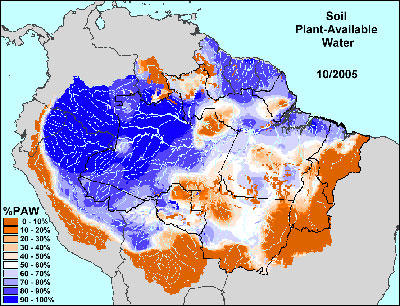
According to the WHRC, the above map is "a product of our ongoing drought monitoring effort from Oct. 2005, the worst month we have in our record going back to 1995. It shows moisture stored in the soil which is available for use by plants, what we call 'Plant-Available Water' or 'PAW', expressed as a percentage of the total water-holding capacity of the top 10m of soil at any given point; %PAW is one of the strongest indicators we have of severity of drought and of forest susceptibility to fire. Courtesy of WHRC.
Consensus is not yet clear on this issue. Another study published inScience in 2007 stated that forests would actually do better in drought conditions, because they would receive more sunlight from a cloudless sky. However, the results of this study have not been able to be reproduced.
Given the differing opinions, more research may be needed before consensus can be reached on how the Amazon will react to climate change, especially in light of other threats such as deforestation.
Citation: Samanta, A., S. Ganguly, H. Hashimoto, S. Devadiga, E. Vermote, Y. Knyazikhin, R. R. Nemani, and R. B. Myneni (2010), Amazon forests did not green‐up during the 2005 drought, Geophys. Res. Lett., 37, L05401, doi:10.1029/2009GL042154.
Copyright mongabay 2010
Read more... Sphere: Related Content
Subscribe to:
Posts (Atom)


 Posts
Posts