Showing posts with label media. Show all posts
Showing posts with label media. Show all posts
13 March 2012
Read more... Sphere: Related Content

10 March 2012
Remotely Piloted War
In the American mind, if Apple made weapons, they would undoubtedly be drones, those remotely piloted planes getting such great press here. They have generally been greeted as if they were the sleekest of iPhones armed with missiles
By Tom Engelhardt | Foreign Policy in Focus | March 6, 2012
Read more... Sphere: Related Content02 February 2012
Wall Street Journal under attack for climate op-ed
The Wall Street Journal is under scrutiny for publishing an op-ed attacking climate science last Friday, while turning down another op-ed explaining climate change and signed by 255 researchers with the U.S. National Academy of Sciences, which was eventually published in the journal Science
Jeremy Hance | mongabay.com | January 31, 2012
Read more... Sphere: Related Content06 January 2012
The climate change message is not being heard. Here's how to change tack
Focus on the economic case, drop the activist-speak, talk about solutions rather than doom – and don't rely on politicians
Sunny Hundal | guardian.co.uk | 5 January 2012
Read more... Sphere: Related Content
Preaching to the converted? A climate march in London, December 2010. Photograph: Luke Macgregor/Reuters
03 January 2012
Will the World End in 2012?
The millenarian prophecies of doom that have rumbled on since 2000 are coming to a head this year, with the Mayan prophecy of the end of the world receiving serious news coverage
by Molly Scott Cato | Gaian Economics | 3 January 2012

06 November 2011
The Reign of the One Percenters
Income inequality and the death of culture in New York City
By Christopher Ketcham | November/December 2011 issue | Orion
Read more... Sphere: Related Content
Photograph: William Steacy
17 October 2011
10 ways to support the Occupy movement
The #OccupyWallStreet movement continues to spread with more than 1,500 sites. More and more people are speaking up for a society that works for the 99 percent, not just the 1 percent
B Sarah van Gelder | Oct 16 2011 by YES! Magazine in Energy Bulleting | Oct 16 2011
Read more... Sphere: Related Content
In Westlake Park, Seattle, shortly before police removed the tent and arrested occupiers. Sign reads: 250,000 Homeless Vets Is Unacceptable.: Photo by Sarah van Gelder.

06 April 2010
REDD in the news: 29 March – 4 April 2010
A round up of the last seven days’ news on REDD, in chronological order with short extracts (click on the title for the full article). For those who can’t wait until Monday for their REDD news, REDD-Monitor’s news page is updated daily: REDD in the news
By Chris Lang | REDD-Monitor | 6th April 2010
 Networks emerge as key actors in community forestry
By Imogen Badgery-Parker, CIFOR, March 2010 | In recent years, governments in developing countries have transferred at least 200 million hectares of forests to communities living in and around them. Now, more than a quarter of forests in developing countries are owned by or assigned to communities. Tenure is particularly important in light of the ongoing global negotiations on REDD (reducing emissions from deforestation and forest degradation). For REDD schemes to be successful, clear usage and access rights and responsibilities over forest resources and carbon pools needs to be established so that efficient and equitable payments for carbon sequestration can be made. Communities will only benefit from these schemes if their rights are secure.
Global Project: UN-REDD International Support
UNDP, March 2010 | The Joint Programme is focused on international support functions (global activities) that attempt to support the country actions and provide the international community with confidence and understanding of the technical and social aspects of a post 2012 REDD mechanism. The programme design draws from the respective strengths of the partner agencies in line with One-UN objectives and provides technical and scientific support as well as knowledge management. Specifically the international support functions aim to achieve the following outcomes by mid 2010: Outcome 1: Improved guidance on Monitoring, Reporting and Verification (MRV) approaches (led by FAO) Outcome 2: Increased engagement of stakeholders in the REDD agenda (led by UNEP) Outcome 3: Improved analytical and technical framework of multiple benefits for REDD decision-makers (led by UNDP and UNEP) Outcome 4: Increased knowledge management, coordination and communication (co-led by the three agencies)
Forestry Carbon Consultant on Environmental Expert
Jobs, environmental-expert.com, April 2010 | My client is looking for an experienced Forestry Carbon Consultant to join their team in Chile. This is an exciting role and an opportunity to join one of the most successful companies specialising in the ecosystem and land-use space today. Responsibilities:- · Assessing forestry projects (reforestation, afforestation, REDD etc) to understand the potential for emission reduction or offsetting · Overseeing the asset management, development and financing of such projects · Working closely with forestry professionals to review progress of existing projects · Making key strategic decisions on which projects to develop and invest in · Frequent travel to parts of South America in order to visit project sites · Working with landowners of endangered forest areas in order to ensure the value of their assets are maximised and to minimise deforestation.
29 March 2010
Norway widens carbon VAT fraud probe into money laundering
By Gwladys Fouche, Reuters, 29 March 2010 | A Norwegian police investigation into alleged carbon tax evasion is widening its scope into money laundering, with five men charged, Oslo police said on Monday. The Norwegian authorities’ investigation is part of a wider probe into tax fraud relating to carbon emissions trading that European police agency Europol said cost treasuries up to 5 billion euros ($6.72 billion) in lost revenues. “We have three arrested and five charged … Altogether it’s six companies (we are investigating),” said police superintendent Boerre Walderhaug, head of the finance and environment unit at Oslo police.
Scientists hold climate talks in Kenya
By Rambui Waweru, Capital News, 29 March 2010 | Scientists from 14 countries in Eastern and Southern Africa gathered in Nairobi on Monday at the start of a three-day workshop to address the role of sustainable agriculture, forestry and agro-forestry in the fight against climate change. The workshop is expected to determine research priorities and the next steps for Reducing Emissions from Deforestation and forest Degradation (REDD) and agriculture in the region. The workshop is co-hosted by the Common Market for Eastern and Southern Africa (COMESA) and the World Agro-forestry Centre. “One way to improve African participation in the bio-carbon market is better governance,” said George Wamukoya, climate change advisor to the COMESA secretariat.
HSBC Ejects Carbon Traders From Index
By James Kantor, Green Inc. Blog, NYTimes.com, 29 March 2010 | The banking giant HSBC removed two companies involved in carbon trading from its Climate Change Index on Monday because they had lost too much value. Analysts from HSBC said the cause was mainly that governments had failed to come up with a timetable for a global climate deal at the United Nations summit in Copenhagen in December. “Carbon trading was the major loser from Copenhagen,” HSBC analysts said in their March 21010 Quarterly Index Review. “Cap and trade needs hard targets and binding rules – and Copenhagen delivered neither,” HSBC said. The two companies ejected were Climate Exchange and Trading Emissions. Both companies are based in the Isle of Man and listed on the London Stock Exchange.
Forests May Depend on Survival of Native People
By Stephen Leahy, IPS, 29 March 2010 | After the failures in Copenhagen to agree on a new climate protection treaty, and more recently at the Doha meetings on trade in endangered species to prevent bluefin tuna from going extinct, indigenous forest communities may offer examples of sensible governance for shared resources on a small planet. Hundreds of poor Mexican Zapotec indigenous farmers have become owners of a multi-million-dollar diversified forest industry, offering an important model of a community-based enterprise that supports local people and conserves the natural environment, says David Barton Bray, a professor and associate chair in the Department of Earth and Environment at Florida International University in Miami.
30 March 2010
Carbon Trading and the Great Recession
By James Kanter, Green Inc. Blog, NYTimes.com, 30 March 2010 | The recession brought with it a slowdown in industrial production, and that has translated into far fewer greenhouse gas emissions in 2009 than in previous years… Mark C. Lewis, a research analyst at Deutsche Bank in London, forecast this week a decline in emissions of 10.4 percent compared with 2008 among industries covered by the system. Kjersti Ulset, the head of European carbon analysis for Point Carbon in Norway, estimated this week a decline of 11 percent… Two sectors to watch closely on Thursday are steel and cement. Companies in both of these sectors already have huge amounts of surplus permits they did not need to use because of the downturn. Steelmakers like ArcelorMittal and cement manufacturers like Lafarge can sell their surplus or bank them for use in coming years. That opportunity potentially represents a huge windfall for those companies.
Oil conglomerate ’secretly funds climate change deniers’
By Tom Leonard, Telegraph, 30 March 2010 | An oil conglomerate has allegedly spent nearly £16.5 million ($25 million) on campaigns to discredit climate change and clean energy policies, according to a new report. Koch Industries, which is owned and run by two Kansas-based brothers and has substantial oil and chemicals interests, spent the sum between 2005 and 2008 to finance “organisations of the ‘climate denial machine’”, claims the environmental campaign group Greenpeace. Despite the relatively small size of the conglomerate, the sum is three times that spent by ExxonMobil, the western world’s biggest oil company, in the same period.
Is carbon trade a scam?
Al Jazeera, 30 March 2010 | Is carbon trading a win-win situation, helping to reduce greenhouse gas emissions and helping poorer countries make money by selling their credits? Or is the system being exploited – to the detriment of the environment? [R-M: Discussion with Daphne Wysham of Institute for Policy Studies, Joe Romm of climateprogress.org, and Patrick Birley, Chief Executive of the European Climate Exchange.]
Will the global Forestry Carbon Market go REDD? Find out more at Carbon Markets 2010 conference
Carbon Markets Summit, 30 March 2010 | Will the global forestry carbon market turn to REDD credits? And where are the opportunities for Asia? The Carbon Markets 2010 conference offers a view into REDD, highlighting developments in Southeast Asia. While nearly $150 million has been spent to date on carbon offsets from planting trees and preserving forests, the market is in a precipitous position over limitations in the CDM for forestry projects. However, the industry got a boost at the Copenhagen talks, when nations promised a $3.5 billion international scheme to reduce emissions from deforestation and degradation (REDD), with the U.S. alone pledging $1 billion, according to Reuters reports.
From Copenhagen to Cochabamba
By Franz Chávez, IPS, 30 March 2010 | A different way of fighting global warming will be tried out in the central Bolivian city of Cochabamba when government representatives and thousands of activists gather for the World People’s Conference on Climate Change and the Rights of Mother Earth. The social organisations sponsoring the Apr. 19-22 conference have announced an alternative platform to the efforts of the 15th Conference of the Parties to the United Nations Framework Convention on Climate Change (COP-15), which ended in failure in icy Copenhagen in December 2009.
Japanese policy mix needs strong shot of emissions trading
WWF, 30 March 2010 | An effective policy approach to turn Japan into a low-carbon economy needs emissions trading at its heart, a WWF report has found. The new research shows that a strong emissions trading scheme would have little impact on the Japanese economy, while allowing the Hatoyama government to effectively reach its ambitious targets for emission reductions. “Japan has wasted years playing around with voluntary emissions trading, so it’s high time to finally get serious and design a strong scheme for this country, in order to regain our role as a competitive and modern economy”, said Naoyuki Yamagishi, Climate Programme Leader at WWF Japan.
Another alleged scam unearthed in the carbon markets
By Brady Yauch, Probe International, 30 March 2010 | Carbon markets are again facing allegations of a scam involving the trading of carbon credits. Reuters reports the Australian company WesternField Holdings Inc. has been accused of defrauding investors down under of A$3.5 million ($3.2 million) through a telemarketing swindle. Although blacklisted by the country’s securities regulator, the firm continues to operate. According to the Australian Competition and Consumer Commission (ACCC), WesternField allegedly cold-called potential investors and promised them large returns for short-term investments in carbon credits. Investors were told they could review their “investment certificates” at an independent website registered under the name CTR Limited (carbontrustregistry.com), supposedly based in Hong Kong.
Pearl Jam guitarist sees business key to climate
By Alister Doyle, Reuters, 30 March 2010 | While many people dream of becoming a rock star, Pearl Jam guitarist Stone Gossard says he is trying to be more of a businessman to help slow climate change. The U.S. band, which has sold 60 million albums since 1991, said Monday it was investing $210,000 to plant trees in Washington State to soak up an estimated 7,000 tonnes of carbon dioxide linked to a 32-date 2009 tour.
UN-REDD and Indonesia Collaborate to Curb Deforestation
Climate-L.org, 30 March 2010 | Indonesia and the UN-REDD Programme launched efforts to reduce emissions from deforestation and forest degradation in developing countries (REDD) in Indonesia by supporting the Indonesian Ministry of Forestry in their preparations for national REDD implementation. US$ 5.6 million, provided by the Norwegian Government, was allocated to help with policy preparation, testing of methodologies, and coordination between the different REDD initiatives in Indonesia. In launching the initiative, Forestry Minister Zulkifli Hasan highlighted the importance of local communities in REDD, calling for REDD to help improve livelihoods of forest-dependent communities, as well as preserve forests and biodiversity.
Indonesia to establish rainforest trust fund
mongabay.com, 30 March 2010 | Indonesia is preparing to establish a trust fund to reduce deforestation, reports the Jakarta Globe. The National Forest Trust Fund, which will be raised by the Ministry of Forestry from foreign donors, would be an expansion of a pilot initiative established last year in a debt-for-nature swap between Indonesia and the United States, according to Hadi Daryanto, director general of forest production at the Ministry of Forestry. The money, which would be managed by an independent group, would finance conservation projects and promote sustainable forest management.
Minister of Forestry and the United Nations launch joint effort to combat deforestation and forest degradation
UNDP press release, 30 March 2010 | Today the Ministry of Forestry and the United Nations launched The United Nations Collaborative Programme on Reducing Emissions from Deforestation and Forest Degradation (UN-REDD) with a kick-off workshop opened by H.E. Zulkifli Hasan, Minister of Forestry. In his opening remarks the Minister emphasized the danger of climate change and the need for action to reduce emissions “Our country is very vulnerable: it has 80,000 kilometre coast line, more than 17,000 islands, many people depend on agriculture, forestry and fisheries for their income and food security. Many of these forest dependent communities still live in poverty”.
31 March 2010
Depopulation may be harming the Amazon rainforest
Rhett A. Butler, mongabay.com, 31 March 2010 | Urbanization may be having unexpected impacts in the Amazon rainforest by leaving forest areas vulnerable to exploitation by outsiders, report researchers writing in Conservation Letters. Conducting field surveys during the course of 10,000-kilometers of travel along remote Amazon rivers, Luke Parry of Lancaster University found that a sharp decrease in rural habitation has not been accompanied by a decline in harvesting of wildlife and forest resources, indicating that urban populations exact a heavy toll on distant forests through hunting, fishing, logging, and harvesting of non-timber forest products.
REDD: What would it mean for the tribal communities?
Find Your Feet’s Blog, 31 March 2010 | The Indian government is very keen to use REDD strategies to sustain its forests. But have they considered the sustainability of the livelihoods of adivasis, where forest produce is their sole source of income?… What the REDD scheme overlooks is the motivation factor i.e. financial gain. This is an arena waiting to be exploited by large corporations and corrupt government officials. Rewards of finance and carbon credits will encourage government agencies to repress the community voices and interests in order to give private companies access to the forest lands. Further commodification of forest resources, according to REDD’s strategy, is not the solution. An effective method for tackling these issues would be to ensure that the government of India implements and respects the existing legislations in India.
A Model for Reducing Illegal Logging in REDD Projects
By Dan Tefft, TreeBanker’s Blog, 31 March 2010 | Unfortunately you don’t have to look very far to find examples of scams associated with forestry carbon projects, and, right along side those stories you’ll find legitimate concerns about leakage from illegal loggers… he point I’m trying to make is that the carbon market has the potential to fund the protection of these valuable assets. REDD lays the foundation for using carbon credit funds to protect forests, especially rainforests… A world-wide carbon market is coming. Like any other market, the power to direct the market will be in the hands of the purchasers. Will they choose to buy credits from transparent, ethical sources or will it be the hurried, “Give me whatever you’ve got!!!”
Nepal’s forests: Selling carbon credits
Jagadish Chandra Baral PhD, The Himalayan Times, 31 March 2010 | Nepal, like any other developing country, now could sell carbon credits in the global market by way of reducing its contemporary deforestation and degradation rates and by way of forest conservation and enhancement. It sounds too good to be true? No, surely not. The world has now conceptually moved pretty ahead in terms of rewarding the developing countries for carbons with those origins… Thanks also to the global UNFCCC initiative which has prepared to take a great leap from its original Kyoto position (1997) that had limited its reward domain to the carbon generated from new plantations. Both the UNFCCC sponsored specialized group (AWG-LCA) and the much controversial Copenhagen have ratified the concept. It can thus be predicted that the forthcoming convention of parties (COP15) scheduled in Cancun in November 2010 would approve the case… Baral is associated with the MoFSC.
REDD Stakeholder National Consultation Workshop
Government of Nepal, 31 March 2010 | REDD stakeholder consultation workshop was organised by the REDD cell on 28th March 2010. There were 24 partcipants participated in the workshop. They were from government organisations, NGOs/INGOs, university teachers and studenys, forestry related associations and civil society. The main objective of the workshop to share, discuss and finalise the component 1 and 2 of the RPP. The participants discussed in group and finalised the contents of the componets.
1 April 2010
In Europe, a Call for Tighter Caps on Emissions
By James Kanter, New York Times, 1 April 2010 | Climate advocates called for tighter caps on greenhouse gas emissions in the European Union after figures released on Thursday showed that some of the dirtiest industries benefited from a surplus of permits. The figures from the European Commission showed the largest annual decline in emissions from industries covered by the bloc’s carbon trading program since it began in 2005, a drop that was largely a result of the global economic slowdown. Many of the companies that were issued permits have made millions of euros from selling their excess credits, anticipating that they would have plenty in years to come, or because they needed to generate cash to shore up their balance sheets as the economic crisis bit deeper. In many cases these companies have also held on to some of their surpluses, which would make it easier for them to offset future emissions after the economy recovers.
Native Peoples Reject Market Mechanisms
By Daniel Zueras, IPS, 1 April 2010 | Solutions to global warming based on the logic of the market are a threat to the rights and way of life of indigenous peoples, the Latin American Indigenous Forum on Climate Change concluded this week in Costa Rica. Proposals from governments and international non-governmental organisations (NGOs), such as the Clean Development Mechanism and the UN-REDD Programme (United Nations Collaborative Programme on Reducing Emissions from Deforestation and Forest Degradation in Developing Countries), “are new forms of economic geopolitics” that endanger indigenous rights enshrined in treaties, says the final declaration of the forum, which ended Wednesday. These proposals allow states and transnational corporations to promote dams, agrofuels, oil exploration, tree plantations and monoculture crops, that cause expropriation and destruction of indigenous peoples’ territories and the criminalisation, prosecution and even murder of native people.
India to seek funds for developing nations to increase forest cover
By Padmaparna Ghosh, livemint.com, 1 April 2010 | India will press for a global fund to help developing countries increase their forest cover—as part of efforts to combat climate change—at a crucial meet to be held in Norway next month, environment minister Jairam Ramesh said. The country is unlikely to benefit from a $3.5 billion (around Rs15,785 crore) fund being mobilized for reducing emissions from deforestation and forest degradation in developing countries, also known as REDD.
Madagascar’s conservationists pin hopes on UN’s REDD scheme
ethiopianreview.com, 1 April 2010 | Johannes Ebeling, a Madagascar-based independent carbon markets expert, believes the potential of REDD is huge in African nations such as Madagascar, Liberia and the Democratic Republic of Congo. “It would be a huge opportunity to mitigate greenhouse gases in a lot of different countries, especially those that don’t have a lot of industrial emissions,” said Ebeling… Jeannicq Randrianarisoa, who is overseeing Conservation International’s pilot REDD project in eastern Madagascar, says the most daunting task ahead is to change traditional ways of life. “The biggest challenge is to have these communities change their current practices of slash-and-burn cultivation,” said Randrianarisoa. “That’s how their ancestors showed them how to make a living, so it’s a very hard cycle to break as it’s the only way they know how to live.”
IUCN report on REDD and national implementation
By Bill Eichler, Trust & Verify Online, 1 April 2010 | In December 2009, the International Union for Conservation of Nature (IUCN) published what the MEA Bulletin describes as a ‘comprehensive’ report on ‘national legal frameworks for reducing emissions from deforestation and forest degradation in developing countries (REDD).’ Focusing on four case studies – Brazil, Cameroon, Guyana and Papua New Guinea – the study ‘identifies main themes for ensuring successful REDD legal regimes and elaborates relevant legal and policy considerations with regard to each.’
3 April 2010
Govt warns provinces over annual forest fires
Adianto P. Simamora, Jakarta Post, 3 April 2010 | The government has warned local authorities to take preventative measures against expected forest fires that have become an annual threat during dry season. Environment Minister Gusti Muhammad Hatta has summoned governors, regents and lawmakers from 10 provinces prone to forest fires as the country prepares to enter the dry season by late April. “We have warned authorities, particularly from six-prone provinces to take action to prevent forest fires,” he told reporters…. “Slash and burn farming practices are still commonplace among local farmers clearing land. Local administrations should deal with the practice to curb the forest fires,” he said. Hatta claimed that big companies such as plantations had implemented the non-burning land clearance practices. “But what we are worry about is the big companies will utilize local people to clear the land by burning,” he said.
4 April 2010
LCDS: Stepping-stone to a global forest-carbon market!
By Dr. Clive Thomas, Stabroek News, 4 April 2010 | Significantly, the Quick Assessment Report is categoric in stating upfront its conclusion that: “At present a national approach to assess carbon stock has not been developed nor implemented in Guyana” (p 1). The report does recognise that a limited number of aspects and areas of forest assessments have been in process across several agencies in the country in recent years. It does, however, conclude that there still needs to be a “methodological assessment model developed to assess carbon stock at the national level” (p 1). Disconcertingly, I have found the report to be conflicting in reporting the results of its assessment of the degraded forest area.
Germany backs RP initiatives on climate change
The Philippine Star, 4 April 2010 | Encouraged by the Philippines’ determined actions to reduce greenhouse gases and adapt to climate change, the development enterprise German Technical Cooperation (GTZ) has launched innovative environmental protection measures in the country budgeted at almost five million euros (P325 million) for the next two to three years. GTZ is implementing the 2.7-million-euro “Climate-Relevant Modernization of the National Forest Policy and Piloting of REDD Measures in the Philippines” in partnership with the Department of Environment and Natural Resources (DENR) and in behalf of the German Federal Ministry for Environment, Nature Conservation and Nuclear Safety.
REDD-Monitor is licensed under a Creative Commons Attribution-Noncommercial-Share Alike 3.0 Unported License.
Read more... Sphere: Related Content29 March 2010
REDD in the news: 22-28 March 2010
A round up of the last seven days’ news on REDD, in chronological order with short extracts (click on the title for the full article). For those who can’t wait until Monday for their REDD news, REDD-Monitor’s news page is updated daily: REDD in the news
REDD-Monitor | 29th March 2010
 Climate research in Vietnam receives a boost
World Agroforestry Centre, March 2010 | “What we need from the World Agroforestry Centre is the scientific basis. Our people need the scientists to work beside them.” Mrs Pham Minh Thoa, newly appointed Director General of Vietnam’s Department of Science, Technology and International Cooperation, made this statement during a visit to the Centre on Friday 19 March 2010 with colleague Dr Pham Manh Cuong, National REDD Team Leader, UN-REDD Vietnam Programme. Their visit came just one day after representatives from the Government of Norway had visited the Centre to discuss Norwegian support for the Centre’s research into reducing emissions from all land uses. This work will be carried out by the Centre and the Alternatives to Slash and Burn Partnership in three countries: Vietnam, Cameroon and Peru.
22 March 2010
Indonesia Walks a ‘Tricky’ Path Toward Growth and Sustainability
By Jessica Leber, NYTimes.com, 22 March 2010 | “We are trying to implement REDD, but at the same time, we need to accelerate our development,” said Wandojo Siswanto, Indonesia’s lead climate negotiator on forest issues, during a visit to Washington this month… Siswanto pointed to an early pilot project on the Berau district, an area the size of Belize in Borneo’s East Kalimantan province, as one of several efforts to move from piecemeal conservation projects to grand, large-scale plans. Eventually, the goal is create a rigorous national program that could meet international REDD standards… It is working out the details in places like Berau. “There is still great opportunity here, but there’s also significant threat on the horizon,” said Sarene Marshall, deputy climate change director of the Nature Conservancy, which is actively helping run the project.
The challenges of managing high expectations for REDD-plus
By Jan Willem den Besten (IUCN), Alertnet, 22 March 2010 | Civil society, government organizations and local communities in many tropical rainforest nations have started REDD-plus preparation planning with a lot enthusiasm, eager to take part in this proposed global mechanism for the reduction of forest-related CO2 emissions. REDD-plus would be a financial incentive for reducing deforestation and forest degradation with the aim of cutting carbon emissions from those sources. Under it, governments hope to receive payments for their efforts; the ‘plus’ indicates the inclusion of sustainable management, conservation and restoration of forests in the effort. There is however a danger that early enthusiasm for REDD-plus could be quelled by unrealistic promises and false expectations – so much so that the effort could become a victim of its own promises.
UN-REDD policy board visit to Kikuyu Escarpment Forests
Kenya Forests Blog, 22 March 2010 | Later on the group travelled to Naivasha, where they were given an update on the Mau Forest Ecosystem and the efforts that were being undertaken to reclaim and rehabilitate this important water tower. Mr. Anthony Maina, a member of the Interim Coordinating Secretariat (ICS) made a presentation on what the Secretariat was undertaking and he outlined the five phases of reclamation. Mr. Esau Omollo, the KFS Deputy Director Natural Forest Management also participated in this meeting and he informed the visitors of the KFS commitment to forest conservation.
Business should get credit for saving forests, coalition says
By Ben German, The Hill’s E2-Wire, 22 March 2010 | Power companies should get credit under a climate change bill for forest conservation, a coalition of groups said Monday. Companies also should get credit for supporting farming activites that reduce greenhouse gas emissions, the groups said. “By providing an affordable means to address climate change, public and private incentives (such as offsets) for forests and farms can help Americans save money while leading the way to a low carbon economy.”
UN-REDD, 22 March 2010 | During its fourth meeting in Nairobi, Kenya 18-19 March 2010, the UN-REDD Programme Policy Board approved US$14.7 million in funding for national UN-REDD programmes in Bolivia, the Democratic Republic of Congo (DRC) and Zambia, bringing the total amount of funding for UN-REDD national programmes to-date to US$48.3 million. The Policy Board approved US$4.7 million for Bolivia, US$5.5 million for DRC and US$4.5 million for Zambia.
23 March 2010
Suggestions about Amerindians not understanding LCDS ‘insulting’ – Sukhai
Stabroek News, 23 March 2010 | The minister stressed that English is the first language of this country’s indigenous communities, and suggestions about whether some Amerindians understood the Low Carbon Development Strategy (LCDS) presentations can be viewed as insulting. “…All Amerindians speak English, English is our first language and Amerindians are no different to any other Guyanese. I will not want to insult the Amerindians by saying they cannot understand the presentations done on the LCDS,” Sukhai charged yesterday in response to a question during a press briefing at her ministry.
Sukhai questions translating LCDS into Amerindian languages
Kaieteur News, 23 March 2010 | Minister of Amerindian Affairs, Pauline Sukhai, yesterday said that Amerindians cannot read or write their own languages, and so questioned how effective it would be if the Low Carbon Development Strategy (LCDS) would be translated. Sukhai declared that all Amerindians speak English, and she said it would be insulting to suggest that they did not understand the LCDS consultations. However, she contradicted herself later, indicating that there were cases where some Amerindians could not understand the presentations in English and so interpreters were called in, some of them even being paid. Speaking at a press conference held at the Ministry of Amerindian Affairs, Sukhai said that the frequently asked questions about the LCDS were translated into some Amerindian languages, but she questioned how effective that was since the Amerindians don’t read or write their language.
Indonesia Trust Fund to Tackle Rampant Deforestation
By Fidelis E Satriastanti, Jakarta Globe, 23 March 2010 | Indonesia is set to establish a new trust fund to reduce the rapid rate of deforestation in the country. The National Forest Trust Fund will collect money from donor countries, especially developed ones, to finance conservation projects and promote sustainable forest management… Hadi Daryanto, director general of forest production at the Ministry of Forestry, said on Tuesday that the details of the fund were still being worked out between the government and potential donors… adi said the government had already set up a trust fund in 2009 as a part of a debt-swap program with the US government under the Tropical Forest Conservation Act to save Sumatran forests… On Sept. 14, 2009, the Indonesian Climate Change Trust Fund was launched to attract donor support for efforts to tackle climate change issues… Basah said the British government had committed 10 million pounds ($15 million) to the ICCTF.
A Pioneering Biologist Discusses The Keys to Forest Conservation
By Caroline Fraser, Yale Environment 360, interview with Daniel Janzen, 23 March 2010 | Ironically, this whole carbon fuss does bring a potential bright light. And that bright light is that if the world does get serious about what is packaged under the acronym of REDD [Reduced Emissions from Deforestation and Forest Degradation] and puts in a big bucket of money that is used to lock down big chunks of forest in a permanent carbon storage state, that has the potential — and I have to underline the word “potential” — for truly saving big blocks of wild areas. And there are a lot of ifs between the big picture wish or international agreements and actual on-the-ground doing it. But if there were a bucket like that that was available so that people like me, who are seriously out there trying to lock down big chunks of forest, that could become a financial instrument for actually doing it. That could be a major tool.
The Environment and Politics Part V Post-COP 15 – The Way Forward
Action Against Climate Change, 23 March 2010 | Liberia has been singled out of West Africa as the only tropical rain forest nation at the conference. But interestingly, countries with dry forest like Ghana and Kenya are far ahead of Liberia with the REDD process. For instance, Ghana submitted her proposal in January 2010 and is to defend her proposal next month in Gabon. Liberia must wake up from her slumber that is keeping her backward. Our leaders that attend these meetings are not really disseminating information acquired at these meetings. In a discussion on the types of forest that qualify for REDD, Liberia and the Congo Basin countries were singled out but we, as a country, are lacking institutional policy and technology to be at par with other nations.
24 March 2010
Community networks key to forest reform
By Adianto P. Simamora, Jakarta Post, 24 March 2010 | Communities linked to their own networks and organizations have the best chance of success in community forestry, a research finds. The three-year research project, conducted by the Center for International Forestry Research (CIFOR), assessed 30 sites in 10 countries across Africa, Asia and Latin America. “The research focused on communities that had fought for or been granted new statutory rights,” Anne Larson, senior associate at CIFOR said… For REDD schemes to be successful, clear ownership of forest resources and carbon pools needs to be established so that payments for carbon sequestration can be made. Without having secure rights and clear ownership over carbon pools, communities and indigenous groups may not be able to claim benefits from REDD schemes, and may even be dispossessed.
Woodland Dwellers Say State Can’t See Forest for the Trees
By Fidelis E Satriastanti and Dimas Siregar, Jakarta Globe, 24 March 2010 | Teguh Surya, head of advocacy at the Indonesian Forum for the Environment (Walhi), said the government had failed to acknowledge the complicated issues surrounding land disagreements with indigenous peoples. “The idea of REDD is just irrelevant because the government did not include all stakeholders, such as indigenous people, when they drafted the regulations. They were not given any room to participate in this process,” he said. He said in preparing to participate in the REDD mechanism, the government should concentrate on human rights issues and protection for indigenous people. He said the scheme was being misused as a way to make money instead of reduce emissions.
Ag, Forestry Groups Urge Senators to Include REDD in Climate Bill
By Environmental Defense, 24 March 2010 | You can add two more important stakeholders — and unusual allies — to the growing list calling for the Senate to include strong Reducing Emissions from Deforestation and Forest Degradation (REDD) provisions in their bill: agriculture and forestry groups. In a letter this week to the drafters of current climate legislation for the Senate, 31 businesses, agriculture groups, and environmental organizations (including EDF) asked for the bill to include agriculture and forest provisions. REDD can help address the serious worldwide deforestation problem, the letter to Senators John Kerry, Lindsey Graham and Joe Lieberman, says.
Indonesia Merging Deforestation Rules to Spur Carbon Trading
By Fidelis E Satriastanti, Jakarta Globe, 24 March 2010 | Less than a year after finalizing them, the government is set to untangle regulations aimed at reducing deforestation and forest degradation in a bid to attract carbon-trading investment. Wandojo Siswanto, head of the climate-change working group at the Forestry Ministry, said the three regulations to be reviewed all cover the same ground, including demonstration activities, carbon-storage activities and Reducing Emissions from Deforestation and Degradation procedures… “We want to keep the lead in the world and also at the negotiation table, and we have been trying to look at troubles for investment” resulting from the regulations, Wandojo said. “We want to make sure that this [new regulation] can be easily implemented,” he said. He added that the review was expected to be finalized before the Mexico climate summit in November. The World Bank says 20 trial schemes are in various stages of development in Indonesia.
Robin Tauck Joins Marriott’s Efforts to Protect Amazon Rainforest
TRIP press release, 24 March 2010 | Tauck Romano Innovative Philanthropy (TRIP) is joining Marriott International’s ongoing effort to leverage sustainable tourism, conservation and training in Brazil’s Amazon Rainforest. TRIP has committed $50,000 to support education and a new Sustainable Agriculture Learning Center within the Juma Reserve in the Brazilian state of Amazonas… Travel industry veteran Robin Tauck (TRIP Foundation trustee and President R. Tauck & Partners) believes the Sustainable Agriculture Learning Center is a clear example of how new and innovative programs show promise and build sustainable, positive change. “I am personally proud to be an initial international travel partner joining Marriott and the state of Amazonas in supporting such innovative programs in Juma. The Amazon Rainforest is known as the lungs of the world, and we can all leverage Marriott’s leadership via our large, responsible and caring industry,” said Tauck.
Forests expert officially complains about ‘distorted’ Sunday Times article
By David Adam, Guardian, 24 March 2010 | A leading scientist has made an official complaint to the Press Complaints Commission over an “inaccurate, misleading and distorted” newspaper story about a supposed mistake made by the UN’s panel on global warming. Simon Lewis, an expert on tropical forests at the University of Leeds, says the story, published by the Sunday Times in January, is wrong and should be corrected.
25 March 2010
Tracing the Demise of Cap and Trade
By John M. Broder, 25 March 2010 | “Economywide cap and trade died of what amounts to natural causes in Washington,” said Fred Krupp, president of the Environmental Defense Fund, who has been promoting the idea for more than two decades. “The term itself became too polarizing and too paralyzing in the effort to win over conservative Democrats and moderate Republicans to try to do something about climate change and our oil dependency.”… C. Boyden Gray, White House counsel in the first Bush administration and a strong advocate of the acid rain cap-and-trade program, said that opponents were largely correct in labeling the Waxman-Markey plan a tax, because so many of the pollution allowances were given away to industry rather than allocated based on past emissions. “This is potentially a $3 trillion tax,” Mr. Gray said, “which is pretty steep in the best of times, and poison in the worst of times.”
Global Deforestation Slowing, but Much More Needs to Be Done
By Environmental Defense, 25 March 2010 | The latest global deforestation estimate from the United Nations Food and Agriculture Organization (FAO) indicate that deforestation rates slowed from 2000 – 2010 relative to the 1990s… But the large-scale positive incentives to reward forest conservation and sustainable land uses are not yet in place. For this trend to last when commodity prices go up (as they inevitably will), we need a price signal from the carbon market to make living forests worth as much or more than dead ones: reducing emissions from deforestation and forest degradation (REDD).
Forest loss slows, as China plants and Brazil preserves
Resources for a sustainable future, 25 March 2010 | The world’s net rate of forest loss has slowed markedly in the last decade, with less logging in the Amazon and China planting trees on a grand scale.Yet forests continue to be lost at “an alarming rate” in some countries, according to the UN Food and Agriculture Organization (FAO). Its Global Forest Resources Assessment 2010 finds the loss of tree cover is most acute in Africa and South America… UN agencies hope the net rate of loss will be slowed further in coming years if the climate change-related initiative on Reducing Emissions from Deforestation and forest Degradation (REDD) comes to fruition.
World deforestation decreases, but remains alarming in many countries
FAO Media Centre, 25 March 2010 | World deforestation, mainly the conversion of tropical forests to agricultural land, has decreased over the past ten years but continues at an alarmingly high rate in many countries, FAO announced today. Globally, around 13 million hectares of forests were converted to other uses or lost through natural causes each year between 2000 and 2010 as compared to around 16 million hectares per year during the 1990s, according to key findings of FAO’s most comprehensive forest review to date The Global Forest Resources Assessment 2010. The study covers 233 countries and areas. Brazil and Indonesia, which had the highest loss of forests in the 1990s, have significantly reduced their deforestation rates. In addition, ambitious tree planting programmes in countries such as China, India, the United States and Viet Nam – combined with natural expansion of forests in some regions – have added more than seven million hectares of new forests annually.
26 March 2010
UN REDD: More countries, more funding
carbonpositive.net, 26 March 2010 | A further $US15 million has been approved under the UN REDD programme for creating an avoided deforestation and forest carbon enhancement mechanism (now termed REDD+) across developing forest nations. A policy board meeting in Nairobi last week approved $4.7 million for Bolivia, $5.5 million for the Democratic Republic of Congo and $4.5 million for Zambia. The meeting also highlighted the need for greater harmonisation of the UN’s REDD initiative with other international schemes of the same aim; that is, mobilising capital in developed countries to pay developing world forest communities to protect and restore their forests so vital to the fight against climate change. There are now 22 recipient countries signed up to the UN REDD programme following the addition of Costa Rica, Kenya, Mexico, Nigeria, the Philippines, Congo, Solomon Islands and Sudan as observer members this year. The scheme’s three donor countries are Norway, Denmark and Spain.
Deforestation worldwide slowing, says UN
RFI, 26 March 2010 | Worldwide deforestation slowed in the last decade “for the first time”, but an area the size of Costa Rica is still being destroyed each year, the United Nations has said. The global fight against climate change, the body warns in a report, depends to a large extent on countries’ willingness to preserve woodland and plant new trees. Some 13 million hectares of forest a year were converted to other uses or lost through natural causes between 2000 and 2010, a report issued by the UN Food and Agriculture Organisation (FAO) has found. This means a fall from about 16 million hectares a year from the decade before.
European Commission: Climate Policy Post-Copenhagen
Tropical Forest Group, 26 March 2010| The European Commission released a report on how to move forward after Copenhagen. It is a fairly uninteresting report, with no major surprises. The things we found interesting are:… 3) Very little mention of REDD in the 12 page document, despite REDD+ having its own mechanism in the Accord as well as a meaningful SBSTA decision. [R-M: The report is available here: http://bit.ly/cpvgao]
UN-REDD Programme Board Holds Fourth Meeting
Climate-L.org, 26 March 2010 | The UN-REDD Programme Policy Board met for its fourth meeting from 18-19 March 2010, in Nairobi, Kenya, and approved US$14.7 million in funding for national UN-REDD programmes in Bolivia, the Democratic Republic of Congo and Zambia. This decision brings the total amount of funding for UN-REDD national programmes to US$48.3 million… n her closing remarks, Nobel Laureate Professor Wangari Maathai welcomed the collaboration between the UN and the World Bank, and emphasized “the need to manage these [REDD+] resources with a responsible and transparent approach.”
Obama To Bring Climate Change Agenda To Indonesia
Antara News, 26 March 2010 | US President Barack Obama who has delayed until next June his planned visit to Indonesia will bring three agenda items on climate change, a WWF official said. “There are three agenda items, namely forest and peat land management, clean technology and climate change, and coral triangle,” WWF-Indonesia Program Director for climate and energy affairs, Fitrian Ardiansyah said here on Thursday. Fitrian said that for the forest and peat land management, the United States would see how far Indonesia could cut its gas emissions and the chance for cooperation. “There is a tropical forest conversion program where a fund would be made available for the Reducing Emissions from Deforestation and Forest Degradation (REDD) scheme,” she said. If Indonesia is able to formulate it, there would be a clean technology such as renewable energy technology and energy conservation, she said.
27 March 2010
President set to commence work on high level UN climate change panel
Guyana Chronicle, 27 March 2010 | President Bharrat Jagdeo leaves Guyana tomorrow for a two-day meeting in London with his colleague members of the high-level panel organised by United Nations (UN) Secretary General Ban-ki-moon to advise on financing for countries in the fight against climate change. Speaking to the media at a press conference yesterday at the Office of the President, the Head of State said the panel will include the four appointed heads of Government (himself, the Prime Ministers of the United Kingdom, Ethiopia and Norway) and a number of finance ministers and others from the ‘big’ countries.
Africa urged to offer incentives for renewable energy
By Emmanuel Onyango, Knowledge Matters, 27 March 2010 | African countries have been told to develop tangible incentives for the adoption of alternative livelihoods and energy sources to mitigate emissions from deforestation. The call was made on Thursday by participants from SADC member countries at the just-ended meeting themed: Reduce Emission from Deforestation and Forest Degradation. They said successes achieved the United Nations Collaborative Programme on Reducing Emissions from Deforestation and Forest Degradation in developing countries (REDD) would also require large scale stakeholders engagement across all levels especially at the grassroots to ensure that communities receive tangible benefits from it. The participants also called for a well designed strategy and policy to achieve positive effects on the conservation of associated biological diversity and ecosystem services as well as livelihoods in forest dependent communities.
28 March 2010
Norway’s disingenuousness once more
By Dr Clive Thomas, Stabroek News, 28 March 2010 | Since, as we have noted before, the LCDS is based on a trajectory of REDD/REDD-plus in which it is morphed into a sustainable global carbon trading market (or a series of interlinked regional carbon trading markets), the question that immediately springs to mind is: how disingenuous can Norway be? Norway is aware that the LCDS explicitly projects the development of REDD and REDD-plus into an arrangement in which transitional funding is provided to poor rainforest countries precisely to further the development of global markets for trading forests-based offsets delivered by these countries. To claim that the Guyana initiative is divorced from Norway’s goal in developing forest-based offsets to greenhouse gas emissions for polluting firms (including Norwegian ones), individuals, and polluting governments with emissions reductions targets in both voluntary and compliance markets is misleading, deceptive and I would add, unworthy…
Indigenous People’s Rights always accorded top priority
Guyana Chronicle, 28 March 2010 | MINISTER of Amerindian Affairs, Ms Pauline Sukai says that contrary to opinion in some quarters, the rights of the Indigenous Peoples have always been accorded top priority by the present administration as evinced by its unwavering commitment to addressing various issues affecting the community. “Indigenous peoples rights continues to be a high priority in Guyana as reflected in the Government’s commitment to maintaining progress on issues such as land titling, stakeholder involvement and empowerment of Amerindians,” the minister said in a statement Friday.
Agatha: rope indigenous people into climate change decisions
The Hindu, 28 March 2010 | Minister of State for Rural Development Agatha Sangma has called for timely interventions and properly implemented policies to protect the lifestyles of several hundred million indigenous people (Scheduled Tribes in India) in Asia-Pacific who are faced with the threat of climate change and extreme rural poverty. Indigenous people make up six per cent of all humanity on earth and yet, they stand perilously close to the twin threat, she said at an Asia-Pacific regional seminar in Manila on Thursday. The seminar on ‘Indigenous peoples, Climate Change and Rural Poverty: Promoting Innovative Approaches and Solutions’ was organised by the Asian Forum of Parliamentarians on Population and Development.
REDD-Monitor is licensed under a Creative Commons Attribution-Noncommercial-Share Alike 3.0 Unported License.
Read more... Sphere: Related Content25 March 2010
REDD in the news: 15-21 March 2010
A round up of the last seven days’ news on REDD, in chronological order with short extracts (click on the title for the full article). For those who can’t wait until Monday for their REDD news, REDD-Monitor’s news page is updated daily: REDD in the news
By REDD-Monitor | 22nd March 2010
 Publication Details – The REDD Opportunities Scoping Exercise (ROSE)
Forest Trends, March 2010 | The REDD Opportunities Scoping Exercise (ROSE): A Tool for Prioritizing Sub-National REDD Opportunities and Constraints Experiences in Ghana, Tanzania and Uganda [R-M: The report is available here: http://bit.ly/cQHwfG]
Forest Industries EU, March 2010 | The technical material was developed in mid-2008 and is ‘global’ in nature. Starting at the ‘global’ level was a deliberate action by the developers of this program as the current global dialogue and debate will create the ground rules for national and project-led developments in REDD… The combined efforts of The Climate, Community and Biodiversity Alliance (CCBA), Conservation International, Deutsche Gesellschaft für Technische Zusammenarbeit (GTZ), The Rainforest Alliance, The Nature Conservancy and World Wildlife Fund (WWF) led to the development of this training program.
16 March 2010
Indigenous Lands, Protected Areas, and Slowing Climate Change
Ricketts et al, PLoS Biology, 16 March 2010 | For REDD to succeed, forest nations must develop policies and institutions to reduce and eventually eliminate forest clearing and degradation. One of the most straightforward components of such a program is also one of the oldest and most reliable tricks in the conservation book: protected areas. Indigenous lands and other protected areas (hereafter ILPAs—created to safeguard land rights, indigenous livelihoods, biodiversity, and other values—contain more than 312 billion tons of carbon (GtC). Crucially, and paradoxically, this “protected carbon” is not entirely protected. While ILPAs typically reduce rates of deforestation compared to surrounding areas, deforestation (with resulting greenhouse gas [GHG] emissions) often continues within them, especially inside those that lack sufficient funding, management capacity, or political backing. [R-M: The paper can be downloaded here: http://bit.ly/ae1g4L]
17 March 2010
More questions than clear answers at rushed LCDS consultations
Stabroek News, 17 March 2010 | There were concerns about the scope of government consultations on forest preservation plans, according to the Guyanese Organisation of Indigenous Peoples (GOIP), which said some meetings were “hurried” and that there were more questions than clear answers about policies. In a statement yesterday, GOIP corroborated recent concerns about the process voiced by some indigenous leaders, while objecting to “threats” and “scare tactics” reportedly used against those who hold an alternative position on the Guyana/Norway plan. GOIP also disassociated itself from a statement issued by activist Ashton Simon, who listed it among other indigenous rights NGOs that were “baffled” by the statement made by the leaders.
WWF, CI reaffirm support for LCDS thrust
Guyana Chronicle, 17 March 2010 | THE World Wildlife Fund (WWF) Guianas and Conservation International (CI) Guyana are urging this country to continue its thrust towards early development of a local carbon economy. The two non-governmental organisations in a joint statement yesterday said they recognize the importance and value of early movement towards a low carbon economy for sustained economic growth, while strengthening local livelihoods and ensuring both local and global climate security. “We are convinced that such an economy can be built without resorting to large scale forest loss seen in other parts of the world”, they said. The joint statement did not refer to a statement from a workshop organised by the Amerindian People’s Association (APA) last week which claimed that some indigenous leaders criticised the consultations on the LCDS and advocated a hold on the LCDS and related activities.
There were detailed consultations on the LCDS and there is still work to be done
By Jocelyn Dow, letter to the Editor, Stabroek News, 17 March 2010 | Obviously I do not share the view that the LCDS process was a farce or that it failed to take account of FPIC. The limitations of this initial consultation period were anticipated, many were addressed and improved over time and there is still work to be done. The LCDS is not a harbour, it is a voyage as are all current initiatives at national scale to maintain low carbon emissions and to be compensated for same at national and or global levels. Our forests are cleaning the greenhouse gases even as we speak. Should we not ensure that we receive payment as negotiated for this global good while we work to sort out our issues?
18 March 2010
By Nitin Desai, Business Standard, 18 March 2010 | A measure of caution is required in shifting the focus of forestry just to carbon sequestration. It could be as distorting as the earlier focus on production forestry. Consider the experience of India with “scientific forestry” set up after the British brought in three German foresters to establish the forest department and the forest institute in Dehra Dun. Sustainable working plans were prepared for the forests which were brought under government control and removals were calibrated to match annual increments in forest stock. But this did not prevent large-scale forest loss with surviving dense forests found only in inaccessible areas. An even bigger distortion was the alienation of forest communities that were treated as interlopers. Moreover, since sustainability was defined in terms of maintenance of growing stock, there was also a monomaniacal obsession with replanting quicker-growing species with little regard to other ecological consequences.
“Recycled” carbon credit scandal sparks price slump
By James Murray, BusinessGreen, 18 March 2010 | Europe’s carbon market descended into chaos yesterday as fears over ” recycled” carbon credits sparked a collapse in the price of Certified Emission Reductions (CER) from €12 (£10.70) to less than €1 a tonne, forcing two exchanges to suspend trading of the UN-backed credits. The crisis was triggered after the emergence that a number of CERs that were controversially “recycled” by the Hungarian government and sold on to a trading firm last week were discovered on the BlueNext exchange in France. Both Bluenext and the Nord Pool exchanges suspended trading of CERs amid fears more carbon credits may end up being illegally reused within the EU.
Toshaos council needs $$ to continue LCDS, REDD+ consultations – Pearson
Stabroek News, 18 March 2010 | A lack of money hinders the National Toshaos’ Council (NTC) from holding further consultations in Amerindian communities about government’s forest preservation strategies, the organisation’s head, Yvonne Pearson says. Following concerns ex-pressed recently by some indigenous leaders and groups on the scope of government’s consultations on the Low Carbon Develop-ment Strate-gy (LCDS) and REDD+ initiatives, Pearson at a press conference yesterday, said the NTC realises there is a need for more information sharing and awareness sessions.
Reactions to the APA statement are misguided – says GHRA
Kaieteur News, 18 March 2010 | The furore surrounding the statement issued by a conference of Amerindian leaders on land rights is, in the opinion of the Guyana Human Rights Association, misplaced and unhelpful. The sensitivity manifest by the supporters of the LCDS and REDD+, is uncalled for, the GHRA said in a statement . Nothing in either statements issued by the conference or later by the APA suggests lack of support, or even criticism of the LCDS/REDD+ strategies, indeed, the releases are not primarily concerned with REDD+. The central concern of both statements is that developments of any kind, whether in extractive industries, other projects or in the LCDS/REDD+ not take place until “fair and transparent policies and actions to resolve our outstanding land claims must be put in place as a priority.”
APA draws more fire on LCDS claims
Guyana Chronicle, 18 March 2010 | THE Amerindian People’s Association (APA) is under more criticism for its recent claims that the public consultations on the Low Carbon Development Strategy (LCDS) were cosmetic and the strategy should be put on hold until some issues are clarified. Ms. Jocelyn Dow, one of two independent monitors for the London-based International Institute for Environmental Development (IIED) for the widespread national consultations last year, said she does not share the view that the LCDS process was a farce or that it failed to take account of FPIC (Free Prior and Informed Consent) as claimed by the APA.
Reuters, 18 March 2010 | The United States has some environment-related projects in Indonesia and may see that rise after Obama’s visit. Washington signed an agreement last year to cut Indonesia’s debt payments by about $30 million in exchange for saving forests in Sumatra. The climate change part of the comprehensive agreement is likely to focus on forests and sustainable peatland management, but there may be an announcement on clean energy as well. Sources close to the negotiations expect the United States to announce new funding of around $20-40 million, which may be classified as fast-start climate funding that rich countries promised to make available to developing countries in Copenhagen last year. That could be money directed to forest preservation projects operating under a U.N.-backed framework called reducing emissions from deforestation and degradation (REDD). Funding for a Southeast Asian “regional centre of excellence” on climate change could also be announced.
Moving Beyond Copenhagen – A Small Island State’s Perspective
By Ian Fry, International Environmental Officer, Environment Department, Government of Tuvalu, Climate-L.org, 18 March 2010 | While reducing emissions from deforestation and forest degradation (REDD) may appear to be one of the success stories of 2009, we are already starting to witness the emergence of “creative” accounting techniques to inflate potential market windfalls from avoiding deforestation. “Creative” accounting may line the pockets of some ambitious entrepreneurs but it will not stop deforestation. We need strong elements that resolve emissions displacement, governance, human rights issues, demand-side measures and permanence.
19 March 2010
Is oil palm plantation forest?
By Yansen, Jakarta Post, 19 March 2010 | The United Nations guideline only defines trees (as carbon absorbers) based on high, without any detail of the species. Therefore, he argued that the proposal will allow Indonesia to receive more benefits from REDD based on the expansion of green areas. However, this reason in fact sounds funny. The basic paradigm of REDD is avoiding deforestation. The incentives of this scheme are based on the ability of a country to avoid deforestation from its natural forest. Donors are not stupid and do not facilitate funding for areas that are not naturally forested. It seems to be that the Indonesian government would like to receive double benefits from oil palm: the investment on plantation development as well as REDD compensation from its status as trees. Are they joking?
Press Release: Indigenous people, forests & climate
Forest Peoples Programme, press release, 19 March 2010 | Indigenous peoples were excluded when forest countries and donor governments met in Paris on March 11, 2010 to discuss a major forests and climate initiative. The parties met under an invitation from the French and Norwegian governments to start developing governance structures for the 3.5 billion USD Reducing Emissions from Deforestation and Forest Degradation (REDD) readiness funds announced in Copenhagen at the United Nations Framework Convention on Climate Change (UNFCCC) COP15 last December. The UNFCCC negotiations are still far from delivering final commitments in full respect of indigenous peoples’rights.
Copenhagen was a step backwards and undid good work done since Kyoto
By Pablo Solon-Romero, The Guardian, 19 March 2010 | In the aftermath of the Copenhagen climate conference, those who defended the widely condemned outcome tended to talk about it as a “step in the right direction”. This was always a tendentious argument, given that tackling climate change can not be addressed by half measures. We can’t make compromises with nature. Bolivia, however, believed that Copenhagen marked a backwards step, undoing the work built on since the climate talks in Kyoto. That is why, against strong pressure from industrialised countries, we and other developing nations refused to sign the Copenhagen accord and why we are hosting an international meeting on climate change next month. In the words of the Tuvalu negotiator, we were not prepared to “betray our people for 30 pieces of silver”.
Australia to help improve road network in W. Kalimantan
Jakarta Post, 19 March 2010 | Travel time will be cut and road safety improved for people using part of a major West Kalimantan highway being significantly upgraded with Australian support. The Australian Embassy said in a statement made available to Antara state news agency on Friday that Australian Ambassador to Indonesia Bill Farmer, Indonesian Public Works Minister Djoko Kirmanto and West Kalimantan Governor Cornelis H.M. launched Thursday an improvement project on the Pontianak-Tayan road network. The 31.5-kilometer stretch is an important link in the Trans Kalimantan Highway and Farmer said the upgrading project would significantly improve travel for motorists. “Better roads mean better access to markets, education, hospitals and other services,” Farmer said.
Indonesia to review forest carbon laws: official
By Suananda Creagh, Reuters, 19 March 2010 | Indonesia has launched a review of laws governing a U.N.-backed carbon trading scheme aimed preserving rainforests, a forestry ministry official said on Friday. Indonesia in 2008 became the world’s first country to design a legal framework for reducing emissions from deforestation and degradation (REDD), a scheme that would allow rich countries to pay developing nations not to chop down their trees.
Clark Labs press release, 19 March 2010 | The technical issues of REDD–carbon accounting, additionality, baseline or “business as usual,” leakage and permanence—are complex and require sophisticated tools. Currently, IDRISI Taiga and its Land Change Modeler is the only integrated modeling solution to address many aspects of REDD projects. The Land Change Modeler application was developed by Clark Labs in cooperation with Conservation International in a prior contract to address land cover change and its impacts on biodiversity… “Conservation International is a major player in the development of REDD projects throughout the world,” stated Stefano Crema, Research Associate at Clark Labs. “Our relationships with organizations such as CI are extremely valuable, as they inform and optimize our development of robust analytical and modeling tools to solve complicated and multi-faceted problems.”
20 March 2010
WWF hopes to find $60 billion growing on trees
By Christopher Booker, Telegraph, 20 March 2010 | If the world’s largest, richest environmental campaigning group, the WWF – formerly the World Wildlife Fund – announced that it was playing a leading role in a scheme to preserve an area of the Amazon rainforest twice the size of Switzerland, many people might applaud, thinking this was just the kind of cause the WWF was set up to promote. Amazonia has long been near the top of the list of the world’s environmental cconcerns, not just because it includes easily the largest and most bio-diverse area of rainforest on the planet, but because its billions of trees contain the world’s largest land-based store of CO2 – so any serious threat to the forest can be portrayed as a major contributor to global warming.
Customary laws protect forest better than govt does: Study
By Adianto P. Simamora, Jakarta Post, 20 March 2010 | Research shows customary laws that were implemented by a number of local communities were far more effective than government policies to preserve forest in efforts to deal with climate change. For local communities, obliging traditional laws means respecting their ancestors. Preliminary research says communities of Baduy in Banten province, Kampung Kuta people in Ciamis, West Java province and Dayak people in Kalimantan are among local communities that issue unwritten laws to preserve environment and protect the forest. “Though such agreement is not written, local communities comply more with traditional laws than governmental law,” Ali Akbar, University of Indonesia Faculty of Humanities researcher told a workshop on climate change Friday. He said that communities implementing taboo regulations do not know about the government regulations about the forest.
21 March 2010
By Christopher Booker, EU Referendum blog, 21 March 2010 | The WWF and other green campaign groups talking up the destruction of the Amazon rainforests are among those who stand to make billions of dollars from the scare. This “green gold-rush” involves taking control of huge tracts of rainforest supposedly to stop them being chopped down, and selling carbon credits gained from carbon dioxide emissions they claim will be “saved”. Backed by a $30 million grant from the World Bank, the WWF has already partnered in a pilot scheme to manage 20 million acres in Brazil. If their plans get the go-ahead in Mexico at the end of the year, the forests will be worth over $60 billion in “carbon credits”, paid for by consumers in “rich” countries through their electricity bills and in increased prices for goods and services.
Norway forest $$ still months away
By Gaulbert Sutherland, Stabroek News, 21 March 2010 | US$30 million in forest protection money from Norway is still months away and Oslo will not treat any avoided deforestation or degradation of Guyana’s forest as contributions to its greenhouse gas emissions reduction targets, Norwegian officials said. This latter position is not likely to change, they said. Head of Norway’s International Climate and Forest Initiative, Ambassador Hans Brattskar, and lead negotiator for the Norwegian Climate Delegation, Audun Rosland, also told Stabroek News that it will be several months before Guyana receives any money under the Guyana/Norway forest preservation agreement as independent reviews of actions required by Guyana will have to be done.
REDD-Monitor is licensed under a Creative Commons Attribution-Noncommercial-Share Alike 3.0 Unported License.
Read more... Sphere: Related Content21 March 2010
A new world?: Social media protest against Nestle may have longstanding ramifications
Protest could change the palm oil industry and wake the world up to the power of 'social media'
Commentary by Jeremy Hance | mongabay.com | March 20, 2010
The online protest over Nestle's use of palm oil linked to deforestation in Indonesia continues unabated over the weekend. One only needed to check-in on the Nestle's Facebook fan page to see that anger and frustration over the company's palm oil sourcing policies, as well as its attempts to censor a Greenpeace video (and comments online), has sparked a social media protest that is noteworthy for its vehemence, its length, and its bringing to light the issue of palm oil and deforestation to a broader public.
While, the ramifications of this protest—and Nestle's inability to handle the situation—will not be completely known for awhile, it could have widespread implications for the palm oil industry (and companies sourcing them). But on a bigger scale, the protest being undertaken on so-called 'social media' sites such as Facebook, Twitter, Reddit, and Care2, is an indication of the changing way organizations and individuals are showing their displeasure to giant multi-billion dollar corporations.
The palm oil debate widens and intensifies
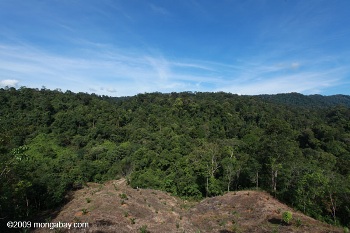 Deforestation for a new oil palm plantation at the edge of Gunung Leuser National Park on the island of Sumatra in Indonesia. Photo by: Rhett A. Butler.
While the protest is targeting Nestle, it may have ramification far behind the candy-giant. After this week any company sourcing palm oil from areas of the world—such as Malaysia and Indonesia—where deforestation is still rampant and species like orangutans are on the edge of extinction, may want to double-check (and triple-check) the reputation of their suppliers. Better yet, they may want to shell-out a bit more for sustainable palm oil, since it may actually save them money (and face) in the long run.
Already, a number of western companies have been dropping suppliers of palm oil that have links to illegal deforestation. Following a BBC documentary on palm oil, giant food and cosmetics-manufacturer Unilever dropped Duta Palma and PT Smart; prior to this Unilever dropped Sinar Mas (the supplier that got Nestle in hot water). Last year, the World Bank suspended lending to all oil palm plantation projects, after one of its recipients, the Wilmar Group, was found to be environmentally irresponsible. Cadbury New Zealand dumped palm oil altogether after consumer complaints.
While these actions show that some companies are sensitive to the palm oil-debate, this new protest is bringing the issue to a far wider audience, likely putting additional pressure on corporations still sourcing palm oil from environmentally-suspect sources, such as General Mills which was recently the target of a protest by the Rainforest Action Network (RAN). It may also spike demand for sustainable palm oil.
At first, sustainable palm oil, overseen by the Roundtable on Sustainable Palm Oil (RSPO) had difficulty finding a market since it is more expensive than unsustainable palm oil and companies (as well as consumers) didn't want to foot the bill. But by February of this year the market for sustainable palm and its production were nearly evenly matched.
The orangutan has become the symbol of the protest against unsustainable palm oil. The Sumatran orangutan, pictured here, is Critically Endangered, largely due to habitat loss. Photo by: Rhett A. Butler.
Now, though the outlook for sustainable palm oil from a business-angle may be far brighter. The continuing negative press may push more companies than ever to decide that it is very much in their interest to pay a little extra for sustainable sources rather than face the prospect of becoming another Nestle. Sustainable palm oil may suddenly see its demand far outshoot its production, at least in the near term.
Yet even sustainable palm oil, courtesy of the RSPO, has many detractors, especially as some RSPO members allegedly continue to clear high conservation value forests for monoculture plantations. For its part, RSPO says it continues to work on its certification process.
Social Media and Big Business
Another possible outcome of this protest: social media protests may have come of age. Even five years ago a protest of this scale on 'social media' sites—mostly on Facebook and Twitter, but also appearing on Care2 and Reddit—would not have been possible, but this protest proves that these sites can have a big impact. Where else can individuals instantly criticize multi-billion dollar corporations to their collective face, and then invite hundreds (maybe even thousands) of their acquaintances to take up the cause?
Figure 1: Extent of Deforestation in Borneo 1950-2005, Projection to 2020. The island of Borneo is split between Malaysia, Indonesia, and Brunei.
There is no question that social media sites have taken a big chunk out of mainstream media sources in providing news and conversation-topics to an increasingly plugged-in public. Places like Reddit and Digg are becoming the new front-page for many news-junkies who thrive on variety. Especially for younger generations, social media—not Fox News or CNN or the NY Times—is becoming theplace where one catches-up on news, spreads information, and sounds their opinions. In this case, however, the opinions aren't between friends, but between thousands of individuals and one big corporation.
While it's clear that Nestle has been taken aback by the scale and vehemence of the protest, it's just as clear that there are plenty of individuals out there who are simply fed-up with the actions of many multinational corporations, which they view as spoiling the environment for profit, stomping on human rights, exploiting the poor, and turning a deaf ear to any criticism.
In fact, while the protest has focused on Nestle's impact on rainforests in Indonesia, it has also tacked on a list of other abuses by the food-giant. Social-media users have unearthed a multitude of skeletons in Nestle's closest: aggressive marketing of baby formula to mothers in the developing world causing malnutrition and mortality; illegal extraction of groundwater in Brazil for Nestle company, Perrier; child labor abuses in Ghana for the production of chocolate; aggressive labor busting, including in Colombia where eight unionizing Nestle employees were assassinated, though there is no link to the company for the killings; and continuing to promote unhealthy foods around the world.
Indonesia has some of the world's most biodiverse rainforests, sporting well-known species like orangutans, tigers, elephants, komodo dragons, and rhinos. But most of Indonesia's species are tiny like this red grasshawk dragonfly. Photo by: Rhett A. Butler.
The online protest against Nestle didn't really take off until after the company pushed YouTube to remove a clever video from Greenpeace criticizing the company, citing copyright infringement. While the protest may owe much of its beginning to Nestle's own draconian measures, including callous comments from a moderator on its Facebook page, it will be doubly interesting to see what Greenpeace, and other activist organization, learn from the uproar. While Greenpeace, one of the savviest and most effective activist organizations out there, has long used social media to spread information about its campaigns, it is not always easy to get people physically involved in an issue. Social media, however, allows for little long-term commitment and a chance to reach companies directly. I bet that Greenpeace and others will increasingly view online media as the most important tool to reach long ambivalent and distant corporations.
But as one commentator said on Nestle's Facebook page today, this protest has gone beyond Greenpeace to become 'grassroots'. That begs the questions: could social media be the new face of effective grassroots activism in an increasingly interconnected and information-heavy world?
Maybe—if this protest works. Of course, much depends on the next few days. Will the campaign against Nestle continue across the social-media sphere, which is nothing if not fickle? Will the story have legs with news sources? Will consumers threatening to boycott follow-through? Will Nestle cave in or continue its statement that it will switch over to sustainable sources…in 2015?
But, for individual protestors the question is really something far deeper: does our voice matter? Collectively, on the Internet, can we make the world a better place?
Whatever happens next, there is no doubt that we are in uncharted territory.
Copyright mongabay 2010
Read more... Sphere: Related Content20 March 2010
The 5 characteristics of scientific denialism
Denialism is “the employment of rhetorical arguments to give the appearance of legitimate debate where there is none, an approach that has the ultimate goal of rejecting a proposition on which a scientific consensus exists”. They go on to identify 5 characteristics common to most forms of denialism
Climate Progress | March 19, 2010
One of the best climate websites is SkepticalScience.com run by physicist John Cook.
The goal of SkepticalScience is to “explain what peer reviewed science has to say about global warming” and answer the most common questions and objections raised both by the well-meaning doubters and the not-well-meaning disinformers.
Fortunately for us, Cook is blogging more now, which means I’ll be quoting him more (see “How we know global warming is happening — Skeptical Science explains: It’s the oceans!“). Cook has a good discussion of a recent paper, “Denialism: what is it and how should scientists respond?” that I excerpt below:
While the [paper's] focus is on public health issues, it nevertheless establishes some useful general principles on the phenomenon of scientific denialism. A vivid example is the President of South Africa, Thabo Mbeki, who argued against the scientific consensus that HIV caused AIDS. This led to policies preventing thousands of HIV positive mothers in South Africa from receiving anti-retrovirals. It’s estimated these policies led to the loss of more than 330,000 lives (Chigwedere 2008). Clearly the consequences of denying science can be dire, even fatal.
The authors define denialism as “the employment of rhetorical arguments to give the appearance of legitimate debate where there is none, an approach that has the ultimate goal of rejecting a proposition on which a scientific consensus exists”. They go on to identify 5 characteristics common to most forms of denialism:
- Conspiracy theories
When the overwhelming body of scientific opinion believes something is true, the denialist won’t admit scientists have independently studied the evidence to reach the same conclusion. Instead, they claim scientists are engaged in a complex and secretive conspiracy. The South African government of Thabo Mbeki was heavily influenced by conspiracy theorists claiming that HIV was not the cause of AIDS. When such fringe groups gain the ear of policy makers who cease to base their decisions on science-based evidence, the human impact can be disastrous. - Fake experts
These are individuals purporting to be experts but whose views are inconsistent with established knowledge. Fake experts have been used extensively by the tobacco industry who developed a strategy to recruit scientists who would counteract the growing evidence on the harmful effects of second-hand smoke. This tactic is often complemented by denigration of established experts, seeking to discredit their work. Tobacco denialists have frequently attacked Stanton Glantz, professor of medicine at the University of California, for his exposure of tobacco industry tactics, labelling his research ‘junk science’. - Cherry picking
This involves selectively drawing on isolated papers that challenge the consensus to the neglect of the broader body of research. An example is a paper describing intestinal abnormalities in 12 children with autism, which suggested a possible link with immunization. This has been used extensively by campaigners against immunization, even though 10 of the paper’s 13 authors subsequently retracted the suggestion of an association. - Impossible expectations of what research can deliver
The tobacco company Philip Morris tried to promote a new standard for the conduct of epidemiological studies. These stricter guidelines would have invalidated in one sweep a large body of research on the health effects of cigarettes. - Misrepresentation and logical fallacies
Logical fallacies include the use of straw men, where the opposing argument is misrepresented, making it easier to refute. For example, the US Environmental Protection Agency (EPA) determined in 1992 that environmental tobacco smoke was carcinogenic. This was attacked as nothing less than a ‘threat to the very core of democratic values and democratic public policy’.
Why is it important to define the tactics of denialism? Good faith discussion requires consideration of the full body of scientific evidence. This is difficult when confronted with rhetorical techniques which are designed to distort and distract. Identifying and publicly exposing these tactics are the first step in redirecting discussion back to a focus on the science.
This is not to say all global warming skeptic arguments employ denialist tactics. And it’s certainly not advocating attacking peoples’ motives. On the contrary, in most cases, focus on motives rather than methods is counterproductive. Here are some of the methods using denialist tactics in the climate debate:
- Conspiracy theories
Conspiracy theories have been growing in strength in recent months as personal attacks on climate scientists have intensified. In particular, there has been accusations of manipulation of temperature data with the result that “the surface temperature record is unreliable” has been the most popular argument over the last month. This is distracting people from the physical realities of global warming manifesting themselves all over the world. Arctic sea-ice loss is accelerating. Antarctic and Greenland ice sheets are losing ice mass at an accelerating rate. Spring is coming earlier each year. Animal breeding and migration are changing in response. Distribution of plants are shifting to higher elevations.Global sea level is rising. When one steps back to take in the full body of evidence, it overwhelmingly points to global warming. - Fake experts
A number of surveys and petitions have been published online, presenting lengthy numbers of scientists who reject man-made global warming. Close inspection of these lists show very few qualifications in climate science. On the contrary, a survey of climate scientists who actively publish climate research found that over 97% agree that human activity is significantly changing global temperature. - Cherry picking
This usually involves a focus on a single paper to the neglect of the rest of peer-review research. A recent example is the Lindzen-Choi paper that finds low climate sensitivity (around 0.5°C for doubled CO2). This neglects all the research using independent techniques studying different time periods that find our climate has high sensitivity (around 3°C for doubled CO2). This includes research using a similar approach to Lindzen-Choi but with more global coverage. - Impossible expectations
The uncertainties of climate models are often used as an excuse to reject any understanding that can come from climate models. Or worse, the uncertainty of climate models are used to reject all evidence of man-made global warming. This neglects the fact that there are multiple lines of empirical evidence that humans are causing global warming. - Logical fallacies
Strawmen arguments abound in the climate debate. Often have I heard skeptics argue “CO2 is not the only driver of climate” which every climate scientist in the world would wholeheartedly agree with. A consideration of all the evidence tells us there are a number of factors that drive climate but currently, CO2 is the dominant forcing and also the fastest rising. Logical fallacies such as “climate has changed before therefore current climate change must be natural” are the equivalent of arguing that lightning has started bushfires in the past, therefore no modern bushfire is ever started by arsonists.
© 2009 CAP Action
Read more... Sphere: Related Content
Subscribe to:
Posts (Atom)


 Posts