Showing posts with label sea-level-rise. Show all posts
Showing posts with label sea-level-rise. Show all posts
17 March 2012
Read more... Sphere: Related Content
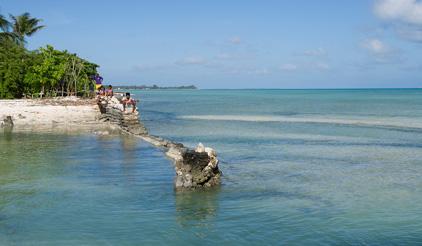 Children in the village of Tebikenikora, on Kiribati’s main Tarawa atoll (Photo: UN Photo/Eskinder Debebe)
Sea-Levels Rising: Millions in Coastal USA at Risk
Nearly four million Americans are at risk of severe flooding as climate change raises sea levels and intensifies storm surges during the coming century, new research indicates
Environmental News Wire | March 14, 2012
 A U.S. Air Force Reserve crew rescues a family in the coastal Texas town of Nederland trapped on their roof by flood waters from Hurricane Ike, September 13, 2008. (Photo by Tech. Sgt. Paul Flipse courtesy U.S. Air Force)
Read more...
Sphere: Related Content
07 March 2012
Entire nation of Kiribati to be relocated over rising sea level threat
The low-lying Pacific nation of Kiribati is negotiating to buy land in Fiji so it can relocate islanders under threat from rising sea levels
By Paul Chapman | The Telegraph | 07 Mar 2012
 The low-lying Pacific archipelago of Kiribati Photo: REUTERS
Read more...
Sphere: Related Content
30 December 2011
Climate change diplomacy and small island developing states
Science (climate scientists) and politics (diplomats and Foreign Ministry officials) may not always speak the same language, but climate change diplomacy (inter-governmental negotiations on climate change issues) inevitably brings them together into a “marriage of convenience”
by Obijiofor Aginam | OurWorld 2.0 | December 26, 2011
Read more... Sphere: Related Content
Photo: Mauroof Khaleel/Presidency Maldives.
09 December 2011
Pacific micro-state switches entirely to renewable energy
Tokelau challenged world leaders at the UN climate talks in Durban to follow its lead
John Vidal | guardian.co.uk | 8 December 2011
Read more... Sphere: Related Content
The head of government of Tokelau island, Foua Toloa, during a press conference at COP17 in Durban. Photograph: Jenny Bates for The Guardian
21 February 2010
The Sacred Island That's Shrinking Away
Varun Pyke has come to the edge of the Indian island where he has spent all 50 years of his life, to recount the story of the riches that he has now lost
By PHILIP REEVES | wbur.org | February 15, 2010
He gloomily jabs a finger out toward the water, pointing well beyond the gray waves lapping on the shores of the long, wide beach on which he is standing.
A mile or two out, there lies what used to be his farm, explains Pyke, a wiry man in a vest and wraparound "lunghi."
He says he had 5 acres, all now part of the seabed.
Rising water levels compelled Pyke to move inland; now he has only 2 acres to farm, barely enough to survive.
Pyke lives on Sagar Island, off the east coast of India. It is part of the Sundarbans, a giant low-lying archipelago that straddles India and Bangladesh, fanning out into the Bay of Bengal.
More than 4 million people live on the Indian side. The delta is wrapped in the world's largest block of mangrove forest and is the habitat of the endangered royal Bengal tiger, which also is threatened by the rising waters.
Standing next to Pyke is a neighbor from his village, a small, brightly clad, middle-aged woman called Durga Pal. She says the water has also swallowed up most of her family's land. Like Pyke, she is struggling to get by on a small patch of land, near the beach.
"Our grandparents and our parents all used to stay here," she said. "We had a lot of wealth and a lot of land before this. But now we are left with very little land and very little money to survive on."
She is surrounded by the rubble of a giant brick wall. Large broken lumps of brickwork are scattered along the beach in a straight line, as far as the eye can see.
This is the remains of a barrier built by the authorities. Villagers say a cyclone ripped down the wall five years ago.
Pal and Pyke believe that if the wall is not replaced, they will both soon lose all of their remaining land. Pyke does not sound optimistic. Saltwater has flooded his home several times recently.
"This year, all my land will be gone because the barrier is gone," Pyke said. He will likely be forced to turn to low-paid laboring.
The perimeter of the giant scattering of islands, mudflats and swampy jungle that make up the Sunderbans have been shifting around for centuries, partly because of silt and subsidence.
But scientists and locals say the rise in water levels began accelerating a few years ago.
"Since 2000, the trend is actually steeper, upwards, steeper," said Pranabes Sanyal of India's Coastal Zone Management Authority. "Day by day, the deterioration is going on. Day by day, more salinization is going on."
Sagar Island is less than 20 miles long. Sanyal estimates that in the past 40 years, its size has shrunk by nearly 10 square miles. Thousands of people have been displaced.
Oceanography professor Sugata Hazra agrees: "For the last 20 to 30 years, we are getting more cyclones and we are losing land to the sea. This is the reality."
Hazra is worried by a recent surge in skepticism about climate change, fueled by widely publicized mistakes made by the U.N.'s climate change panel, including the prediction that the Himalayan glaciers could be gone in 25 years.
Hazra concedes that climate change scientists make mistakes and should correct them.
But he adds: "If they lose the battle to this lobby who are trying to discredit the science of climate change, who are trying to defame the scientists, the world loses the battle."
Hazra says sea levels in the Sundarbans are rising at a rate well above the global average. Several small inhabited islands have been completely submerged in the past few decades.
He stresses that the causes are many and complex. But he has no doubt that human beings are playing a part.
"Look, it is definitely a factor. It is not that it is just a possibility. One of the most important factors is man-made climate change."
The islanders themselves are less specific. Sagar Island is a particularly sacred place for Hindus.
It stands in the giant estuary where the Ganges, Hinduism's holiest river, meets the sea. Once a year, hundreds of thousands of pilgrims gather there for religious festivals.
Amid the island's banana groves and palms, there are hundreds of temples and thousands of small shrines.
So the world should perhaps not be surprised at the answer given by Pyke and his neighbors on the beach, when asked why they think the sea is swallowing up their land.
They have not heard of man-made global warming.
"God is responsible," they all agreed.
© 2009 Trustees of Boston University
Read more... Sphere: Related Content07 February 2010
Netherlands Enters The Climate Fray
RedOrbit | 6 February 2010

A claim made by the UN climate change panel in 2007 that half of the country of the Netherlands was below sea level, is being contested by the country itself.
Dutch authorities estimate that only 26 percent of the country is below sea level and will be asking the Intergovernmental Panel on Climate Change to check its figures, environment ministry spokesman Trimo Vallaart told AFP.
The IPCC’s calculation that 55 percent of the Netherlands was below sea level came from adding the actual estimates that 26 percent of the area was below sea level and 29 percent of the area was threatened from river flooding, Vallaart said.
Vallaart told reporters that the IPCC “should have been clearer” in their findings. The Dutch office for environmental planning had the exact figures. The error has been brought up to the IPCC several times, but nothing has happened as of yet. He was disappointed that proper procedure could not be followed and added that it should not be left to politicians to review IPCC figures.
The Dutch environment ministry plans on reviewing the IPCC’s 938-page Fourth Assessment Report to see if it contains more errors, Vallaart said.
The report initiated politicians around the world to take action on the warning of global climate change on the horizon, but criticism has been met by many activists over their inaccurate claim that Himalayan glaciers would melt by 2035.
The glacier mistake, added to the new Netherlands error, could cause great embarrassment for the IPCC, especially if any more mistakes are found in the report.
© 2002-2009 redOrbit.com. All rights reserved
Read more... Sphere: Related Content04 February 2010
Sea level rise may sink island nations
Island countries could soon drown underneath rising tides, but their people and their governments may endure
By Larry O'Hanlon | Discovery News | Feb 3, 2010
Even after rising tides engulf their lands, residents of island nations could still maintain their identity and their government "in exile." Getty Images

Sea level rise from anthropogenic global warming could erase some island states from the face of the Earth -- but those nations could survive even without land, say researchers.
Governments and people of lost islands could survive "in exile," build structures to mark their submerged territory, retain their status in the eyes of other states and await the day when their islands emerge again when global cooling drops sea levels.
The trouble is current international agreements, including the United Nations Convention on the Law of the Sea, don't address the issue, said international law professor Rosemary Rayfuse of the University of New South Wales in Australia. Just what to do about the possibility of nations being lost, and how to do it, is very much on the frontiers of the legal thinking.
"From the international law perspective, it's fascinating," Rayfuse told Discovery News. "Ultimately, this is going to be a very serious problem."
According to the vast majority of scientific investigations, warming waters and the melting of polar and high-elevation ice worldwide will steadily raise sea levels. This will likely drive people off islands first by spoiling the fresh groundwater, which will kill most land plants and leave no potable water for humans and their livestock.
Low-lying island states like Kiribati, Tuvalu, the Marshall Islands and the Maldives are the most prominent nations threatened in this way.
"The biggest challenge is to preserve their nationality without a territory," said Lilian Yamamoto of Kanagawa University in Japan. "It is unlikely that they can still have a state without it."
Yamamoto is the lead author of a paper on the challenges facing island states in the latest issue of the journal Ocean & Coastal Management.
What seems likely, if no plans are laid to avoid it, is that people who are forced to leave their island states could become stateless. After settling in other countries, if permitted, the descendants of islanders might acquire the nationality of the countries where they were born, Yamamoto told Discovery News.
But if island states want to survive without their islands, they will need to explore new ways to do so, said Rayfuse. The first step is to establish and "grandfather-in" a legal baseline for their coastlines, in order to properly claim their Exclusive Economic Zone, in accordance with the UN Law of the Sea. After that, it gets a bit less clear.
One option that's been discussed is for other nations to provide territory upon which displaced islanders could settle. The problem with that, said Rayfuse, is that any land given would likely be of such poor quality that it would not be wanted.
Island states could also seek some kind of quasi-state status, like that of the European Union, which is not a state itself, but represents many states, Rayfuse explained.
"So these states should set up a trust fund to manage the resources (of their oceanic territories)," she said.
Another option is to get other nations to recognize the vanishing island states, despite their lost territories. However, there is a precedent for this.
The Sovereign Military Order of Saint John of Jerusalem, of Rhodes and of Malta is an ancient religious order which ruled over the islands of Rhodes (1310–1528) and then Malta (1530–1798), until Napoleon kicked them out.
However, they have retained their status under international law, and have their own government which issues its own passports to this day.
Copyright © 2010 Discovery Communications, LLC
Read more... Sphere: Related Content27 January 2010
Pacific Islanders & climate change: leading the fight, feeling the heat
A global temperature rise of 2° Celsius — the target set at the United Nations climate summit in Copenhagen in December — is a death sentence for Tuvalu
Jay Fletcher | Green Left Online | 24 January 2010
It means disaster for the 12 thousand people living there — plus those in other low-lying Pacific Island nations — who will be subject to relentless sea-level rises in coming decades.
Already, with the present 0.8°C rise since pre-industrial times, swelling tides flood the streets, ruin houses, destroy aquifers and crops, kill fish and wildlife, and the incidence of water-borne diseases is increasing.
“We have nowhere to run because our islands are tiny”, Tuvaluan Prime Minister Apisai Ielemia said at Copenhagen: “There is no mountain we can climb up, there is no other inland where we can run to.”
The people of Tuvalu know that hope is fading. Prior to Copenhagen, the Tuvaluan government commissioned its own scientific studies on the impacts of climate change. It found a peak of below 1.5°C is the only option for a chance at survival.
Tuvalu was among numerous nations calling for deep emissions cuts at Copenhagen.
Yet the failure of the so-called world leaders to see past greed, self-interest and the powerful fossil fuel lobby has left nations like Tuvalu, Fiji, the Solomon Islands, the Marshall Islands, the Maldives and the Carterets of Papua New Guinea with the prospect of total immersion.
But rising seas is not the only result of climatic change forcing people to flee their homelands in search of less hostile environments. A 1999 International Red Cross report said up to 25 million people had already fled from places blighted not by war, but by environmental destruction.
Drought and spreading deserts are devastating communities across the globe. Unprecedented floods, cyclones, tsunamis and other extreme weather disasters have killed hundreds of thousands and left many more people completely destitute.
For most, the horror story ends with evacuation, leaving their land forever.
But finding somewhere to go, to seek asylum and refuge in a safe country, is the side of the story most often ignored by wealthy First World nations.
Not only is the urgent need to recognise and accept climate refugees denied, restrictions on migration are getting tougher and attacks on refugee rights are intensifying across the world.
The Australian government is among the most criminal in this category. It has used the recent rise in boats, carrying asylum seekers from war-torn countries such as Afghanistan and Sri Lanka, to breed fear and distrust of refugees.
It locks them up on Christmas Island and has spent hundreds of millions of dollars on border patrol measures to stop anyone from even getting close.
Recent defence papers from Australia, as well as the United States, have included chapters outlining ways the military could be used if conflict breaks out because of “the security impacts of climate change and resource scarcity”.
Building a fortress and fuelling fears of “human tsunamis” is a racist and inhumane reaction to a growing crisis.
Even the most optimistic predictions for the planet mean a rise of climate refugees in the hundreds of millions. Based on science from the Intergovernmental Panel on Climate Change, the Environmental Justice Foundation said in November the number could reach 150 million by 2050, and that 500 to 600 million people could actually be at risk.
In a report released on December 8, the International Organisation for Migration (IOM) said 25 million to 1 billion people could be displaced by climate change by mid-century. It noted the lower prediction was based on out-of-date science. Twenty million people were displaced by environmental disasters in 2008 alone, it said.
The shocking numbers tell only half the story. The countries facing the worst effects of climate change include Bangladesh, Kenya, Somalia, Yemen, Ethiopia, Chad and Rwanda — poor nations already struggling with scarcity and famine, and with very little ability to mitigate climate change, adapt to it, or even relocate.
It is certainly beyond the means of many to make it to wealthier countries.
The IOM report said many future climate refugees will flee to other poor countries already suffering pressures from climate change and instability, such as Afghanistan, Bangladesh, Central America, and parts of west Africa and southeast Asia.
The numbers include a large proportion of people internally displaced, moving from drought-stricken rural areas into already crowded cities, for example, or seeking places to live less affected by worsening weather patterns.
But the breaking point for many of these countries is getting closer. The IOM research showed the number of people affected by environment disasters has more than doubled within 20 years.
The November 3 British Guardian said Bangladesh had suffered 70 climate-related disasters in the last 10 years.
Environmental disasters will kill more and bring greater destruction to lower-income and underdeveloped areas of the world. The estimated 200,000 death toll in Haiti is a stark example.
The UN Department of Economic and Home Affairs said 95% of all deaths from natural disasters occur in the Third World. The “flood disaster risk index”, it said, was “26 times higher for low income than for high income countries”.
As these disasters increase in frequency and intensity, the areas of land that become permanently uninhabitable will increase as well. The lower latitudes of the planet, inhabited by much of the global South, will be affected worst and first.
But it will soon become a global problem and the number of climate refugees will not stop multiplying.
It is no longer a “hidden cost” of climate change. Climate refugees have become very real and very desperate.
The efforts of the Pacific Island states are now being watched by the world. In 2008, the people of the low-lying Carteret Islands began a relocation project to Bougainville, at a cost of millions of dollars.
Tuvalu made a plea to the Australian government as early as 2000 to accept its people if their island became uninhabitable. But the then Liberal/National Coalition government refused to consider taking in refugees displaced by rising seas.
However, the current ALP government's actions at Copenhagen were arguably much worse. While taking part in the effort to ensure no targets, emissions cuts or binding agreements were made at all, it secretly bullied the poorer nations that argued for a 1.5°C cap.
After such a monstrous display, to accept climate refugees would be to acknowledge total and unmitigated failure to take serious action on climate change. True international action must include a massive transfer of funds to countries to allow them to adapt and cope with climate change.
But nations like Australia need to throw open their doors and pay for the mass relocation of people who now have no choice but to abandon their homes to survive.
At Copenhagen the countries with the most at stake pushed for the strongest action. It was rich and greedy countries like Australia that cruelly condemned them to devastation — while building walls at home to stop them seeking refuge.
All articles appearing in Green Left Weekly are copyright by their authors. However, most regular contributors have granted permission for their work to be republished by non-profit green, left, human rights or generally progressive publications.
Read more... Sphere: Related Content22 July 2009
Tuvalu plots world's first zero carbon output by 2020
The tiny South Pacific island nation of Tuvalu could become the first zero-carbon country after vowing to abandon fossil fuels and generate all of its energy from renewable sources by 2020.
By Bonnie Malkin in Sydney | The Telegraph | 20 Jul 2009
Tuvalu: Tuvalu could become the first country in the world to realise the zero-carbon dream.Photo: AFP

At threat from rising sea levels caused by global warming, the low-lying nation plans to swap imported "dirty fuel" for wind and solar power.
With no heavy industry, almost no natural resources and very low existing greenhouse gas emissions, Tuvalu could become the first country in the world to realise the zero-carbon dream.
Lying halfway between Australia and Hawaii in the middle of the Pacific, the government has been forced to act because the nation stands to lose so much from climate change.
Home to a population of 12,000 people, Tuvalu is the fourth-smallest country in the world, measuring just 10 square miles in size. Most of its population are either fishermen or farmers, relying on the land and sea for income and food.
However, the island chain is very low-lying, with most of the country less than three feet above sea level, and the nation's highest point standing at just 15 feet. Worsening flooding in recent years has reminded the administration that Tuvalu faces becoming uninhabitable if predictions of a large sea-level rise this century come true.
In response, a 40 kilowatt solar energy system has been installed on the roof of the country's largest football stadium. The panels now supply five per cent of the electricity needed by the capital, Funafuti and in their first 14 months reduced Tuvalu's consumption of generator fuel shipped from New Zealand by about 17,000 litres.
The project was set up by the e8, an international nonprofit organisation of 10 leading power utilities from G8 countries, and funded by two Japanese power firms.
The Tuvalu government is now working to expand the initial project, and wants to take solar power to the outer islands, starting later this year with the commission of a $800,000 (£480,000), 46 kilowatt solar power system for a secondary school. In all the project is expected to cost the state, which relies on foreign aid as its main source of income, an estimated $20 million.
"We thank those who are helping Tuvalu reduce its carbon footprint as it will strengthen our voice in those international negotiations," said Kausea Natano, the island's public utilities and industries minister. "And we look forward to the day when our nation offers an example to all powered entirely by natural resources such as the sun and the wind."
Tuvalu is among a cluster of countries, including the Maldives, that aim to reduce their emissions to zero over the next decade.
While its effort alone is not expected to make a significant difference in the fight to cut the volume of heat-trapping gases emitted across the globe, the United Nations and many environmentalists have said the move could inspire larger emitters like the United States and China to take bolder steps to limit their carbon footprints.
"In a sense, they are paving the way for medium and larger economies which have to move if we are going combat climate change," said Nick Nuttal, spokesman for the United Nations Environment Programme. "These smaller economies are out to prove you can do it, and do it faster than some people previously thought."
Tuvalu by numbers:
Population: 12,373
Size: 10 square miles
Relative size: 4th smallest country in the world
Population density: 1,142 people per square mile
Highest point: 15 feet above sea level
GDP: $14.94 million (£9 million)
Number of islands: 4
Number of atolls: 5
Capital: Funafuti
History: former British protectorate and now Commonwealth member
© Copyright of Telegraph Media Group Limited 2009
Read more... Sphere: Related Content22 May 2009
Pacific Island countries face urgent issues of climate change, migration
ANTARA News, 05/21/09 17:18
Wellington (ANTARA/Xinhua-OANA) - Over the coming years, the Pacific island countries face the likelihood of increasing numbers of people compelled to leave their homes and livelihoods as a consequence of environmental changes produced by global warming.
Professor Vijay Naidu, director of Development Studies and the head of the School of Governance and Development Studies at the University of the South Pacific (USP), said, "there is no question about continuing increase in global temperatures. Climate change is upon us."
Extreme weather events such as floods, droughts, cyclones and accompanying waves and tidal surges are already impacting communities globally. For Pacific island countries these natural hazards and rising sea level pose serious challenges that cannot be wished away, said Naidu in Suva, the capital of Fiji.
On May 14-15, The UNESCO/Asia Pacific Migration Research Network (APMRN) and the School of Governance and Development Studies at the University of the South Pacific, jointly hosted a two-day workshop on "Climate Change Related Migration in the Pacific" in Suva.
The workshop brought together over 30 leading Pacific experts in the fields of climate change and migration, representatives from key Pacific regional institutions and postgraduate students from the University of the South Pacific, University of Auckland, University of Waikato, University of Papua New Guniea, UNESCO/APMRN, The Pacific Island Forum Secretariat and the UNDP Pacific Center.
The Pacific island countries will need to increase their attention to climate change adaptation, because while atoll states are most vulnerable to the loss of fresh water lenses and inundation, those living in river deltas and high altitude regions of larger islands are also exposed to flooding and frost.
The workshop therefore provided an overview of environmentally forced migration in the Pacific region, including climate change and gender relations.
Participants examined the widespread socio-political, cultural and economic impacts of climate change for Pacific Island countries, with specific focus on tourism, agriculture, food security, fisheries, marine resources, and on fragile coastal zones.
This included case studies relating to sea level rise and relocation of Carteret Islanders in Papua New Guinea, and climate change and floods in urban Fiji.
Workshop participants are collaboratively developing a regional agenda for policy and research.
During the workshop, a selection of short films from Kiribati, Cook Islands, Fiji and Federated States of Micronesia were also shown. (*)
COPYRIGHT © 2009
Read more... Sphere: Related Content17 May 2009
Adapting the International Trade Regime to New Challenges: Climate Change
Tim Groser, the NZ Government official website, 12 MAY, 2009
First, I would like to pay tribute to the International Policy Council - I believe the IPC is the premier, policy-oriented think tank in the world on the relationship between agriculture and trade. I was honoured to be invited in 2005 to be a Member of the IPC, but of course had to resign when I became a Minister. It is a particular pleasure therefore to be invited back to present a paper as the NZ Minister of Trade and the Minister responsible for International Climate Change negotiations. However, all political careers, they say, end in failure. So please don't discount the possibility that at some future point, I may express an interest in rejoining the IPC. I just hope it won't be any time soon.
Completing the Doha Round remains the single most important issue on the international trade policy agenda. NZ is deeply committed to this. But the Doha Round, particularly with respect to agriculture, is essentially building on the Uruguay Round platform - that is what the BIA, or ‘Built in Agenda' was all about. Again with respect to agriculture, we were able to achieve in the Uruguay Round a radical re-instrumentation of agriculture policy instruments but only limited liberalisation. The Doha Round is intended to address that deficit. If we cannot achieve that, there will be no result.
But I am acutely conscious that this focus on the traditional agenda, appropriate though it is, should not obscure the vital need to refresh the mandate of the WTO to deal with tomorrow's problems. Here, the interface between the international trade agenda and the climate change agenda looms larger than any single issue.
Trade and Climate Change: A Ticking Time-Bomb?
I will try to focus here on the positive, but we need to recognise that the trade-climate change linkage, if played out badly, involves major risk. Addressing a previous IPC meeting in Bogor, Indonesia in May 2008 I took the view that it was potentially a ‘time bomb set under the WTO system'. Specifically, I had in mind unilaterally imposed border tax adjustments designed to stop what is called ‘carbon leakage'.
Behind this technical jargon, I think we all know what the intent of such proposals is. These proposals are intended to prevent the migration of your industries offshore if you impose a price on carbon in your country either through a carbon tax or an Emissions Trading System and important trading partners do not. Such charges are intended to equalise the cost. It is a ‘level playing field' argument on steroids.
We are in the middle of the greatest recession since the 1930s and all the people in this room will have learned how the infamous Smoot-Hawley Tariff Act of June 1930 led to an implosion of world trade and ultimately added to misery around the world. Presumably, neither Mr Hawley nor Mr Smoot, when they put in train the process of unilaterally raising US tariffs, thereby prompting retaliation and beggar-thy-neighbour policies, actually intended this.
Similarly, I suspect that those politicians in various countries who today believe there is a simple ‘fix' to carbon leakage through unilaterally imposed carbon tax adjustments do not actually intend to put a time bomb under the world trading system. But there is no doubt in my mind that that is the risk.
However, there is a better way through. In reality, the two negotiations - WTO and UNFCCC - have a lot of common ground. If we get it right, we will have outcomes in each that support the objectives of the other. Allow me therefore to step back and contrast the two negotiations.
WTO and Kyoto: The Case for Incremental Change
Let us take stock first of the Doha Round. This is a highly mature negotiation, based on a successful formula that has evolved over eight previous multilateral trade rounds since 1947. We know the system moves too slowly. We know it is about evolutionary, not revolutionary, change, and that can be very frustrating. But we also know it works and has contributed greatly to underwriting global trade and thus global prosperity.
Our problem with the Doha Round today is simply finding a political way to put in place the last, say, 20% of the deal that needs to be negotiated. I still believe we will get there. The cynics have always been wrong in the past - as the Uruguay Round ground painfully to a conclusion, the GATT was everywhere referred to as ‘the General Agreement to Talk and Talk' and contempt was poured on those still trying to make it work. I believe the cynics will eventually be proven wrong yet again.
By contrast, Kyoto is the first ever attempt to put in place a multilateral agreement involving collective action against anthropogenic, or man-made, global warming. It is easy to pick holes in the international community's first attempt - just as it is easy to pick massive holes in the early GATT Rounds. With only a little exaggeration, we can say that all the early multilateral trade rounds failed to deal with agriculture, clothing and textiles, services trade, omitted coverage of many non-tariff barriers and virtually ignored developing countries. In time, all these of these deficiencies were substantially addressed.
The biggest hole in the UNFCCC is obviously its limited participation in real emissions reductions. The 17 year-old Annex I/non-Annex I dichotomy is outdated, but the current climate architecture doesn't easily allow for changes. I cannot imagine a successor agreement to Kyoto for the second commitment period beyond 2012 that replicates the central feature of Kyoto - namely that only Annex 1 countries - and not even all of them - have an obligation to reduce their net emissions. If there is to be any successor agreement to Kyoto, that has to change.
This is partly a political necessity but it is more than that. Only half of all current emissions now come from Annex 1 countries. What's more, that proportion is falling rapidly with the growth in the emerging economies. The problem is global. And at least from NZ's perspective, we can define the goal: to stabilise global emissions at no more than 450 parts per million of CO2 equivalent. If we don't have broader participation, there is no possibility of reaching that goal - forget even more ambitious targets such as 350 parts per million.
Of course this is very difficult for developing countries - even if they did receive large amounts of financing for mitigation and adaptation. Faced with these obvious difficulties of finding a multilateral way through, I get the sense from reading academic literature and public debate that a lot of effort is going into planning and designing unilateral responses where climate change and trade intersect without even looking to see how the multilateral system can provide effective courses of action.
We have Pascal Lamy to thank for pointing out that we can't look to the WTO to establish a new climate change regime - that's the job of the UNFCCC and frankly, the challenge is too urgent. At the same time, there is a lot of talk about the impediments that current trade rules may put in the way of countries trying to take ambitious mitigation action. That would be a serious concern if it were true. To find out, we need to take a step back and focus on the fundamental principles of the GATT and the WTO.
First, let's take a look at the trade rules that can help countries shift to low-carbon economic development. Liberalising trade in environmental goods and services is a no-brainer: it's a win-win-win for traders, the environment and developing countries. Investment liberalisation is going to be essential for enabling technology transfer. Reducing environmentally harmful subsidies will have climate impacts through discouraging fossil fuel use and encouraging globally optimal efficient patterns of production. Sustainability standards could play a useful role in cutting through the confusion and doubt around the climate benefits of biofuels.
On the climate side we are looking at the WTO to see if its architecture can help us. Under the current Kyoto framework, there's no way to capture the wide range of mitigation action already undertaken by developing countries. New Zealand is one of several countries that have been working on the idea of creating a reporting format for climate change commitments. The point is to capture different national circumstances, inspired by GATT schedules. This is underpinned by the important UNFCCC principle of "common but differentiated responsibilities and respective capabilities" - a very similar concept to the WTO concept of ‘special and differentiated treatment', though rather more extreme in its current application. Not only would it improve transparency, but it would also facilitate the negotiation to be had around comparing actions by different countries.
Carbon Footprinting
Beyond trade architecture, you'll be aware that in Europe there's a groundswell of interest in climate change-related standards, driven by the retail sector, environmental groups - and local producers. Unfortunately, some of the standards have been based on bad science and flawed concepts such as food miles. There needs to be greater international understanding about climate change-related standards: the development of an ISO standardised methodology for carbon footprinting is a good way to start. It's the opportunity to show that we need a science-based standard that looks at the whole life cycle of a product and not just how it gets to the market.
New Zealand is leading a comprehensive carbon footprinting programme to help our producers measure, manage and reduce GHG emissions through a product's entire life cycle. This is going to have a much bigger impact on greenhouse gas emissions than any arbitrary standard in export markets which would risk shifting production to nearer but less efficient producers. Not to mention that such a shift would increase, not decrease, emissions as more carbon intensive agriculture production in third countries replaced less carbon intensive food production in NZ. And importantly, sophisticated carbon footprinting will help position New Zealand producers to meet the demands of our overseas customers for information on the climate change effects of production.
While I'm talking about carbon footprinting, I can't help but note that it's curious that we mainly hear about it in connection with food products. Agriculture makes up about 14% of global emissions, but manufacturing and industrial processes also add up to 14%.
You have to wonder sometimes, why there isn't as strong a push for carbon footprinting non-food goods - why focus on an already very trade-distorted sector? One is tempted to conclude it's got something to do with keeping protectionism up to date.
Agriculture Emissions and Food Security
More generally, there is no doubt in my mind that any global solution to anthropogenic induced climate change will have to involve far greater attention to agriculture. This is a far greater issue for NZ than for any other Annex I country - some 50% of our total GHG emissions come from agriculture. That is not, as I emphasised above, because NZ is underperforming in terms of emissions intensity of its agriculture sector. On the contrary, our carbon footprint per unit of output stands up very well to international scrutiny. The size of our agriculture emissions is a function of the size of our agriculture output. NZ is a food basket for the world - some 90% of the food we produce is exported.
But if the problem with agriculture is largely confined to my small country amongst Annex 1 countries, that is decidedly not the case once developing countries are brought into the equation.
Generally, GHG emissions from agriculture average around 27% for all developing countries - in the case of India agriculture accounts for 21% of India's emissions; for Brazil it is 58%; for Uruguay it is 85% of total emissions. Brazil and Uruguay are like NZ - highly efficient food exporters performing a vital role in world food markets.
I think this is very important. If you accept that there will not be a successor agreement to Kyoto without fuller participation from major developing countries - that is certainly my view - the international community must come to grips with this problem of agriculture. I have spent my professional life in the problems of world agriculture trade, culminating in chairing the WTO Doha Agriculture negotiations. Like others in this room with a similar background, I am acutely conscious that if developing countries feel international commitments will threaten, rather than enhance, their food security, that is the end of the matter. For developing countries, the exigencies of climate change negotiations will never trump food security. Get that political judgement wrong and you will get everything wrong.
What we know is this: food production needs to at least double in the next forty years while, on the other hand, global greenhouse gas emissions need to reduce by at least 50%. There isn't enough mitigation potential in other sectors for agriculture not to be part of the solution.
At the intersection of agriculture and climate change, trade has an important part to play. As agricultural patterns shift, trade will become increasingly important for food security. It has been shown as the climate causes shifts in agricultural production, the costs are lessened when food can flow freely across borders. One study looked at projections for agriculture up to 2060 and found that with trade liberalisation, global impacts due to climate change were reduced. What is more, a hundred million fewer people would be at risk of hunger. Land is a finite resource, so it needs to put to the most efficient use. We will need to achieve the best possible global production patterns for agriculture that will meet both food and climate needs.
I do see some early signs of a greater awareness amongst climate change negotiators of the importance of agriculture. My senior advisers certainly welcomed the increased attention given to agriculture as a sector at the last round of UNFCCC negotiations in Bonn. Two points stood out from the discussions: agriculture does have a role in contributing to global mitigation efforts, especially in developing countries, but its potential can't be unlocked without a large scaling-up of investment in research and development
But this is just a beginning. We need to fully take account of its roles in food production and in providing the livelihood for a very large proportion of the world's population. We will need to design our climate measures to create the right price signals for agriculture producers.
Agricultural Mitigation: The Case for Greater Research
Far greater research into the problems of agriculture emissions is an indispensable part of any sustainable political response to climate change. It is a simple fact of life that research dollars on climate change follow the priorities of the developed world. Absent New Zealand, agriculture emissions are simply not important enough amongst developed countries to attract the research dollar.
As a consequence, there is a huge mismatch around the world between the actual importance of agriculture emissions on a global basis and the effort being made to find technological solutions that would allow expansion of food production and reduction of agriculture emissions. Greenhouse gas emissions from agriculture are comparable to those from electricity and heat. Agriculture needs a technology revolution as profound as that for energy.
That is why New Zealand is establishing a virtual world research centre on agricultural greenhouse gas mitigation. The idea is to draw together international researchers and funding in a cohesive approach to finding collective solutions to this challenge. The New Zealand Government is in the process of putting substance behind that proposal. My task is to try to attract political attention and expressions of interest around the world in working with us.
Climate Change and Trade Rules: The Need for Coherence
Trade rules have the potential to support climate change and agriculture objectives. But some work I've seen recently takes a rather legalistic approach to the interface between trade rules and climate change policies, and I'm concerned that it could have a chilling effect on governments' choices of climate change instruments.
There's a range of issues emerging from countries' responses to climate change, and as yet, no international regime to address those issues - apart from high level guidance by the Kyoto Protocol. Adding to that, their interaction with trade rules is unclear. On emissions trading, for example: are carbon credits a good, a service or something else? What happens if international trade in carbon credits is established outside the Kyoto rules? Is that subject to any rules anywhere? Is free allocation of AAUs a subsidy, and if so is it actionable? Or prohibited? Are all incentives for climate-friendly behaviour subsidies?
These are important questions because they go to the heart of both economic efficiency and environmental effectiveness. New Zealand asks itself, how can an efficient agriculture producing country that prices carbon into that sector remain competitive against a less efficient producer that doesn't? It's a particularly acute issue for New Zealand. We can see that a shift in production away from New Zealand would not only cause economic damage but would be a net addition to global warming - the carbon leakage part of the argument.
I don't pretend to have complete answers, but my point is that we don't have time to wait for perfect responses. Scientists tell us the climate challenge is increasingly urgent and economists tell us that - notwithstanding the current recession - early action is much cheaper than delay. So we seem to have two options: we can avoid measures that are potentially subject to challenge and wait for dispute resolution over first movers; or we can take measures that may lack legal certainty, by making sure to design them according to GATT/WTO principles.
There is a legal dimension to this: some climate change policies might be potentially open to challenge in the WTO. But there is also a political dimension: even if a climate change response is theoretically up for challenge, what is the real risk of a case being taken? How might countries frame a trade-off between national and global good? Is climate change mitigation a higher global goal that might, in a political sense, trump concerns about trade rules?
The Case for a Peace Clause
In any case, risking a trade war over a climate agreement would be absurd. So
I've been very interested to read about ideas for a ‘peace clause'. This might for a time, create a space for climate measures to be implemented in a manner broadly consistent with core WTO principles even if technically there might be room for doubt about WTO consistency. This could be very useful for early movers, while a comprehensive climate change regime was being established. The idea is that a category of measures would temporarily not be subjected to challenge in WTO dispute settlement by governments agreeing to show restraint. This could be combined with agreement to notify such measures to the WTO. These are early thoughts on the issue. Making something workable out of them is a question of confidence and political will.
There are other approaches. One proposal is to negotiate a new WTO trade and climate code. The substance of the proposal is excellent. But let's be realistic: seven years of the Doha Round hasn't even managed to produce agreement in the not-so-complicated environmental goods and services negotiation. The first Kyoto commitment period is already 18 months old and measures are being implemented as I speak. A completely new WTO agreement would just take too long.
The more practical route would be to look at what can be achieved soon, through political declaration language in the Doha outcome and through something similar in the climate change outcome. A peace clause wouldn't be for all time. It would be overtaken eventually by dispute settlement outcomes, and by the enlargement of the pool of countries which take on emission reduction commitments. The increasing comprehensiveness of the global climate regime in subsequent commitment periods will reduce the pressure for governments to feel they need to consider unilateral action to protect their firms' competitiveness. But at this stage it could be a political signal to give governments more confidence that they will be able to meet legitimate concerns from exposed industries about competitive disadvantage. Then, once the new climate change agreement was fully in place, any outstanding trade rules issues could be discussed jointly with the WTO
I do not want to convey the impression that such an approach in the WTO would be straightforward to negotiate. On the contrary, there is a culture that has developed in Geneva whereby sensible, pragmatic problem solving has been overtaken by often myopic concerns about ‘balance'. So expect heavy sledging. Nevertheless, I believe there is an over-arching strategic need to move in this direction and I cannot see a better alternative. Frankly, the alternative is unilateralism or failure on both trade and climate change fronts.
I am also conscious that if we cannot move forward with model agreements at the multilateral level, governments negotiating bilateral and regional free trade agreements could consider leading the way by including a peace clause in those agreements.
Conclusion
So to return to the beginning, what do countries need to do to adapt the international trade regime to the climate challenge? At the multilateral level the answer is obvious: conclude the Doha Round including the trade and environment package. Liberalisation will promote trade in the goods and services needed for low-carbon development pathways. Freed from subsidies, agriculture will move towards globally rational and efficient production patterns. Freer movement of goods will enhance food security. Without subsidies, demand for fossil fuel alternatives and complimentary technologies will increase. The development benefits that will flow from the Round will strengthen developing countries' ability to adapt to climate change and take on mitigation commitments. And the economic benefits to developed countries will enhance our ability to mitigate our emissions and to help those who cannot adapt to climate change on their own.
Two years ago Pascal Lamy argued just that - concluding the Doha round, he said, was the best thing the WTO can to for climate change. But now as we approach Copenhagen seemingly at a faster pace than Doha, we have to change the terms - the best thing we can to for the Doha Round is to conclude a climate agreement this year - or at least a solid framework agreement on which negotiations after Copenhagen could build. The best thing we can do for both the world economy and the climate is to conclude them both, soon.
Copyright
Read more... Sphere: Related Content13 May 2009
Island nations are being overlooked
Island states under threat from even small rises in sea levels want the world's major emitters to make deeper cuts in greenhouse gas emissions.
Michael von Bülow, COP15 Copenhagen, 12/05/2009 20:40
Island nations that could be wiped off the map by rises in sea levels, forcing millions of people to abandon their homes, are being overlooked in international climate talks.
This was the message Tuesday at the five-day World Ocean Conference (WOC) in Manado, Indonesia.
"Dealing with environmental refugees will have a much more serious impact on the global economy and global security in fact than what wars have ever done to this planet," said Rolph Payet, a presidential adviser from the African island nation of the Seychelles.
Payet added that there had been "zero" serious discussions in top international forums on how to deal with massive flows of "climate refugees" from low-lying and drought-prone areas.
Up to 150 million people could be displaced by the effects of climate change by 2050, the Intergovernmental Panel on Climate Change (IPCC) predicts. These include sea level rises of as much as 59 centimeters (23 inches).
Representatives at the WOC said the targets for emissions cuts that are currently being discussed among the world’s major emitters are too low to prevent disastrous rises in sea levels. The Alliance of Small Island States is pushing for 85 percent cuts in greenhouse gas emissions by 2050.
The European Union has committed to reducing its emissions by 80 percent by mid-century. US President Barack Obama has proposed an 83 percent cut.
COPYRIGHT 2008-2009
Read more... Sphere: Related Content12 May 2009
Paradise lost: Islanders prepare for the flood
by Gaia Vince, New Scientist, Magazine issue 2707, 11 May 2009
The Maldives may look idyllic, but in reality they are on the frontline of climate change (Image: Alexis Rosenfeld / SPL)

TWO years ago, the Maldives became the first nation in the world to open an embassy on a virtual island in Second Life. What started as a gimmick could become a tragic reality in coming decades, as sea level rise reduces the entire country to a virtual state. Global greenhouse gas emissions have already committed the residents of the Maldives to a watery future: ocean expansion due to warming has raised sea levels enough to regularly deluge the islands, and melting glaciers will only make matters worse.
The Maldives are not about to give up without a fight, however. As leading climate models predict that sea level rise will make the islands uninhabitable by 2070, 2050 or even as early as 2030, the country is striking back with an ambitious programme of island restoration. But will it be enough to keep the ocean at bay? I visited the archipelago earlier this year to find out.
The islands that make up the Maldives have always led a precarious existence. According to Charles Darwin's theory of island formation, published in 1842, the islands started out as a string of volcanoes, fringed by coral reefs. As the volcanoes subsided and sea levels rose at the end of the last ice age, they were gradually submerged, leaving only the reefs behind. These began growing upwards to remain in warm, sunlit water, eventually forming circular reefs, or atolls, encircling shallow lagoons. Over time, coral debris and sand accumulated on and around the reefs to form low-lying islands. Today, 26 such atolls house the 1196 islands of the Maldives. Of these, 200 are permanently inhabited.
Many of these islands are mere sandbars that come and go with the changing currents. In fact, local people call their country "Woden adhi Girun", which roughly translates as "the nation of appearances and disappearances".
In the past 15 years, though, coastal erosion and rising sea level have meant that more and more of the islands are disappearing permanently. Rising waters, combined with coral growing more slowly or dying as warmer temperatures lead to bleaching, has left the reefs less able to shelter the islands. As a result, waves and storms are rapidly eroding away the coastline of the islands.
These changes are already having devastating effects on the population. Roads and houses are crumbling into the sea, coconut palms are being washed away, and groundwater has become so polluted with seawater that on many islands it is undrinkable. The resort islands, which bring in a third of the nation's income, have also been affected. "Some resort bungalows have been abandoned because they kept getting flooded. And the beach where we used to sunbathe has completely gone," says Sue Gregory from Bath in the UK, who has holidayed in the Maldives since 1999.
So far 20 islands have been abandoned, some of them after the 2004 tsunami gave residents a shocking taste of what higher waters mean for the islands. On one of the worst-hit islands, Kandholhudhoo, the highest tsunami wave was just 2.5 metres, but when it receded minutes later, three people were dead, not a single house was habitable, and residents had to leave the island for good. With rising sea levels and more frequent storms forecast, it may not take a tsunami to inflict similar damage in future.
Ironically, earlier attempts to solve some of the Maldives' problems may only have made them worse. In the 1990s, the then-president, Maumoon Gayoom, set about building artificial sea walls outside the reefs on some islands as a barricade against the rising tide and storms. But while the sea walls have been effective against storms in many places, including protecting the capital Malé from the tsunami, they have also reduced currents flowing over the reefs. Without a flow rate of around 10 metres per second the corals die, removing the islands' natural barrier to coastal erosion. The construction of a dozen or so new harbours during Gayoom's presidency have had similar effects, as did the dredging of the lagoons to build them.
The current president, Mohamed Nasheed, who was elected in November 2008, has other plans. He is focusing on bolstering the islands' natural defences by restoring coral reefs and coastal vegetation. The question is, is it too little too late?
There are some indications that coral can be saved - at least from the effects of warming. In experiments, Robert Tomasetti, a marine biologist employed by the Banyan Tree Resort on Vabbinfaru Island, has found that heat-tolerant corals grafted onto concrete frames or a low-voltage electrical carapace that stimulates growth are better able to endure temporary warming, and can survive when other corals bleach. Done on a larger scale, this could keep enough of the reef alive to delay erosion and buy the islanders some more time.
So far, though, progress has been frustratingly slow. "I would like to be able to find out whether we can transplant heat-tolerant ones to parts of the reef where it is more exposed and so build coverage there," says Tomasetti. "We don't have that level of equipment, so at the moment we're really just growing pretty reefs for the tourists."
Resources aren't the only issue. According to Bruce Hatcher, a marine ecologist at Cape Breton University in Sydney, Nova Scotia, Canada, who has studied the Maldivian reefs, large-scale coral rehabilitation is not feasible. "There is no current technology that allows thousands of kilometres of reef to be regrown, so in terms of mitigating sea-level rise in the Maldives, it is of very limited value," he says.
Restoring coastal vegetation, however, could make more of an impact. Part of the reason that Kandholhudhoo suffered so badly during the tsunami was that the reef had been dredged for building materials, and mangrove swamps had been plundered for timber, exposing the coast to the elements. With no tree roots to bind the topsoil it washed away. Properly managed mangrove plantations could restore this barrier, and since some species can mature in five to 10 years, it could have relatively immediate benefits.
With time running out, though, some feel restoration will not be enough to save the Maldives. Local NGO Bluepeace believes that the nation needs to think bigger. Much bigger. It argues that what is really needed is a series of raised artificial islands, dotted around the archipelago. Bluepeace suggests that seven islands, perhaps paid for by the international community by way of compensation for causing the climate to change, could allow the entire Maldivian population to stay ahead of the rising waters.
Some argue for a series of raised artificial islands, to rehome the entire Maldivian population
The idea is not entirely far-fetched. One artificial island, called Hulhumalé, has already been built to the north-west of the capital, and was officially opened in 2004. While it was designed mainly as a commercial port and to reduce pressure on the overcrowded capital, it was built 3 metres above sea level, enough to ensure it lasts the century, at least by conservative estimates.
Nasheed's government has no plans to build more islands like Hulhumalé, though, arguing that raised islands "cost a fortune to build" and that Hulhumalé has actually increased erosion in adjacent islands by disrupting natural currents. Nevertheless, it does admit that sooner or later the waters will get too high, too often, for the population to stay (see "How long have they got?"). To this end, Nasheed has pledged to divert much of the annual tourist revenue into a "sovereign fund", to enable the country to buy land elsewhere in the world when the time comes. It is an idea that some say is impractical, but one that he believes will be necessary if they are to avoid becoming climate refugees.
Whatever the ultimate solution, the fate of the Maldives lies in the hands of the rest of the world. The emissions we pump out and where we choose to spend our hard-earned cash could make or break the fate of the lowest, and perhaps most beautiful, nation on Earth.
Higher ground
As well as restoring the islands' natural defences, the Maldivian government is relocating vulnerable populations to houses built further inland on previously uninhabited islands. The first such "designer island", Dhuvaafaru Island in Raa Atoll, was unveiled in March this year. Formerly an uninhabited forest, the entire island was razed, and a new village built from scratch for 4000 survivors from Kandholhudhoo, an island left uninhabitable by the 2004 tsunami.
Along with new, spacious homes, the island also features a community centre built on stilts that is large enough to shelter its entire population during high tides, storms or future tsunamis (see photo, left).
The Maldives' current president, Mohamed Nasheed, has plans to build more of these kinds of communities. "We need to bring some of the more isolated villages into the 21st century so that they are better able to deal with the challenges ahead," he says.
How long have they got?
The Maldives is the lowest lying country in the world: 80 per cent of the islands are less than 1 metre above sea level, and the highest point is just 2.3 metres.
Clearly, even a small rise in sea level is bad news for such low-lying land. But predicting when the islands will become uninhabitable is far from simple.
Sea level has risen 52 millimetres on average in the past 15 years. Much of this can be put down to thermal expansion of the water, in which the molecules become agitated and move further apart as temperature rises. We know this is happening because sea level rise has so far been directly proportional to global warming. Some scientists, however, are concerned that melting ice may now have overtaken thermal expansion as the leading cause of sea-level rise. "How these factors will influence regional sea rise over the century is the great unknown," says Steve Nerem at the University of Colorado in Boulder, who monitors sea-level rise.
While we wait for data, we are left with an array of models that vary widely in when they estimate sea level rise will swamp the Maldives. In its latest assessment, the Intergovernmental Panel on Climate Change predicted a rise of up to 59 centimetres by the end of 2100 - a figure that does not include glacial melting. At the other end of the scale, James Hansen's group at NASA Goddard predicts a global sea-level rise of up to 25 metres by 2100, assuming that feedback mechanisms will accelerate melting in Greenland and Antarctica. More conservative models without feedback scenarios, such as that by Stefan Rahmstorf at the Potsdam Institute in Germany, put it at 1.4 metres by 2100.
None of these estimates are comforting for the Maldives. "Even a 1-metre rise would be devastating," says Nerem.
Gaia Vince is a science writer who is travelling the world to investigate the effects of climate change www.wanderinggaia.com
© Copyright Reed Business Information Ltd
Read more... Sphere: Related Content15 March 2009
Maldives aims to become first carbon-neutral country
By Jerome Taylor and Andrew Buncombe, The Independent, Saturday, 14 March 2009
The Maldives – the island nation threatened by rising sea level as a result of global warming – is attempting to become the world's first carbon-neutral country.
The Independent has learnt that tomorrow President Mohammed Nasheed will reveal details of a plan to achieve full carbon neutrality within 10 years. In doing so, his country of islands in the Indian Ocean, will join a small group of nations racing to be first in what environmentalists have described as "the Carbon World Cup".
Five other countries – Costa Rica, Iceland, Norway, New Zealand and Monaco – have signed up to a UN-backed plan to become zero net emitters but none intend to achieve carbon neutrality as quickly as the Maldives, a nation of island atolls which is highly vulnerable to rising sea levels.
Earlier this week, Ahmed Shafeeq Ibrahim Moosa was appointed the country's new envoy for science and technology and is investigating ways to make the country carbon neutral. Mr Moosa, a former political activist and journalist, was appointed with a new Agricultural Minister, one of whose tasks is to reduce food imports.
Mr Moosa said: "Ten years – that's the target. We're going to be looking at solar, wind and waves and working out the best system for us. There will have to be a lot of education. People need to know everyone can do their bit. The Maldives is a small country with only 300,000 people. It will be achievable."
Local environmentalists welcomed the plan. Ali Rilwan, founder of Bluepeace, noted individual resorts were aiming at carbon neutrality, using solar panels to generate electricity and sea water for air-conditioning. "This is the sort of thing international donors are very interested in," he said.
The country's first democratically elected president, Mr Nasheed has made the environment a priority. Confronted by rising sea levels that threaten to swamp many of the 1,200 atolls that make up the Maldives, he announced plans for a fund to buy an alternative homeland, perhaps in India or Sri Lanka. The country has spent £30m on a three-metre-high flood defence wall around the capital, Male, but 80 per cent of the islands are just one metre above sea level or less.
©independent.co.uk
Read more... Sphere: Related Content11 March 2009
Legal issues: sovereign extinction, climate refugees
By Jason Brown, Island Business International
Possibilities for sovereign extinction across Pacific Islands are not being ruled out by climate change officials at the Secretariat of the Pacific Regional Environment Programme (SPREP).
"SPREP has raised the issue in several different fora and the sorts of legal and other issues that would arise which would need to be tackled," says lead Climate Change adviser Espen Ronneburg.
"Our point has been that this is something that should be avoided by taking stronger measures to reduce the impacts of climate change."
As timeframes around man-made global warming implode, there are concerns the regional agency is not keeping up with rapidly accelerating events. Ronneburg admits SPREP can do more.
"On the unexpected issues arising from new research, SPREP is advising members," he told ISLANDS BUSINESs.
"We are working on a climate change portal to give greater speed to info sharing."
Severe weather events like cyclones will render many islands uninhabitable decades before atolls finally disappear under water.
Severe cyclones-category 4 and 5-doubled worldwide between 1970 and 2004, to an annual average of 18, not counting the five cyclones that hit the Cook Islands in 2005, among others.
Deeper concerns exist.
It's not just the frequency but its intensity. Australian meteorologists are on record as calling for a sixth category to be added to cyclone forces.
From sovereign extinction comes another issue-climate refugees.
"The issue of climate change refugees is a contentious one," says Ronneburg.
"No such status is internationally recognised. There are also conflicting views amongst the Pacific Islands countries on what stance to take."
Like almost any regional organisation, Ronneburg says: "We have to take our lead from the members."
But he defends the seemingly low priority given to climate change.
In 2006, SPREP dedicated US1.1 million-just 14% of its total budget-to climate change, most to local "adaptation" strategies than global strategies. For 2008, that percentage more than doubled to 35% with US$2.2 million out of a total budget of US$6.6 million.
However, only a tiny slice of that goes to global action. In fact, a proposal aimed at raising awareness of climate change urgencies at a regional, political level is still listed as "no project" some five years after appearing on the site, and nearly three years after ISLANDS BUSINESS first started asking about it.
Ronneburg defends SPREP against accusations that the regional body remains captured by post-colonial influences, namely free market interests in Australia and New Zealand.
"In terms of pressure from Australia, I would say no. There may have been some issues historically, but with the ratification of the Kyoto Protocol, there were a lot of changes," he says, referring to a change in policy after the Howard years gave way to the current Rudd Government.
Part of the problem was how islands states viewed Australia, Ronneburg citing "a number of reasons."
"One was the Pacific Islands countries' perception of the direction of the Australia-World Bank partnership. Another was the wish of national coordinators to hold all of their financial allocations and not go the regional route-which thus made it more complex to resource for Australia. We do have a major policy framework namely the PIFACC and its Action Plan."
Recent enough not to be in the 2004-2009 action plan, PIFACC (the 2005-2016 Pacific Islands Framework for Action on Climate Change) marks a step towards raising awareness at higher levels.
In September last year, SPREP outlined "using our role" as the secretariat of the Pacific Parliamentary Assembly on Population and Development and the Forum Presiding Officers (Speakers of parliaments) and Clerks Conference to "alert the political arena across the region about climate change and cross-cutting adaptations required. This year the theme for both conferences is Climate Change".
SPREP promises to "further mobilise political decision-making on climate change among our members at the national level through conferences with ministers and 'heads of department' meetings. Collectively, ministers we serve cover more than half the full cabinet portfolios in all member countries and territories. This provides the partnership responsible for implementing PIFACC with a powerful opportunity to raise awareness of the risks of climate change and to galvanise high-level political support for adaptive action".
SPREP critics privately concede that worst case scenarios have only worsened dramatically in the last two to three years. They worry political concerns continue to weigh more heavily than emerging emergencies.
Ronneburg says the 2007 budget figures quoted above do not include a new five-year agreement signed with GEF (Global Environment Fund).
"On budget, we [now] have US$13 million for climate change mitigation, such as renewables and US$30 million for adaptation. We are discussing with many donors how we can implement adaptation, etc., in the region."
Ronneburg points out that only 25% of the new GEF funding will come through SPREP and the other 75% going to member countries.
Copyright © 2007 Islands Business International
Read more... Sphere: Related Content01 February 2009
Living in despair
By Robert Matau, Fiji Times Online, February 01, 2009
A family of Mavua fishing on the Sigatoka river bank after flood waters receded. Below, left, Brothers Aminio Waqairatu, 6, and Epeli Nawasekadavu, 4, helping out at home with the preparation of lunch. Flood waters washed away their farmlands in the backg

EVERY time it floods in the Sigatoka Valley there is a price to pay for farmers and dwellers there.
Almost an acre of their farms is swept away and gravel and sand is left behind to thwart any attempts to rescue their livelihood for a good six months.
The floods may have left three weeks ago but for the farmers in Nabitu and Vunaqoru in the upper reaches of the Kavanagasau Road, they have to bite the bullet and wait for the cyclone season to end before the recovery process begins.
In Nabitu Jaswant Singh, Ram Raj and Jitend Prasad said they had lost almost 30 acres of land to the floods three weeks ago.
"What the floods left behind was fine sand and gravel," Raj said.
"You can build a house with that," he said pointing to the barren land which he used to plant eggplant and tomatoes.
"We do not have anything to buy food, school equipment and pay fees for our children." But the face of despair belonged to villagers at Vunaqoru - even without anything to eat they managed to present a sevusevu to the Fiji Times team, welcoming us to their village.
Alipate Dakevu said they were now looking for remaining breadfruit trees for sustenance.
But for them it has also meant a spiritual dimension.
"We have learnt in our scriptures to share and on Sunday we have decided that anything we get we should share as this is true Christianity," he said.
"But food is running out and for the past three weeks we have yet to get any disaster relief supplies from Government.
"We cannot send our children to school because we do not have the money to do so.
"We ask Government to please hear our plea and assist us in anyway it can."
At the same time it would be right to acknowledge the efforts of Non Government Organisations and all organisations, including Government to assist those affected.
They just need to be bolder to get to the hard to reach places.
Thanks should also go to the President of the United States Barack Obama for signing a new environmental measure aimed at combating greenhouse gas emissions and ending US dependency on foreign energy.
On Monday he ordered the US Environmental Protection Agency (EPA) to reconsider California's request to set its own stricter limits on vehicle carbon dioxide emissions in a bid to combat global warming.
Declaring that the US "will not be held hostage to dwindling resources", Obama also directed the department of transportation to move forward with setting vehicle fuel efficiency standards for 2011 by March this year.
"The federal government must work with, not against, states to reduce greenhouse gas emissions," Obama said at the White House.
"The days of Washington dragging its heels are over. My administration will not deny facts. We will be guided by them."
Meanwhile, the US state department is expected to name Todd Stern, a senior White House official under Bill Clinton, the former US president, as its new envoy on climate change, officials told Reuters news agency on Monday.
This will be a major turnaround to the Bush Administration's eight years of not acting on calls to reduce emissions and failing to act on the California request.
Today for the farmers in the valley it may be late, but better late than not at all.
Vinaka Mr Obama.
Copyright © 2004 - 2007, Fiji Times Limited. All Rights Reserved.
Read more... Sphere: Related Content17 January 2009
Fiji Urges Aid As Flood Toll Rises
Daily Planet Media, 2009-01-16
Fiji has urged Australia and New Zealand to make more emergency funds available to offset some of the damage caused by massive flooding that has been partly attributed to climate change.
Some of the worst flooding on record has caused $100 million destruction to the Fijiholiday tropical islands.
So far 11 people have died by the flooding and up to 10, 000 people have been forced into leaving their homes and taking up emergency accommodation.
Fiji's Attorney-general Aiyaz Sayed-Khaiyum has criticized Australia for providing just $150, 000 in flood aid and New Zealand for its $85, 000 aid grant.
Both Australia and New Zealand have been in confrontation with Fiji over its refusal to allow democratic elections.
Fiji declared a state of emergency and curfews after floodwaters swept through the west coast of Fiji's main island of Viti Levu.
Weather officials has warned the South Pacific nation of a continuing low depression that would bring more heavy rain and strong winds which could overflow the major rivers, Director of Meteorology Rajendra Prasad reported to Daily Planet Media.
© Copyright 2007 by Daily Planet Media
Read more... Sphere: Related Content07 January 2009
Australian military warns of climate conflict: report
AFP in SpaceDaily.Com, Jan 7, 2009
Australia's military has warned that global warming could create failed states across the Pacific as sea levels rise and heighten the risk of conflict over resources, a report said Wednesday.
The Australian Defence Force (ADF) analysis found the military could be called on to undertake more security, disaster relief and reconstruction missions as a result of climate change, the Sydney Morning Herald said.
"Environmental stress, caused by both climate change and a range of other factors, will act as a threat multiplier in fragile states around the world, increasing the chances of state failure," the analysis said.
"This is likely to increase demands for the ADF to be deployed on additional stabilisation, post-conflict reconstruction and disaster relief operations in the future."
The analysis, a summary of which was obtained by the paper using freedom of information laws, also noted the possibility of a serious conflict over the undersea oil and gas deposits of the Arctic as shrinking icecaps make these more accessible.
"Climate change is unlikely to increase the risk of major conflict, although there is one exception," it said.
"The Arctic is melting, potentially making the extraction of undersea energy deposits commercially viable. Conflict is a remote possibility if these disputes are not resolved peacefully."
The analysis, completed in November 2007, found that Australia could face increased illegal migration and fishing as Pacific islands succumbed to rising sea levels and climate change impacted on fishing grounds.
"From a defence planning perspective, we don't know how quickly these changes will occur, exactly what their impact will be, or how states and societies will react," it said.
"Nevertheless, climate change may affect security by increasing stress on fragile states, state and societal competition for resources, environmental threats to ADF infrastructure and increasing the frequency and severity of extreme weather events."
The military released a summary of the analysis but refused to hand over the full 12-page report, saying to do so could damage Australia's defence capability and international relations, the Herald said.
The Australian Defence Force had no immediate comment on the report.
All rights reserved. © 2005 Agence France-Presse.
Read more... Sphere: Related Content31 December 2008
2009 to be one of warmest years on record: researchers
By Christina Fincher, Reuters, Dec 30, 2008 1:37pm EST
1 of 1Full Size
LONDON (Reuters) - Next year is set to be one of the top-five warmest on record, British climate scientists said on Tuesday.
The average global temperature for 2009 is expected to be more than 0.4 degrees celsius above the long-term average, despite the continued cooling of huge areas of the Pacific Ocean, a phenomenon known as La Nina.
That would make it the warmest year since 2005, according to researchers at the Met Office, who say there is also a growing probability of record temperatures after next year.
Currently the warmest year on record is 1998, which saw average temperatures of 14.52 degrees celsius - well above the 1961-1990 long-term average of 14 degrees celsius.
Warm weather that year was strongly influenced by El Nino, an abnormal warming of surface ocean waters in the eastern tropical Pacific.
Theories abound as to what triggers the mechanisms that cause an El Nino or La Nina event but scientists agree that they are playing an increasingly important role in global weather patterns.
The strength of the prevailing trade winds that blow from east to west across the equatorial Pacific is thought to be an important factor.
"Further warming to record levels is likely once a moderate El Nino develops," said Professor Chris Folland at the Met Office Hadley Center. "Phenomena such as El Nino and La Nina have a significant influence on global surface temperature."
Professor Phil Jones, director of the climate research unit at the University of East Anglia, said global warming had not gone away despite the fact that 2009, like the year just gone, would not break records.
"What matters is the underlying rate of warming," he said.
He noted the average temperature over 2001-2007 was 14.44 degrees celsius, 0.21 degrees celsius warmer than corresponding values for 1991-2000.
(Editing by Christian Wiessner)
© Thomson Reuters 2008 All rights reserved
Read more... Sphere: Related Content
Subscribe to:
Posts (Atom)


 Posts
Posts