Showing posts with label impact. Show all posts
Showing posts with label impact. Show all posts
08 February 2012
10 January 2012
The Reality of Extreme Weather, Part 1
Editor’s note: This report is the first in a two-part series chronicling recent findings about climate change. Part 2, to be published in our Jan. 19 issue, examines “What Can Be Done.” Gov. Jerry Brown requested the Scripps Institution of Oceanography meeting as part of a series of events focusing on climate change that the State of California is undertaking over the next several months with the goal of guiding contingency plans for extreme-weather disaster response.
By Lynne Friedmann | Del Mar Times | Jan 10, 2012
Read more... Sphere: Related Content
Scripps Institution of Oceanography, UC San Diego, Senior Development Engineer Douglas Alden conducts fieldwork in the southern Sierra Nevada.
02 January 2012
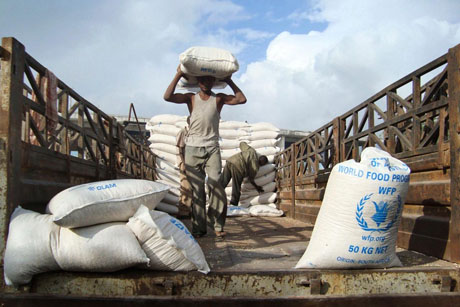
Don’t feed the world? How food aid can do more harm than good
While the media again reports 'famine in the horn of Africa' caused by 'drought', Rasna Warah looks at the real reasons why people are going hungry
Rasna Warah | Red Pepper | January 2012
27 December 2011
Niger Delta: a quiet resistance
Sokari Ekine meets women’s movements in the Niger Delta and discovers that in this militarised country even small acts take courage
Sokari Ekine | Red Pepper | December 2011
Read more... Sphere: Related Content
Women stand next to an oil wellhead that since 2004 has been regularly spilling crude oil near the community of Ikot Ada Udo in the Niger Delta. Photo: Kadir van Lohuizen/Science for Human Rights

25 December 2011
Collateral Damage From Fukushima Hits Europe
Several leading European electricity providers and nuclear power plant constructors now count as part of the collateral damage caused by the tsunami that destroyed the Japanese nuclear power plant of Fukushima last March
By Julio Godoy | Inter-Press Service | Dec 25, 2011
Read more... Sphere: Related Content24 December 2011
Nigeria on alert as Shell announces worst oil spill in a decade
The oil company says up to 40,000 barrels of crude oil was spilled 75 miles off the coast of the Niger delta
John Vidal | guardian.co.uk, Thursday 22 December 2011
Read more... Sphere: Related Content
An oil spill on the shores of the Niger Delta swamps. Shell has said the recent oil spill is likely to be worst in a decade. Photograph: Pius Utomi Ekpei/AFP/Getty Images
19 October 2011
Bolivian president facing election blow amid road protests
High number of spoilt ballots in judicial elections seen as rebuke for Evo Morales over road plan through indigenous Amazon land
Tom Phillips in Rio de Janerio | guardian.co.uk | 17 October 2011
Read more... Sphere: Related Content
Bolivia's president, Evo Morales, cast his vote in the judicial elections. Around 45% voters spoiled their ballots, according to a preliminary count. Photograph: AP
07 April 2010
Norway - FOREST EUROPE (MCPFE) – a holistic approach to sustainable forest management
The multiple crises of climate, finance and food require the need for action to limit deforestation and to manage our forests sustainably. This is necessary in order to mitigate climate change and to adapt forests to changes in temperature, water supply and other factors affected by changes in climate
Norway Ministry of Agriculture and Food in International Security Research and Intelligence Agency | 6 April 2010
Introduction
World forests are in the spotlight for good reasons. Deforestation and forest degradation continues at an alarming rate. The multiple crises of climate, finance and food require the need for action to limit deforestation and to manage our forests sustainably. This is necessary in order to mitigate climate change and to adapt forests to changes in temperature, water supply and other factors affected by changes in climate.
It is necessary to utilise the potential of sustainable managed forests for development and income in difficult economic times. Forests, directly and indirectly, are part of the solution in the severe food situation faced by societies in many parts of the world. The linkage between forest management, forest functions and food security is too often neglected.
Reduced emissions from deforestation and degradation (REDD +) is one of the main priorities for Norway in the climate change negotiations. The Copenhagen accord mandate countries to “immediate establishment of a mechanism including REDD plus, to enable the mobilisation of financial resources from developed countries”. We intend to continue our effort in this regard. The Prime minister of Norway will host a meeting in Oslo in May which will aim at moving the issue forward on the basis of the outcome from Copenhagen.
Europe`s forests constitute 25 per cent of the worlds forest. They are equally important as forests in other regions for the future wellbeing of the societies depending on them – and for other parts of the world. 85 percent of European forests are located outside the EU while 15 per cent are within the EU-27. Sustainable forest management is a dynamic concept. Changes in society’s needs, environmental questions and the need for economically viable solutions are challenges to the entire region. FOREST EUROPE has shown its ability to respond to these challenges and we intend to develop the cooperation further.
Spain and Norway are co-chairing the General Coordinating Committee of FOREST EUROPE. We both see the merit in developing a robust process for the future. Currently the European countries are focused on the preparations for the next ministerial conference scheduled for June 2011. The ministerial conference will determine the content, form and direction of the future of FOREST EUROPE. Synergies between the work within the EU and the work of FOREST EUROPE definitely exist.
FOREST EUROPE and EU commitments to sustainable forest management
Forests in Europe provide a wide range of goods and services. Sustainable forest management is the basis for a lasting supply of these goods and services.
The pan-European region has endorsed a shared concept of sustainable forest management. All EU member states and the Commission have signed FOREST EUROPE resolutions confirming sustainable forest management as core approach to forests sustainability.
EU and FOREST EUROPE do share the same goals for securing all forest functions.
Sustainable forest management as part of the solution for climate change
Sustainable forest management in Europe embodies forest protection, reforestation and afforestation. Sustainable forest management through this explicitly recognises the linkages between commitments expressed in the UN Framework Convention on Climate Change and its Kyoto Protocol.
The IPCC Fourth Assessment Report underlined that, “in the long term, sustainable management of forests will generate the largest sustained mitigation benefit”. To achieve these benefits, sustainable forest management should aim at maintaining or increasing forest carbon stocks, while also producing fiber and energy from the forest.
Sustainable forest management in Europe is also consistent with the ecosystem approach (as defined by Convention on Biological Diversity).
Conservation of forest biodiversity is an essential and integral part of sustainable forest management.
Information and reporting on SFM
FOREST EUROPE was the first regional process to develop, and politically endorse, criteria and indicators that allow the evaluation of progress towards sustainable forest management at the national scale.
FOREST EUROPE together with UNECE/FAO regularly report on the progress towards sustainable forest management in Europe.
The new report on the state of Europe’s forests and sustainable forest management will be launched at the Ministerial Conference in Oslo in 2011 – and will provide trends since the first report in 2003.
Challenges and possibilities
Europe’s forests face a number of challenges; Forest fires, pests and storms, just to mention some of them. We have experienced threats to forests in the past. The new dimension is the direct and indirect effects of climate change. Adaptation to changed climatic conditions and expected extreme events will be the key challenge for the future. The continuous change of climate conditions will increase impacts on forest ecosystems in Europe, their health, vitality and productivity.
Threats to Europe’s forests and challenges must be addressed ... and potentials for forests and the forest sector in Europe must be realized.
How can we do this?
Countries in Europe can do a lot to meet these challenges and utilize the possibilities provided by forests. As a basis we should secure all forest function through sustainable forest management.
National level actions will be the most important in order to meet the challenges. However, cooperation at European level will add significant value to the national actions. Indirect and direct effects of climate change know no borders – and we need to meet these threats jointly in the broadest possible cooperation.
Together we should develop a shared vision, define common goals and identify the supportive actions for the future.
We should join forces to utilise the role of Europe’s forests potential to be a vital part of the solution to climate change
I think it is time to work towards a legal framework on forests in the whole European region for more effective implementation of sustainable forest management.
To secure the broadest possible cooperation, we should utilize the synergies between EU and FOREST EUROPE. We face the same threats, the same challenges and we are aiming at the same goals. We should not limit this cooperation to the 15 per cent of Europe’s forests within the EU borders, but make an effort that covers the entire pan-European region.
Thank you
© Copyright 2010 - ISRIA - all rights reserved
Read more... Sphere: Related ContentCoal Mine Disaster Brings New Reason to Consider Renewables
The rather dramatic irony of this blog entry is that I thought about writing it yesterday after reading about China’s flooded mine and all the men trapped there. At that point, I was thinking about how much safer our own mines are here in the U.S., how that probably wouldn’t happen here after all the OSHA safety requirements and other issues involved. I was going to write about that, slant the article to say we can help China make mining less dangerous. Then, this morning, I read about the coal mine blast in West Virginia. It has killed 25 people with four still missing
Kathleen Davis | Renewable Energy World.com | 06 April 2010
Coal mining is a dirty, nasty business---even with our OSHA regulations, even with our laws and safety requirements. We’re not so different, at the core, from China, after all. It may, in fact, be impossible to make mining a really safe endeavor.
I come from a long line of coal miners. I’ll bet you are surprised by that revelation. My grandfather was a coal miner. And his father. And his father’s father. My family’s dug a lot of black chunks out of the ground.
My grandfather used to talk a lot about what miners fear most---back then it was a scary term called “blackdamp.” Blackdamp is the removal of oxygen in the air, which is replaced by toxic gases. Pretty much all tight, sealed environments can create blackdamp, but it’s especially nasty in coal mines because the coal itself adds to the problem. Coal, once exposed to air, begins absorbing oxygen and giving off carbon dioxide and water vapor. My grandfather used to talk about blackdamp as if the mine itself was breathing, cutting off air from the miners inside its gullet.
You can’t smell blackdamp. You usually only become aware when you get lightheaded and dizzy, uncoordinated like you’ve had way too much to drink.
Blackdamp was what miners feared most in my grandfathers’ day. But, that wasn’t usually what killed them. It did kill some, of course, but most miners were killed from the force and power of collapses or accidents, not from the creeping blackdamp. Still, the blackdamp scared them most---that slow, crazy spiral to asphyxiation that it represented. My grandfather said the scariest thing was an awareness that death is coming down that mine in bits and parcels, in small steps and strides. And you had to watch. You had to realize what was coming.
My grandfather stopped fearing the blackdamp in 1947 because he stopped being a coal miner in 1947. March 26, 1947, to be exact. He was running late for his shift at the Centralia Coal Company’s No. 5 mine on the edge of Centralia, Illinois. He wasn’t usually the type to run late---at least not as I recall. (We always made it to the movies and the circus early enough to get sodas and popcorn when I was a kid.) But, that one day in 1947, he was a bit behind. He told me the reason was something to do with a family birthday celebration that had kept him up way too late the night before.
The celebration hadn’t, however, slowed down my great-grandfather. Not a bit. He was bang on time for the mine collapse---the worst coal mine disaster that the country had seen in nearly 20 years. 111 men died in that mine disaster, including my great-grandfather Jacob Rethard. My grandfather, Raymond, would talk about digging with shovels and picks and bare and bloody hands---anything to get his father and those other men trapped, even though they knew just minutes after the shaft fell that hope for the lives of those men was completely futile: If the force didn’t get them, the blackdamp and growing lack of oxygen certainly would. It was a race against time, and they didn’t have the equipment to win. Still, my grandfather kept digging until he recovered the body of his father. His father was no. 110---the 110th body. 110 out of the 111 eleven dead pulled from that mine.
And my grandfather walked away from that disaster dirty and bloody and done. He left coal mining behind without a second thought.
As human beings, we are incredibly resilient. My grandfather certainly was. He became a security guard, working everywhere from Vegas to Oklahoma City. He raised a family and rarely talked about that coal mine collapse that killed his father. He was funny, a great cook, and he used to build the most amazing blanket-and-kitchen-chair forts in his living room, much to the annoyance of my grandmother. He pressed on.
As a society, we often mirror my grandfather’s ability to move forward. Hundreds of men in China die, and it really doesn’t stop us from flicking a light switch. We don’t make that connection much. 25 men in West Virginia died today, and it hasn’t stopped me from using my computer or my television. We have a great capacity to accept and move on. But, maybe we shouldn’t be so quick to adapt.
I’ve thought a lot about the place of renewables in this industry in the last few years---most of it focused on the practical. I still think they are expensive and lacking in a certain economy of scale. But, perhaps I should think less about the financial cost of renewables and more about the lives they might save---not just with reducing global warming but direct human lives like those we lose regularly in coal mines around the world.
Jacob Rethard was a solid, tough family man who was proud to be a coal miner, but it cost him his life. My grandfather, Raymond Rethard, walked away from that disaster that killed his father a changed man, one who saw coal mining as not worth the risk. In the end, he died at a ripe old age surrounded by family---not by darkness and blackdamp.
Perhaps we should pay more attention to the humanity embroiled in the dangers of mining. If renewables become more prevalent, could we save more men in China and in West Virginia and in Illinois from dying in the dark? Years ago I made a definitive choice to never buy diamonds because of the human cost they sometimes require to mine. It was a change in attitude, and I know I’m not alone in that attitude or choice. Perhaps we also need to consider a change in attitude and adjust our social concepts and technological advances to give the advantage to renewables, even if they are more expensive. We should remember that we sometimes pay a very large, very human price for very cheap power.
And, bottom line, that human price may be much, much less if renewables were given a stronger foothold in power production.
Kathleen Davis is senior editor with POWERGRID International magazine and Electric Light & Power magazine (online at www.power-grid.com).
© Copyright 1999-2010 RenewableEnergyWorld.com - All rights reserved
Read more... Sphere: Related Content06 April 2010
Stranded ship "time bomb" to Great Barrier Reef
A stranded Chinese coal ship leaking oil onto Australia's Great Barrier Reef is an environmental time bomb with the potential to devastate large protected areas of the reef, activists said on Monday
Reuters | Apr 5, 2010
The ship was a "ticking environmental time bomb," Gilly Llewellyn, director of conservation for the World Wide Fund for Nature (WWF) in Australia, told Reuters.
She said this was the third major international incident involving its owners in four years.
Australian government officials say the stricken Shen Neng I belongs to the Shenzhen Energy Group, a subsidiary of China's state-owned China Ocean Shipping (Group) Company, better known by its acronym COSCO.
In 2007, COSCO was linked to a major oil spill in San Francisco bay, while last year it was tied to another in Norway, both of which damaged environmentally sensitive areas.
"We are seeing a concerning pattern potentially associated with this company," Llewellyn told Reuters.
COSCO officials in Australia could not be contacted for comment on Monday.
The Great Barrier Reef stretches along Australia's northeastern coast and is the only living structure on Earth visible from space. It is the world's largest coral reef and a major tourist draw.
As salvagers struggled on Monday to stop the ship breaking up and spilling hundreds of tons of oil and thousands of tons of coal, environmentalists told Reuters tighter controls on shipping were needed to protect the reef as Australia's energy industry expands.
SHIP NEEDS HELP
Although only a small amount of the 975 tons of fuel oil on board has so far leaked, Australian officials have warned the ship is unable to move off the shoal unaided, as its engine and rudder were damaged.
International salvage firm Svitzer has been engaged and has attempted to use tugs to stabilize the vessel, but the head of the government agency overseeing the operation said on Monday the ship was still moving on the reef.
The 230-meter (754-ft) ship was carrying 65,000 tons of coal to China when it ran aground on Saturday with 975 tons of heavy fuel oil on board, a type of oil environmentalists say is particularly sticky and damaging to marine organisms.
The ship was off-course and traveling at full speed when it hit, Australian officials have said. If it broke up as feared, environmentalists said the effects could be devastating.
"We would potentially be looking at an environmental disaster," Llewellyn said." It would be an extremely large spill."
Among the animals affected would be protected species of turtles, dugongs, and marine birds, as well as the sensitive corals, she said.
Chris Smyth, an ocean campaigner with the Australian Conservation Foundation, said with Australia planning to expand its energy industry, its government needs to consider whether ships should be traveling through the reef at all.
"It is going to actually increase shipping traffic substantially and the likelihood of these kinds of incidents occurring in the future," he told Reuters.
This is Australia's third such recent disaster, he said, following two last year, another oil spill off the Queensland coast and a major oil well blowout in the Timor Sea.
It should be clearer within the next few days what the likely scale of this disaster may be, Smyth said. In a worst case scenario, the spilled oil could reach protected areas on the Australian mainland, he said.
On Monday, Queensland state premier Anna Bligh called for tough legal action against the shipowners, saying they could face fines of up to A$1 million ($920,000), with the captain facing a further fine of up to A$220,000.
Investigations are underway by the Australian Maritime Safety Authority (AMSA) and the Australian Transport Safety Bureau.
A spokeswoman for AMSA told Reuters its investigation would be "exploring breaches and possible offences" under Australian law. Some 23 crew who were on board the vessel when it ran aground so far appeared to be safe, she said.
Rescue officials have said the ship will require a long and careful salvage operation, expected to take weeks.
(A$1=$0.92)
(Editing by Jerry Norton)
(Sydney Newsroom +612 6273 2730)
© Copyright 2010 Thomson Reuters
Read more... Sphere: Related ContentMachine gains support, low-impact on forests
The Forestry Ministry, NGOs and scientists are researching a new technology called the “mono-cable” to replace tractors to reduce damage caused by logging
Nurni Sulaiman | The Jakarta Post | April 6, 2010
The mono-cable is a machine designed for the logging industry, which is expected to help preserve the environment.
PT Belayan River Timber and PT Narkata Raya are among the first logging companies in East Kalimantan to use the mono-cables. They have been using them from 2009.
“We have 16 mono-cable machines and plan to increase the number to 25 or 30 this year,” Untung Iskandar, director of Belayan told The Jakarta Post in Long Bagun village in West Kutai regency.
“We hope we can change our conventional logging methods to one that supports sustainable forests.”
The Post observed that damage to land caused by tractors reached was four to six times higher than that caused by mono-cables.
Besides less damage, mono-cable also incurs less production cost from between Rp 150,000 (US$15) and Rp 175,000 to Rp 95,000 per cubic meter, Belayan’s operational director, Andreas Adi Nugroho, said.
Tractors need two skilled workers to operate while a mono-cable needs five to seven people with low-level skills.
Benjamin Jarvis, program manager of The Nature Conservancy said that another difference between tractors and mono-cables was the impact on tree survival.
He said tractors damaged soil so that trees would take five years to grow 10 centimeters in diameter. But he said it only took months for a tree to grow that much using mono-cables.
James Halperin, a US Department of Agriculture’s Forest Service representative, saw the mono-cable practice last week during his Kalimantan visit. “This is an excellent way for a company to improve forest management,” he said.
Listya Kusumawardhani, director of forest production development at the Forestry Ministry said during the visit to East Kalimantan she would report the mono-cable method to the minister for a consideration to make it policy.
Andreas said the mono-cable method could help reduce illegal logging. Belayan could recruit illegal loggers, usually nearby residents without many income options, to operate the machine.
“Some ex-illegal loggers are working as mono-cable operators in our team,” Andreas said.
Two operators, Hanyeq Jaang and Ami Daud, said their stress-levels lessened when they were hired.
“Now we are working full-time without feeling guilty,” Ami said Hanyeq added as a legal worker, he could take home a monthly salary of Rp 2 million on average. “As an illegal logger I could take home up to Rp 4 million, but sometimes I did not receive anything. We worked under pressure and worried about being arrested.”
Hanyeq and Ami are among 40 locals from Long Hubung district who work at Belayan under collaborative management.
Diah Rakhmah Sari, a postgraduate student from Mulawarman University in Samarinda said she researched the mono-cable method and valued its low impact on the environment, “This is a breakthrough in forest management. Logging may become more environmentally friendly and it does not destroy the top soil like the tractor.”
Copyright © 2008 The Jakarta Post - PT Bina Media Tenggara. All Rights Reserved
Read more... Sphere: Related Content03 April 2010
Minister Hatta backs much-debated food estate
Environment Minister Gusti Muhammad Hatta has thrown his weight behind a plan to set up a food estate in Merauke, Papua province, a plan many environmental groups see as a setback
Adianto P. Simamora | The Jakarta Post | April 3, 2010
Gusti said the project should first develop 366,612 hectares of ailing forested land of while waiting for assessments on the planned 1.6 million hectares.
“The food estate projects should be implemented in steps without victimizing primary forests in Merauke,” Gusti said.
He made the statement after Greenomics Indonesia had a meeting with Gusti and other senior staff about the Merauke Integrated Food and Energy Estate (MIFEE) on Thursday.
Gusti also cautioned that the massive 1 million hectare forest conversion for agriculture in Central Kalimantan province under Soeharto administration was not to be repeated.
The deputy minister for environmental damage control at the Environment Ministry, Masnellyarti Hilman said the ministry was working on a proposal that the environmental impact analysis for the MIFEE project should be made by the central government.
She insisted that Merauke administration should first assess its environmental condition to determine whether the province could accommodate such big projects.
The 2009 Environmental Law requires local authorities to run strategic environmental assessments to identify capability of environment to accommodate the projects.
The impact analysis will be issued based on the findings of the strategic assessment.
The law says the project developers should first secure an environmental permit from the Environment Ministry before applying for business permits.
The MIFEE project was under the Agriculture Ministry’s program that aimed to boost food production. A number of big companies, including from energy sector will reportedly take part in the project.
The Agriculture Ministry has not yet secured licenses from the Forestry Ministry to convert the forest.
Forestry Minister Zulkifli Hasan previously said he would issue a permit to convert the virgin forest for food estate projects.
Greenomics Indonesia agreed that priority should be given to the primary 366,612 hectares, with permission from the Forestry Ministry.
“If there is progress, the project could be expanded to another 139,333 hectares of ailing production forest but permits should be [obtained] from the House of Representatives,” Greenomics executive director Elfian Effendi said.
He said that the total natural forest which could be converted for MIFEE projects was only 505,945 hectares.
Greenomics said that if the government continued its plan to dig 1.6 million hectares in Merauke, some 1.1 million hectares would be from the conversion of natural forests, which would be against the government’s pledge to protect forests to cut emissions.
“Minister Gusti must continue comparing the impacts of massive forest conversion for food estates to the government’s pledge to cut 26 percent emissions by 2020,” he said.
He said that the ministry should apply the 2009 law as instrument to control the project through the impact analysis and environmental permits.
Copyright © 2008 The Jakarta Post - PT Bina Media Tenggara. All Rights Reserved
Read more... Sphere: Related Content14 March 2010
UN climate change claims on rainforests were wrong, study suggests
The United Nations' climate change panel is facing fresh criticism after new research contradicted the organisation's claims about the devastating effect climate change could have on the Amazon rainforest
By Richard Gray | Telegraph.co.uk | 13 Mar 2010
A new study, funded by Nasa, has found that the most serious drought in the Amazon for more than a century had little impact on the rainforest's vegetation Photo: REX
A new study, funded by Nasa, has found that the most serious drought in the Amazon for more than a century had little impact on the rainforest's vegetation.
The findings appear to disprove claims by the Intergovernmental Panel on Climate Change (IPCC) that up to 40% of the Amazon rainforest could react drastically to even a small reduction in rainfall and could see the trees replaced by tropical grassland.
The IPCC has already faced intense criticism for using a report by environmental lobby group WWF as the basis for its claim, which in turn had failed to cite the original source of the research.
Scientists have now spoken out against the 40% figure contained in the IPCC report and say that recent research is suggesting that the rainforest may be more resilient to climate change than had been previously thought.
It comes just days after the UN announced an independent review into the panel's procedures following a series of scandals over its most recent report which was found to contain factual errors and claims which were not based on rigorous scientific research.
The InterAcademy Council, which is the umbrella organisation for the national academies of science around the world, will examine how the IPCC's reports are compiled and communicated.
Dr Jose Marengo, a climate scientist with the Brazilian National Institute for Space Research and a member of the IPCC, said the latest study on the Amazon's response to drought highlighted the errors in the previous claims.
He said: "The way the WWF report calculated this 40% was totally wrong, while (the new) calculations are by far more reliable and correct."
The new study, conducted by researchers at Boston University and published in the scientific journal Geophysical Research Letters, used satellite data of the Amazon rainforest to study the effects of a major drought in 2005 when rainfall fell to the lowest level in living memory.
The drought saw rivers and lakes dry up, causing towns and cities that rely upon water flowing out of the rainforest to suffer severe water shortages.
But the researchers found no major changes in the levels of vegetation and greenery in the forests despite the drought.
They claim this contradicts the statements made in the IPCC's 2007 assessment report on climate change.
It said: "Up to 40 % of the Amazonian forests could react drastically to even a slight reduction in precipitation; this means that the tropical vegetation, hydrology and climate system in South America could change very rapidly to another steady state.
"It is more probably that forests will be replaced by ecosystems that have more resistance to multiple stresses caused by temperature increase, droughts and fires, such as tropical savannahs."
Professor Ranga Myneni, from the climate and vegitation research group at Boston University who was the senior researcher in the study, said criticised the IPCC’s claim that a “even a slight reduction in precipitation” would cause drastic changes in the rainforest.
He said: “There was more than a slight reduction in precipitation during the drought of 2005. It is that particular claim of the IPCC that our analysis rejects.”
Sangram Ganguly, a scientist from the Bay Area Environmental Research Institute in California and one of the researchers who conducted the new study, said: "Our results certainly do not indicate such extreme sensitivity to reductions in rainfall."
Dr Arindam Samanta, the lead author of the study, said: "We found no big differences in the greenness levels of these forests between drought and non-drought years, which suggests that these forests may be more tolerant of droughts than we previously thought."
The IPCC has been left embarrassed after it emerged the panel had quoted unsubstantiated and erroneous claims about the melting of glaciers in the Himalayas and had also used information from student dissertations and magazine articles to compile its report.
The chair of the panel, Rajendra Pachauri has come under mounting pressure to resign following the scandal and questions over his ability to lead the organisation.
Dr Keith Allott, head of climate change at WWF UK, said: "The WWF report from 2000 on the threat of wildfires in Amazon was based on respected sources and peer-reviewed literature available at the time.
"Subsequent peer-reviewed literature has confirmed that the Amazon faces serious risks from climate change. This new study is a welcome addition to the growing body of evidence."
Dr Simon Lewis, an expert on forest die back at Leeds University and a research fellow at the Royal Society, said the Boston University study had helped to clear up debate about how the rainforest responded to short-term drought.
But he added that long-term reductions in rainfall might have a very different impact.
No one was available to respond at the IPCC yesterday.
© Copyright of Telegraph Media Group Limited 2010
Read more... Sphere: Related Content07 March 2010
EU drafts reveal biofuel's "environmental damage"
EU documents reveal worries over biofuels impact. Draft reports predict "shock" for commodity markets
By Pete Harrison | Reuters in AlertNet | 04 Mar 2010
Biodiesel and other "green" fuels that Europeans put in their cars can have unintended consequences for tropical forests and wetlands, European Union reports show -- the first evidence of EU misgivings.
The EU aims for its 500 million citizens to get about a tenth of their road fuels from renewable sources such as biofuels by 2020, but some EU officials want the target reduced in a review in four years time.
Modelling exercises are starting to show unwanted impacts spreading across the planet via commodity markets.
"The simulated effects of EU biofuels policies imply a considerable shock to agricultural commodity markets," warns one draft report produced to advise policymakers.
"Current and future support of biofuels...is likely to accelerate the expansion of land under crops, particularly in Latin America and Asia," warns another, one of 116 documents released to Reuters under freedom of information laws. More are still awaited.
"It carries the risk of significant and hardly reversible environmental damages," adds the draft.
The warnings are not new. Environmentalists have been making them for years.
But the impact studies and emails show for the first time that European policymakers are also seriously worried about the impact on tropical forests, wetlands and savannah. However, they are struggling to quantify the likely damage.
"The large amount of documents and their detailed content show the Commission have been considering indirect land use change impacts very seriously," said a spokeswoman for European Energy Commissioner Guenther Oettinger.
"There is no definitive and official answer on the size or character of this issue at this stage," she added.
Lobbyists from bioethanol industry group, ebio, have seized on the confusion, demanding policymakers "reject the concept".
Meanwhile, in the European Commission, which instigates EU policy, officials are split over the wisdom of continuing with a target that was set in 2008 and already prompted billions of dollars of investment globally.
One internal letter from an agriculture official warns that taking account of the full carbon footprint of biofuels could "kill" an EU industry worth about 5 billion euros a year ($6.8 billion).
LAND USE CHANGE
At the centre of the debate is an issue drily referred to as "indirect land use change", which has put palm oil producers in Malaysia and Indonesia in the cross-hairs of environmentalists.
Critics say that regardless of where they are grown, biofuels compete for land with food crops, forcing farmers worldwide to expand into areas never farmed before -- sometimes by hacking into tropical rainforest or draining peatlands.
Satisfying the EU's thirst for biofuels would need 5.2 million hectares of land by 2020, reads one report -- a bigger area than the Netherlands. But where to find that land?
Burning forests to clear the land can pump vast quantities of climate-warming emissions into the atmosphere, cancelling out any theoretical climate benefit from the fuel. Iconic species such as Orangutans are also put under renewed pressure.
"Many decades may be needed before the initial induced carbon losses are compensated by the savings due to greater biofuel use," reads one draft study by agriculture experts.
Draining peatlands can have a similar impact as soils rot and release methane gas into the atmosphere.
If just 2.4 percent of European biofuels came from palm oil grown on former peatlands, for example in Indonesia, the entire climate benefits of EU biodiesel would be wiped out, says a report by the Commission's own research centre.
"The problems are only going to get worse unless the EU rewrites its law to allow only biofuels that bring benefits to be sold in Europe," said campaigner Nusa Urbancic at environment group T&E. "This information must be brought out into the open so there can be a proper debate."
If the issue wasn't complicated enough, policymakers will have to take account of numerous mitigating factors.
Increased demand for the cereals and oil seeds from which biofuels are made does not always result in farmers expanding agricultural land. Sometimes they can increase yield by using fertilisers, pesticides and irrigation.
Pressure on the land can also be relieved by using the spent grains from biofuels to feed animals -- substituting some of the maize or other feed grains that might have otherwise been grown.
(Editing by Sue Thomas)
© Reuters Foundation 2002. All rights reserved
Read more... Sphere: Related ContentIndonesia says Unilever move on palm oil "unfair"
A move by Unilever to stop buying palm oil from Indonesia's top supplier Sinar Mas and to blacklist another supplier PT Duta Palma was "unfair," Indonesian Agriculture Minister Suswono said on Friday
Aloysius Bhui | Reuters | Mar 5, 2010
A view of burnt trees in a peatland area for palm oil plantations near Teluk Meranti village in Pelalawan, Indonesia's Riau province November 11, 2009. Credit: Reuters/Beawiharta
Green campaigners and consumers have turned up the heat on European firms such as Unilever, saying these companies' palm oil suppliers are responsible for deforestation and peatland clearence that can speed up climate change.
"If there is a dispute we should ask an independent to judge objectively what was the weakness. A unilateral decision by Unilever I think is unfair," the minister told reporters.
Unilever, the world's top palm oil buyer, blacklisted Duta Palma last month, after previously halting a $33 million supply contract with Sinar Mas unit PT SMART.
"We have to prove if the accusations are right so going forward there will not be misunderstanding," added Suswono, who uses one name like many Indonesians.
The move by Unilever, and other campaigns by NGOs, has prompted palm planters in Indonesia and Malaysia to set up a forum to cooperate in promoting sustainable practices and to be united in the face of pressures from buyers.
"There have been accusations that palm oil expansion has caused deforestation, destroyed biodiversity, the natural home of orangutan and peat land," said a joint statement between Indonesian and Malaysia palm oil groups.
The palm oil industry, which has come under fire from green groups and Western consumers, set up the Roundtable of Sustainable Palm Oil (RSPO) in 2004 to develop an ethical certification system that includes commitments to preserve rainforests and wildlife.
However, there have been rifts between members with consumer giant Unilever stopping buying crude palm oil from the two Indonesian producers, both of which are fellow members of RSPO.
"Without Indonesia and Malaysia, RSPO could collapse," said Datuk Mohammad Saleh, chairman of the Malaysian Palm Oil Association (MPOA).
(Additional reporting by Yayat Supriatna; Editing by Ed Davies)
© Copyright 2010 Thomson Reuters
Read more... Sphere: Related Content05 March 2010
Chile quake reconstruction 'to take up to four years'
Chile's reconstruction will take "three to four years" as the country recovers from the earthquake that killed some 800 people, its president has said
BBC News | 4 March 2010
Chile is still assessing the enormous cost of the quake

"There are rural areas where everything has tumbled to the ground... infrastructure has been destroyed," Michelle Bachelet told Chilean radio.
It would take foreign aid and most of the mandate of President-elect Sebastian Pinera to rebuild, she added.
Three days of national mourning have been declared, to begin on Sunday.
Tremors have continued to rock the nation after Saturday's 8.8 magnitude earthquake, one of the strongest recorded.
One of 6.3 hit the north of the country, 255km (160 miles) north-east of Antofagasta and 1,260km north of the capital Santiago, the US Geological Survey said.
On Wednesday, strong aftershocks of magnitude 5.5 and higher were felt in several cities, including Santiago, and prompted tsunami warnings, which were later lifted.
'Government of reconstruction'
The cost of the damage, which Ms Bachelet described as "enormous", has so far been estimated at between $15bn and $30bn.
"Chile has the resources for a number of actions, but we will have to ask for credit from the World Bank and other entities," Ms Bachelet said.
President-elect Pinera is set to take office next week.
He said his government would be one of reconstruction, with a plan of four clear stages - "to cope with the emergency needs of citizens, find people who are still missing, provide prompt and timely assistance to the sick and wounded, and restore law and order so that people can return to peace".
UN Secretary General Ban Ki-moon is to visit Chile on Friday to assess the damage and meet Ms Bachelet and Mr Pinera.
An 18-hour nightly curfew remains in place in Concepcion, Chile's second largest city, and six other towns badly affected by the earthquake.
Officials have said 802 people are confirmed to have died, of whom 279 have been identified. But there are reports of many people still missing in the coastal town of Constitucion.
About two million Chileans are believed to have been affected by Saturday's 8.8 magnitude earthquake, the seventh most powerful on record and the worst disaster to befall Chile in 50 years.
The epicentre of the quake was 115km north-east of Concepcion and 325km south-west of the capital Santiago.
About 1.5 million homes in Chile have been damaged.
Most of the collapsed buildings were of older design - including many historic structures.
 © MMX
© MMX
Read more...
Sphere: Related Content
A fund for climate chaos
RBS investment in tar sand exploitation is a highly irresponsible use of public bailout money
Kevin Watkins | guardian.co.uk | 4 March 2010
Do you feel comfortable about your money financing global warming and weakening government transparency in poor countries? If not, take a hard look at the Royal Bank of Scotland and ask yourself ask why a bank that depends on public funds is subverting national policies on climate change and international development.
Unlike banker bonuses, the lending practices of recapitalised banks have so far escaped scrutiny. When RBS issued its recent results statement media interest locked on to operating losses and pay awards. Few questions have been asked about what the bank has been doing with the government's 84% stake.
But next week, parliament's environmental audit committee will hold an inquiry on the mandate of UK Financial Investments (UKFI) – the body charged with looking after the taxpayer interest in RBS and other banks. It will ask whether that mandate is helping or hindering Britain's efforts to promote low-carbon economic growth.
With RBS this is an open and shut case. Since recapitalisation, it has been bankrolling some of the world's most ecologically destructive investments. RBS is a global leader in underwriting loans for companies such as Shell and Conoco Philips, exploiting oil tar sands in Canada's Alberta province. Detailed analysis by People and Planet, the environmental organisation, documents a tar sand portfolio that has grown by $2.7bn since the government bailout.
The damage inflicted by this lending is hard to overstate. When it comes to climate change, tar sand is a toxic asset. This is because the oil has to be released through high pressure steam pumping – producing a single barrel of oil from tar sands releases three times as much CO2 as a barrel of conventional oil. So why is a government working for an international agreement to cut carbon emissions allowing RBS to back investments that are driving up global warming?
Official answers to that question have lacked credibility. Lord Myners, the financial services secretary, maintains that UKFI has a duty to manage the taxpayer stake on "a commercial basis". Leaving aside Treasury rules requiring ministers to consider the environmental impacts of public spending, tar sand investment is only commercially viable if you resort to madhouse economics.
The profitability of these investments hinges critically on balance sheets that attach a low price to carbon emissions. If the price of the CO2emitted in tar sand production was set at a market rate consistent with an international agreement under which rich countries cut greenhouse gas emissions by 20% by 2020 – between $80 and $100 a tonne – RBS tar sand loans would have no attraction.
The RBS is taking a punt on loans that offer big corporate profits, subject to the petroleum industry avoiding the costs of long-term ecological damage. In effect, it is exploiting the market failures at the heart of the climate change problem, and gambling on governments failing to correct them.
Climate change is not the only problem. RBS is lending to oil companies operating in sub-Saharan Africa that are falling far short of best standard practices on transparency, profit sharing and environmental safeguards.
There is an alternative. Instead of using taxpayer's money to finance climate chaos, RBS could be gearing its lending towards support for a low carbon transition strategy for Britain. The public stake in banks brings with it responsibilities and opportunities. If the law governing the UKFI mandate allows taxpayer money to be used to inflict irreparable damage on our climate and sponsor irresponsible lending, then the law is an ass – and it's time to change it.
uardian.co.uk © Guardian News and Media Limited 2010
Read more... Sphere: Related Content01 March 2010
Green fuels cause more harm than fossil fuels, according to report
Using fossil fuel in vehicles is better for the environment than so-called green fuels made from crops, according to a government study seen by The Times
Ben Webster, Environment Editor | The Times | March 1, 2010
The expansion of plantations has pushed the orang-utan to the brink of extinction in Sumatra, where it takes 840 years for a palm oil plantation to soak up the carbon emitted when rainforest is burnt
The findings show that the Department for Transport’s target for raising the level of biofuel in all fuel sold in Britain will result in millions of acres of forest being logged or burnt down and converted to plantations. The study, likely to force a review of the target, concludes that some of the most commonly-used biofuel crops fail to meet the minimum sustainability standard set by the European Commission.
Under the standard, each litre of biofuel should reduce emissions by at least 35 per cent compared with burning a litre of fossil fuel. Yet the study shows that palm oil increases emissions by 31 per cent because of the carbon released when forest and grassland is turned into plantations. Rape seed and soy also fail to meet the standard.
The Renewable Transport Fuels Obligation this year requires 3¼ per cent of all fuel sold to come from crops. The proportion is due to increase each year and by 2020 is required to be 13 per cent. The DfT commissioned E4tech, a consultancy, to investigate the overall impact of its biofuel target on forests and other undeveloped land.
The EC has conducted its own research, but is refusing to publish the results. A leaked internal memo from the EC’s agriculture directorate reveals its concern that Europe’s entire biofuels industry, which receives almost £3 billion a year in subsidies, would be jeopardised if indirect changes in land use were included in sustainability standards. A senior official added to the memo in handwriting: “An unguided use of ILUC [indirect land use change] would kill biofuels in the EU.”
The EC hopes to protect its biofuel target by issuing revised standards that would give palm plantations the same status as natural forests. Officials appear to have accepted arguments put forward by the palm oil industry that palms are just another type of tree.
A draft of the new rules, obtained by The Times, states that palm oil should be declared sustainable if it comes from a “continuously forested area”, which it defines as areas where trees can reach at least heights of 5m, making up crown cover of more than 30 per cent. “This means, for example, that a change from forest to oil palm plantation would not per se constitute a breach of the criterion,” it adds.
Clearing rainforest for biofuel plantations releases carbon stored in trees and soil. It takes up to 840 years for a palm oil plantation to soak up the carbon emitted when the rainforest it replaced was burnt. The expansion of the palm oil industry in Indonesia has turned it into the third-largest CO2 emitter, after China and the US. Indonesia loses an area of forest the size of Wales every year and the orang-utan is on the brink of extinction in Sumatra.
Last year, 127 million litres of palm oil was added to diesel sold to motorists in Britain, including 64 million litres from Malaysia and 27 million litres from Indonesia. Kenneth Richter, biofuels campaigner for Friends of the Earth, said: “The billions of subsidy for biofuels would be better spent on greener cars and improved public transport.”
Copyright 2010 Times Newspapers Ltd.
Read more... Sphere: Related ContentGuyana bans gold mining in the 'Land of the Giants'
Guyana has banned gold dredging in the Rewa Head region after an expedition turned up unspoiled wilderness and mind-boggling biodiversity. The researchers, in just six weeks, stumbled on the world's largest snake (anaconda), spider (the aptly named goliath bird-eating spider), armadillo (the giant armadillo), anteater (the giant anteater), and otter (the giant otter), leading them to dub the area 'the Land of the Giants'
Jeremy Hance | mongabay.com | March 01, 2010
"During our brief survey we had encounters with wildlife that tropical biologists can spend years in the field waiting for. On a single day we had two tapirs paddle alongside our boat, we were swooped on by a crested eagle and then later charged by a group of giant otters. I think that about sums the place up. There is little human disturbance in the Rewa Head and as a result, wildlife flourishes in blissful naivety," one of the expedition members, Rob Pickles, said in a press release.

The photo shows an "inquisitive adult male giant otter approaching the boat. While some individuals are remarkably fearless and will approach to within several yards of the boat, the mood of the group is determined by the breeding female. If she feels threatened the group will normally 'periscope' and disappear," according to Biodiversity Report on Rewa Head. Photo by Robert Pickles.
Pickles, a PhD student studying giant river otters, teamed up with another PhD student, tapir-expert Niall McCann, to explore the area with the aid of the Zoological Society of London (ZSL). Astonishingly the team encountered six anacondas during their expedition, four of which were over 16 feet long.
But it wasn't just big species that the team recorded, but rare ones as well. Pickles and McCann recorded the presence of half of Guyana's listed threatened species during their expedition, including crested and harpy eagles, as well as the little-seen bush dog.
"Visiting the Rewa Head felt like we were walking in the footsteps of Wallace and Bates, seeing South America with its natural density of wild animals as it would have appeared 150 years ago," Pickles told mongabay.com in a recent interview regarding their expedition.
Despite the good news that Guyana has banned gold mining in the area, the Rewa Head remains threatened.
"[The area] currently lies in a logging concession. Unless Guyana is given alternative financial incentives, its government will be forced to lease its land to oil drillers, miners and loggers. One of the world’s last Edens is on the brink of destruction," explains Niall McCann.
Currently, the US-owned company, Simon and Shock International, has a license to extract timber from 400,000 hectares, while oil drilling concessions cover 78 million hectares.
McCann and Pickles are working with ZSL conservationists to gain international support for the government of Guyana's plan to conserve its vast forests as a carbon sink for financial returns. According to the conservationists, the area is a perfect testing ground for projects like REDD+ (Reducing Emissions through Deforestation and Forest Degradation).
"Guyana is in an incredibly fortunate position in that it still retains 76 percent of its forest cover which constitutes some of the most carbon-rich forests of South America. As such, and with a president keen to offer his nation’s forests as part of the world’s carbon sink, Guyana should be embraced by the international community," Pickles told mongabay.com in the interview.
In all Pickles and McCann recorded 251 bird species and 33 large mammal species in Rewa Head.
"In the wake of Copenhagen and the build up to the Convention on Biological Diversity, reducing biodiversity loss and greenhouse gas emissions are high on the political agenda. Protecting areas such as the Rewa Head through sustainable management is a positive strategy for addressing these key issues," said Professor Jonathan Baillie, Director of Conservation at ZSL, adding that "global leaders need to recognize that real economic benefits are to be gained through the conservation, not destruction, of our world’s living things."
To read the interview with Robert Pickles: Guyana expedition finds biodiversity trove in area slated for oil and gas development, an interview with Robert Pickles
Anaconda found in Rewa Head. Photo by Ashley Holland.
The jaguar Panthera onca is classified as Near Threatened: a previous six-week expedition to Rewa Head observed ten jaguars. Photo by: Ashley Holland and Gordon Duncan.
World's largest spider, the goliath bird-eating spider Theraphosa blondii, from Guyana’s interior. Photo by: Gordon Duncan.
According to biodiversity report: "In the dry season huge sandy beaches are exposed in the Lower Rewa, providing a nesting ground for giant South American river turtles (Podocnemis expansa). The superabundance of eggs laid in these sand banks is a boon which many forest species time their breeding cycle to coincide with." Photo by Ashley Holland.
Brazilian tapir Tapirus terrestrisi photographed 10ft from the expedition boat. The Brazilian tapir is classified as Vulnerable. Photo by: Robert Pickles.
Schneider’s dwarf caiman Paleosuchus trigonatus. Photo by: Niall McCann.
"Hand-axe sharpening grooves and geometric designs below Corona Falls on the River Rewa testify to the fact that there were once indigenous people inhabiting this area," according to Biodiversity report. Photo by: Rob Pickles.
Copyright mongabay 2010 Read more... Sphere: Related Content
Logging and oil concession in Rewa Head. Map courtesy of Mike Robert Pickles.
25 February 2010
ENERGY: Coal-Fired Power on the Way Out?
The past two years have witnessed the emergence of a powerful movement opposing the construction of new coal-fired power plants in the United States
Analysis by Lester R. Brown* | IPS | Feb 24, 2010
Initially led by environmental groups, both national and local, it has since been joined by prominent national political leaders and many state governors.
The principal reason for opposing coal plants is that they are changing the earth's climate. There is also the effect of mercury emissions on health and the 23,600 U.S. deaths each year from power plant air pollution.
Over the last few years the coal industry has suffered one setback after another. The Sierra Club, which has kept a tally of proposed coal-fired power plants and their fates since 2000, reports that 123 plants have been defeated, with another 51 facing opposition in the courts.
Of the 231 plants being tracked, only 25 currently have a chance at gaining the permits necessary to begin construction and eventually come online. Building a coal plant may soon be impossible.
What began as a few local ripples of resistance to coal-fired power quickly evolved into a national tidal wave of grassroots opposition from environmental, health, farm, and community organisations. Despite a heavily funded ad campaign to promote so-called clean coal (one reminiscent of the tobacco industry's earlier efforts to convince people that cigarettes were not unhealthy), the U.S. public is turning against coal.
One of the first major industry setbacks came in early 2007 when a coalition headed by the Environmental Defence Fund took on Texas-based utility TXU's plans for 11 new coal-fired power plants. A quick drop in the utility's stock price caused by the media storm prompted a 45-billion-dollar buyout offer from two private equity firms.
However, only after negotiating a ceasefire with EDF and the Natural Resources Defence Council and reducing the number of proposed plants from 11 to three, thus preserving the value of the company, did the firms proceed with the purchase. It was a major win for the environmental community, which mustered the public support necessary to stop eight plants outright and impose stricter regulations on the remaining three.
Meanwhile, the energy focus in Texas has shifted to its vast wind resources, pushing it ahead of California in wind-generated electricity.
In May 2007, Florida's Public Service Commission refused to license a huge 5.7-billion-dollar, 1,960-megawatt coal plant because the utility could not prove that building the plant would be cheaper than investing in conservation, efficiency, and renewable energy sources. This point, made by Earthjustice, a non-profit environmental legal group, combined with strong public opposition to any more coal-fired power plants in Florida, led to the quiet withdrawal of four other coal plant proposals in the state.
Coal's future is also suffering as Wall Street turns its back on the industry.
In July 2007, Citigroup downgraded coal company stocks across the board and recommended that its clients switch to other energy stocks.
In January 2008, Merrill Lynch also downgraded coal stocks. In early February 2008, investment banks Morgan Stanley, Citi, and J.P. Morgan Chase announced that any future lending for coal-fired power would be contingent on the utilities demonstrating that the plants would be economically viable with the higher costs associated with future federal restrictions on carbon emissions.
Later that month, Bank of America announced it would follow suit.
In August 2007, coal took a heavy political hit when U.S. Senate Majority Leader Harry Reid of Nevada, who had been opposing three coal-fired power plants in his own state, announced that he was now against building coal-fired power plants anywhere in the world.
Former Vice President Al Gore has also voiced strong opposition to building any coal-fired power plants. So too have many state governors, including those in California, Florida, Michigan, Washington, and Wisconsin.
In her 2009 State of the State address, Governor Jennifer Granholm of Michigan argued that the state should not be importing coal from Montana and Wyoming but instead should be investing in technologies to improve energy efficiency and to tap the renewable resources within Michigan, including wind and solar. This, she said, would create thousands of jobs in the state, helping offset those lost in the automobile industry.
One of the unresolved burdens haunting the coal sector, in addition to the emissions of CO2, is what to do with the coal ash - the remnant of burning coal - that is accumulating in 194 landfills and 161 holding ponds in 47 states. This ash is not an easy material to dispose of since it is laced with arsenic, lead, mercury, and many other toxic materials.
The industry's dirty secret came into full public view just before Christmas 2008 when the containment wall of a coal ash pond in eastern Tennessee collapsed, releasing a billion gallons of toxic brew. Unfortunately, the industry does not have a plan for safely disposing of the 130 million tonnes of ash produced each year, enough to fill one million railroad cars.
The dangers are such that the Department of Homeland Security tried to put 44 of the most vulnerable storage facilities on a classified list lest they fall into the hands of terrorists. The spill of toxic coal ash in Tennessee drove another nail into the lid of the coal industry coffin.
In April 2009, the chairman of the powerful U.S. Federal Energy Regulatory Commission, Jon Wellinghoff, observed that the United States may no longer need any additional coal or nuclear power plants. Regulators, investment banks, and political leaders are now beginning to see what has been obvious for some time to climate scientists such as NASA's James Hansen, who says that it makes no sense to build coal-fired power plants when we will have to bulldoze them in a few years.
In April 2007, the U.S. Supreme Court ruled that the Environmental Protection Agency (EPA) is both authorised and obligated to regulate CO2 emissions under the Clean Air Act.
This watershed decision prompted the Environmental Appeals Board of the EPA in November 2008 to conclude that a regional EPA office must address CO2 emissions before issuing air pollution permits for a new coal-fired power plant. This not only put the brakes on the plant in question but also set a precedent, stalling permits for all other proposed U.S. coal plants.
Acting on the same Supreme Court decision, in December 2009 the EPA issued a final endangerment finding confirming that CO2 emissions threaten human health and welfare and must be regulated, jeopardising new coal plants everywhere.
The bottom line is that the United States now has, in effect, a de facto moratorium on the building of new coal-fired power plants. This has led the Sierra Club, the national leader on this issue, to expand its campaign to reduce carbon emissions to include the closing of existing plants.
Given the huge potential for reducing electricity use in the United States by switching to more efficient lighting and appliances, for example, this may be much easier than it appears.
If the efficiency level of the other 49 states were raised to that of New York, the most energy-efficient state, the energy saved would be sufficient to close 80 percent of the country's coal-fired power plants. The few remaining plants could be shut down by turning to renewable energy - wind farms, solar thermal power plants, solar cell rooftop arrays, and geothermal power and heat.
The handwriting is on the wall. With the likelihood that few, if any, new coal-fired power plants will be approved in the United States, this de facto moratorium will send a message to the world. Denmark and New Zealand have already banned new coal-fired power plants. Other countries are likely to join this effort to cut carbon emissions.
Even China, which was building one new coal plant a week, is surging ahead with harnessing renewable energy development and will soon overtake the United States in wind electric generation.
These and other developments suggest that the Plan B goal of cutting net carbon emissions 80 percent by 2020 may be much more attainable than many would have thought.
*Lester R. Brown is founder and president of the Earth Policy Institute. "Plan B 4.0: Mobilising to Save Civilisation" can be downloaded for free at www.earthpolicy.org/index.php?/books/pb4.
Copyright © 2010 IPS-Inter Press Service. All rights reserved.
Read more... Sphere: Related Content
Subscribe to:
Posts (Atom)


 Posts
Posts