Showing posts with label technology. Show all posts
Showing posts with label technology. Show all posts
13 March 2012

China's nuclear power plant review: 'problems in 14 areas' found
Should we be concerned? A nuclear official said in passing this weekend that problems in 14 areas need to be resolved. In the wake of Fukushima, a shade more transparency would be welcome
By Peter Ford | Christian Science Monitor | March 12, 2012
 A Chinese flag is seen near a nuclear power plant in Hohhot, Inner Mongolia Autonomous Region, February 15. Carlos Barria/REUTERS
Read more...
Sphere: Related Content

13 February 2012
Satellites key to global conservation: Ice caps, forests feed $2.1B market
Brazilian deforestation and melting polar ice caps are feeding a boom in demand in the $2.1-billion market for satellite data, images and services used to monitor the planet
By Chiara Remondini And Alex Morales | Bloomberg in The Windsor Star | February 13, 2012
Read more... Sphere: Related Content09 January 2012
Technological progress for dummies
Not you, CASSE signatory. You’re no dummy. You already know that the fundamental conflict between economic growth and environmental protection can’t be overcome with technological progress
by Brian Czech | Jan 9 2012 by The Daly News in Energy Bulletin Jan 9 2012
Read more... Sphere: Related Content04 January 2012
Let nature nurture the gadget generation
The countryside can reveal to children that machines should be their slaves, not their masters
By Roger Scruton | The Telegraph | 03 Jan 2012
Read more... Sphere: Related Content
Very few children today are brought up in the country and even children’s literature, which was once a sweet guide to Eden, now contains more gizmos and gadgets than landscapes Photo: ALAMY
03 January 2012
How to downsize a transport network: the Chinese wheelbarrow
For being such a seemingly ordinary vehicle, the wheelbarrow has a surprisingly exciting history. This is especially true in the East, where it became a universal means of transportation for both passengers and goods, even over long distances
by Kris De Decker | Low-tech Magazine | December 29, 2011

30 December 2011
Hawaii: Our Very Own Island Nation, Battling Climate Change Via Innovation
Amid the abstract arguments that often dominate discussions of climate change (let’s face it, for the average person climate models and debates over half a degree here or there don’t hold much relevance), the pleas of island nations have helped to put a human face on things
Amy Westervelt | Forbes | December 29, 2011
Read more... Sphere: Related Content

10 December 2011
World Petroleum Congress in Doha, Qatar - ExxonMobil: ‘Technology to beat Peak Oil’ and Total pulls itself into line
Before the World Petroleum Congress in Doha, Qatar the newspaper Gulf Times wrote in an article that, “A highlight is the keynote speech that will be delivered by Total’s President and CEO, Christophe de Margerie on the theme: “Peak oil – ahead of us or behind us?” on December 7”. The fact that Peak Oil is the theme for one of the seven main presentations at the congress shows that Peak Oil is now an important topic of discussion in the international and national oil industries. Earlier, Total had indicated that they believed Peak Oil could occur before 2030 so it was with some suspense that we awaited the message from Total and their managing director de Margarie
by Kjell Aleklett | Dec 9 2011 by Aleklett's Energy Mix in Energy Bulletin | Dec 9, 2011
Read more... Sphere: Related Content26 November 2011
Green energy could trigger 'catastrophic' blackouts
'Unstable' renewable energy sources increase the risk of 'supra-regional' electricity blackouts with multi-billion pound consequences, insurance giant Allianz has warned
By Matthew Holehouse | The Telegraph | 23 Nov 2011
Read more... Sphere: Related Content
Renewable energy is volatile and risks triggering devastating power outages, Allianz have warned Photo: Alamy
25 October 2011
Breakthrough technology enables 3D mapping of rainforests at the level of individual trees
High above the Amazon rainforest in Peru, a team of scientists and technicians is conducting an ambitious experiment: a biological survey of a never-before-explored tract of remote and inaccessible cloud forest. They are doing so using an advanced system that enables them to map the three-dimensional physical structure of the forest as well as its chemical and optical properties
Rhett A. Butler | mongabay.com | October 24, 2011
Read more... Sphere: Related Content
This image shows a small deforested patch with individual trees, colored by height. The densest biomass is red, while deforested areas — with low biomas — are shades of blue. Image courtesy of the Carnegie Airborne Observatory. Click picture to enlarge.
06 April 2010
Machine gains support, low-impact on forests
The Forestry Ministry, NGOs and scientists are researching a new technology called the “mono-cable” to replace tractors to reduce damage caused by logging
Nurni Sulaiman | The Jakarta Post | April 6, 2010
The mono-cable is a machine designed for the logging industry, which is expected to help preserve the environment.
PT Belayan River Timber and PT Narkata Raya are among the first logging companies in East Kalimantan to use the mono-cables. They have been using them from 2009.
“We have 16 mono-cable machines and plan to increase the number to 25 or 30 this year,” Untung Iskandar, director of Belayan told The Jakarta Post in Long Bagun village in West Kutai regency.
“We hope we can change our conventional logging methods to one that supports sustainable forests.”
The Post observed that damage to land caused by tractors reached was four to six times higher than that caused by mono-cables.
Besides less damage, mono-cable also incurs less production cost from between Rp 150,000 (US$15) and Rp 175,000 to Rp 95,000 per cubic meter, Belayan’s operational director, Andreas Adi Nugroho, said.
Tractors need two skilled workers to operate while a mono-cable needs five to seven people with low-level skills.
Benjamin Jarvis, program manager of The Nature Conservancy said that another difference between tractors and mono-cables was the impact on tree survival.
He said tractors damaged soil so that trees would take five years to grow 10 centimeters in diameter. But he said it only took months for a tree to grow that much using mono-cables.
James Halperin, a US Department of Agriculture’s Forest Service representative, saw the mono-cable practice last week during his Kalimantan visit. “This is an excellent way for a company to improve forest management,” he said.
Listya Kusumawardhani, director of forest production development at the Forestry Ministry said during the visit to East Kalimantan she would report the mono-cable method to the minister for a consideration to make it policy.
Andreas said the mono-cable method could help reduce illegal logging. Belayan could recruit illegal loggers, usually nearby residents without many income options, to operate the machine.
“Some ex-illegal loggers are working as mono-cable operators in our team,” Andreas said.
Two operators, Hanyeq Jaang and Ami Daud, said their stress-levels lessened when they were hired.
“Now we are working full-time without feeling guilty,” Ami said Hanyeq added as a legal worker, he could take home a monthly salary of Rp 2 million on average. “As an illegal logger I could take home up to Rp 4 million, but sometimes I did not receive anything. We worked under pressure and worried about being arrested.”
Hanyeq and Ami are among 40 locals from Long Hubung district who work at Belayan under collaborative management.
Diah Rakhmah Sari, a postgraduate student from Mulawarman University in Samarinda said she researched the mono-cable method and valued its low impact on the environment, “This is a breakthrough in forest management. Logging may become more environmentally friendly and it does not destroy the top soil like the tractor.”
Copyright © 2008 The Jakarta Post - PT Bina Media Tenggara. All Rights Reserved
Read more... Sphere: Related Content14 March 2010
Journey to the Center of the Earth
Miles below the ocean floor lies enough oil to power the U.S. for more than a decade—and perhaps our best shot at energy independence
By Matthew Philips | NEWSWEEK | Mar 12, 2010
From the window of a helicopter 1,500 feet above the Gulf of Mexico, oil platforms look like Tinkertoys in a swimming pool. Dozens dot the horizon stretching south from New Orleans and continuing out as the water deepens and turns a darker blue. Then, about 50 miles offshore, the platforms stop, and for the next hundred miles there's nothing. This is the deepwater Gulf of Mexico, where the ocean floor is 8,000 feet down and covered in a heavy layer of muck. Below that is an ancient salt bed several miles thick, and hidden under that, trapped tens of thousands of feet down, there's oil—billions and billions of barrels of it. And it's all in U.S. waters.
Chevron's Tahiti platform, about 190 miles offshore, first appears as a speck in open water. Even up close, its size is deceiving. A three-level structure sits above the surface, but its 555-foot hull is entirely submerged. At 714 feet tall and weighing more than 80 million pounds, Tahiti is the equivalent of a 70-story skyscraper floating in 4,000 feet of water. The first thing you notice when stepping onto its platform is a high-pitched hum: the sound of thousands of barrels of oil being pulled from the depths and pumped back to shore.
To Chevron, it's among the most beautiful sounds in the world, proof that a decade of investment in deepwater-drilling technology is beginning to pay off for big oil companies like itself, as well as BP, ExxonMobil, and Shell. After a string of hurricanes led to seven straight years of declining oil production in the Gulf of Mexico, a handful of new deepwater projects reversed the trend in 2009. This year deepwater oil is likely to power the first year-over-year increase in total U.S. domestic production since 1991. The turnaround comes as President Obama is making it a priority to wean America off foreign oil. That will require replacing more than half the oil we consume, or nearly 10 million barrels a day, even though domestic oil production has dropped 50 percent since 1970.
Oil producers like Chevron say offshore drilling represents our best shot at energy independence. Today some two thirds of U.S. production comes from land-based reserves, mostly in Texas and Alaska, but those sources aren't producing the way they once did. The U.S. government estimates that the Gulf of Mexico holds somewhere around 70 billion barrels of oil, 40 billion of which remain undiscovered in the deep water. Combined with the entire Outer Continental Shelf, there's thought to be more than 85 billion barrels of undiscovered crude off the coast of the U.S., more than a decade's worth of oil at our current pace. By 2020, 40 percent of U.S. oil could come from offshore, according to analysts at IHS Cambridge Energy Research Associates.
With easily accessible oil in decline around the globe, oil majors are vying for reserves hardly worth a second look a few years ago: plumbing the frigid waters off Greenland, where icebergs have to be towed away from rigs; sifting the viscous tar sands of Alberta, Canada; venturing into the rainforests of Venezuela's Orinoco Basin; and probing more than 4,000 feet below the ocean off the shores of Ghana. Last year Brazil's state-owned Petrobras drew the first oil from its 9.5 billion to 15 billion barrels of proven new reserves buried below 4.5 miles of sea, sand, rock, and salt, and spread over an area larger than Britain, 185 miles off the coast of Brazil.
In the U.S., however, offshore drilling remains politically fraught. Environmentalists argue that we can achieve energy independence by cutting demand and ramping up renewables. They add that the thousands of gallons of mud deepwater drilling unearths contain toxic metals—mercury, lead, and cadmium—that may end up in the seafood supply. The water that comes up from wells contains a toxic mix of benzene, arsenic, lead, and various radioactive pollutants, according to studies by the Natural Resources Defense Council. Storms only make things worse: hurricanes Rita and Katrina led to 125 spills from platforms and pipelines on the Outer Continental Shelf, releasing nearly 685,000 gallons of petroleum products into the ocean.
But since 9/11, the imperative to reduce our reliance on Middle Eastern oil appears to be trumping environmental concerns. Republicans have long been in favor of more drilling, and now Blue Dog Democrats like Virginia Sens. Mark Warner and Jim Webb are lobbying Interior Secretary Ken Salazar to make offshore drilling a priority. In a December 2009 Rasmussen poll, 68 percent of Americans supported offshore drilling in domestic waters.
So while the world debates capping carbon emissions, oil companies are busy plowing their billion-dollar profits back into deep water. The Gulf of Mexico is the front line of this effort, largely because it's one of the few places on earth where private companies are still allowed to operate. "In most places in the world, there's a growing consensus that oil assets should be run by the state," says Jeff Rubin, a former chief economist at CIBC World Markets. "The number of places where the private sector has the right to be is getting smaller every day."
Chevron's Tahiti began pumping its first oil in May 2009, making it the deepest-producing offshore oil platform in the world. It is already yielding 125,000 barrels a day and delivered more than $1 billion in revenue in its first five months of operation. Chevron and its partners spent $2.7 billion getting Tahiti to this point; this year the company will add up to six more wells.
The brainpower behind all this is back in Houston at Chevron's North American Exploration headquarters in the former Enron building. Geologist Barney Issen sits on the fifth floor in what's called the Viz room, where he manipulates 3-D computer models of the Tahiti field. The proprietary model represents millions of dollars and years of work for Chevron. It's the company's road map of the deepwater gulf; without it, Chevron would be groping in the dark down there.
It takes months to drill a deepwater well, and it can cost more than $100 million. Temperatures exceed 450 degrees at that depth; the 20,000 pounds of pressure per square inch is enough to crush a dump truck. Even with million-dollar, hard-as-diamond bits, drilling four and five miles through mud, salt, and several layers of rock is painstaking work. In shallower waters, companies could drill 100 or 200 feet an hour, but in the deep water, they're lucky to do that much in a day. Like getting a hit in baseball, in deepwater drilling anything more than a 30 percent success rate is considered excellent.
On Tahiti, the oil comes roaring up from six different wells at a scorching 160 degrees. After it's cooled by seawater, it gets separated from natural gas, pressurized, treated, sold to refineries, and piped back to shore. Twice a day, production-operations manager Tim Bracey pulls a sample from a test line. "That's what we're all out here for," he says, holding up a test tube. "Get this out of the ground, sell it, and make money for the company."
Environmentalists see a slightly more complicated picture. Even when everything goes perfectly, extracting oil from this far underground takes a toll on the environment. "You're going to have spills," says Felicia Marcus, Western director of the Natural Resources Defense Council. "Marine life and coastal communities will be impacted, [so] we have to start asking ourselves if it's worth it."
For Chevron, the answer is obviously yes: next year a handful of new deepwater projects are scheduled to come online. Chevron and its competitors are even working on "ultra-deepwater" projects to extract oil from more than 7,000 feet of water and some 40,000 feet of earth. Someday there may be greener and easier ways to power America. But for now, the conservative cry of "drill, baby, drill" will echo even farther offshore.
With Mac Margolis
© 2010 Newsweek, Inc.
Read more... Sphere: Related Content01 March 2010
Argentine biodiesel exports seen firm despite law
Argentina is set to implement a law requiring diesel to be blended with biodiesel in the coming weeks, but the nation's key exports of the green fuel could still rise as production soars
Maximilian Heath | Reuters | Feb 26, 2010
Argentina, a leading exporter of biodiesel and the No. 1 soyoil supplier, was due to introduce the law on January 1, but it was delayed until the government agreed to allocate supply quotas to the country's top producers, industry sources say.
"The delay was caused by the need to adjust the biofuels program to fit with the possibilities of the domestic market, overcoming the hurdle caused by the law," said Claudio Molina, chief executive of the Argentine Association of Biofuels and Hydrogen (AABH).
The law was designed to boost production by the country's small- and medium-sized distillers.
However, with smaller plants unable to meet the extra 860,000 tonnes of annual demand created by the 5 percent blend requirement, Argentina has opened this year's supply quota to big oilseed crushers such as Vicentin, Glencore, Louis Dreyfus and Molinos Rio de La Plata.
Protracted negotiations over the price of biodiesel being sold in the local market also delayed the law's introduction, said Carlos St. James, president of the Argentine Chamber of Renewable Energies (CADER).
"In April you'll start seeing it at the pumps everywhere, that your gasoil is being mixed with 5 percent biodiesel ... it's on now, it's not going to be delayed anymore," he said, adding that production would grow sharply.
"There was this silent market with installed capacity that is suddenly going to come to life," he said.
Argentina produced about 1.2 million tonnes of biodiesel in 2009 -- virtually all of which was exported -- and industry groups estimate an output of between 1.6 million and 2.2 million tonnes this year.
EXPORTS SEEN FIRM
The South American country's biodiesel industry started to take off in 2007, when it exported the fuel for the first time, shipping a modest 170,000 tonnes.
A brisk market for plant-based fuels in European Union countries has seen Argentine exports increase more than five-fold and the country is now one of the biggest global providers of biodiesel -- irking producers in Europe.
Argentina's biodiesel law is not expected to dent fast-growing exports, and some industry analysts think shipments of the fuel will rise further this year in spite of the vast new domestic market.
"Producers have enough installed capacity to meet the needs of both the internal and export markets," AABH's Molina said.
Exports should rise to about 1.4 million tonnes this year compared with last year's 1.2 million, according to CADER's St. James.
Gabriel Obrador, vice president of the Argentine Chamber of Biofuels (CARBIO), said between 300,000 and 400,000 tonnes will be diverted away from the export sector as the new law comes into effect.
Biodiesel shipments from Argentina face an export tax of 20 percent compared with 32 percent for soyoil, which could mean soyoil exports are more heavily impacted by the blending law.
Increasing global output of biodiesel will likely restrain soyoil exports this year by top suppliers the United States, Brazil and Argentina, according to the Hamburg-based oilseed analyst group Oil World.
Argentina became the world's top biodiesel supplier in 2009, according to the AABH association. CARBIO expects it to overtake the United States as the No.1 exporter this year.
"This is a very promising industry, even though it's still just starting. However, it's making solid progress because governments have decided to take action on global warming and actively reduce emissions of greenhouse gases," Obrador said.
(Additional reporting and writing by Helen Popper; Editing by Rebekah Kebede)
© Copyright 2010 Thomson Reuters
Read more... Sphere: Related Content08 February 2010
Entropy revisited
by Guy R. McPherson | Nature Bats Last in Energy Bulletin | Feb 5 2010
You can't win, you can't break even, and you can't get out of the game. Those kernels are my favorite descriptors of the Three Laws of Thermodynamics. Respectively, the clauses mean (1) energy is conserved (First Law), (2) entropy never decreases, thus precluding perpetual motion machines (Second Law), and (3) it is impossible to cool a system to absolute zero (Third Law). The Second Law in particular puts insurmountable, irreversible constraints on everything we do. Without the Second Law, there would be no heat losses in energy systems, and electricity would be far too cheap to meter and commodify.
One way of looking at our current set of predicaments is that we've been on a binge, consuming energy considerably faster than it can be captured and stored by Earth's ecosystems. While fossil fuels once appeared limitless (and still do to deniers of peak oil), and though we're literally bathed in energy (in the form of sunlight), the disappearance of the fossil-fuel storehouse accumulated over millions of years isn't something that can be replaced with anything nearly as convenient as fossil fuels. Solar, wind, wave, geothermal, nuclear, and hydropower simply don't pack the same punch as fossil fuels, either singly or in combination. In short, we're falling off the net-energy cliff, and there's no lifeline to grab onto, no known technology to break the fall.
Long before the Industrial Era, work such as growing food, manufacturing goods, and distributing materials was accomplished via the limited power of human muscle (the monuments of the ancient world all being built with slave labor) and draught animals. Later, water wheels and windmills enabled us to convert force into mechanical power. The steam engine and combustion engine now allow us to tap the huge energy storehouse represented by fossil fuels and perform work we could not have done before, which translates into the sudden, exponential rise in human population and rapid destruction of the natural world. The differential between muscle power and simple mechanical power versus that harnessed by the application of fossil fuels can hardly be overstated. The trend from animal slaves (including humans) to fossil-fuel slaves seems like a one-way street, considering the paucity of draught animals and sanctioned slavery relative to the human population, but it isn't. Enslavement to fossil fuels ends when the now-abundant supply turns to scarcity, at which point radical austerity sets in.
Three attributes of fossil fuels are particularly noteworthy. First, fossil fuels -- especially crude oil -- have amazingly high energy density. If you've burned oak in a wood stove, you have witnessed the heating power of 6,000 Btu per pound. Depending on the type, coal contains 8,000–14,000 Btu per pound. The devil's excrement blows away wood and coal at nearly 20,000 Btu per pound. Once found, coal and oil are much more convenient to extract and deliver than wood, which explains in part why so many more railroad hopper cars are filled with coal than with firewood.
The second characteristic favoring consumption of fossil fuels is energy return on investment (EROI, sometimes expressed as EROEI for energy return on energy invested). Charles Hall is the primary authority on this subject, and his primer at The Oil Drum illustrates the importance of EROI while also showing how rapidly EROI has declined for U.S. oil. Specifically, average EROI of U.S. crude oil dropped from 100:1 in the 1930s to 30:1 in 1970 and down below 20:1 today while EROI for coal has varied from 40:1 to 80:1 during the same period. Meanwhile, firewood has an EROI of about 30:1, much higher than nuclear or solar photovoltaic (PV) and about the same as hydropower (we've nearly run out of rivers to dam, at least in North America).
The third big issue regarding fossil fuels is their potential energy. Coal and oil are just lying underground, containing dense sums of energy, begging us to gobble it up for our own immediate use, leaving nothing behind in the quintessential capitalist game of heedless maximization (e.g., Daniel Quinn's theory of leavers and takers). There's no need to turn a turbine with the quaint use of wind or water to generate electricity. There's no need to bust apart atoms through exotic, risky, and expensive means that produce the nastiest of all wastes. Insatiable vampires, we jam our fang-like straws into the ground to extract easily combusted ancient sun-blood.
It's easy to understand why we committed to crude oil early in the industrial game. Its energy density, EROI, and convenience of combustion are irresistible. It's small wonder, then, that we developed an entire civilization based on fossil fuels. The physics underlying the conversion of energy into heat, power, force, or work is a tangle of interrelated concepts not easily sorted out by nonscientists. However, whether various inputs and outputs are measured in watts, Btu, calories, joules, newtons, or volts, what's clear is that civilization is currently engorged, literally feasting on fossil fuels. But it's not anything close to a zero sum game, where resources stay constant and are only shifted around over time. Rather, the Second Law guarantees there is always a diminishing return.
Ultimately, all this points to a future in which we will be energy poor because we've used up the storehouse of cheap, convenient energy. In the not-so-distant future, the purportedly nonnegotiable American way of life, which is based on inexpensive and rapid movement of humans and materials via conversion of stored energy to mechanical power, will no longer be possible. Put in more immediate terms, there will soon be a time when old folks say with some nostalgia, "Oh yeah, I remember warm showers."
_______________________
The initial draft of this essay was prepared by Brutus, who contributed considerable editorial expertise toward later drafts.
Read more... Sphere: Related ContentGoogle Earth boosts deforestation monitoring capabilities
Rhett A. Butler | mongabay.com | February 07, 2010
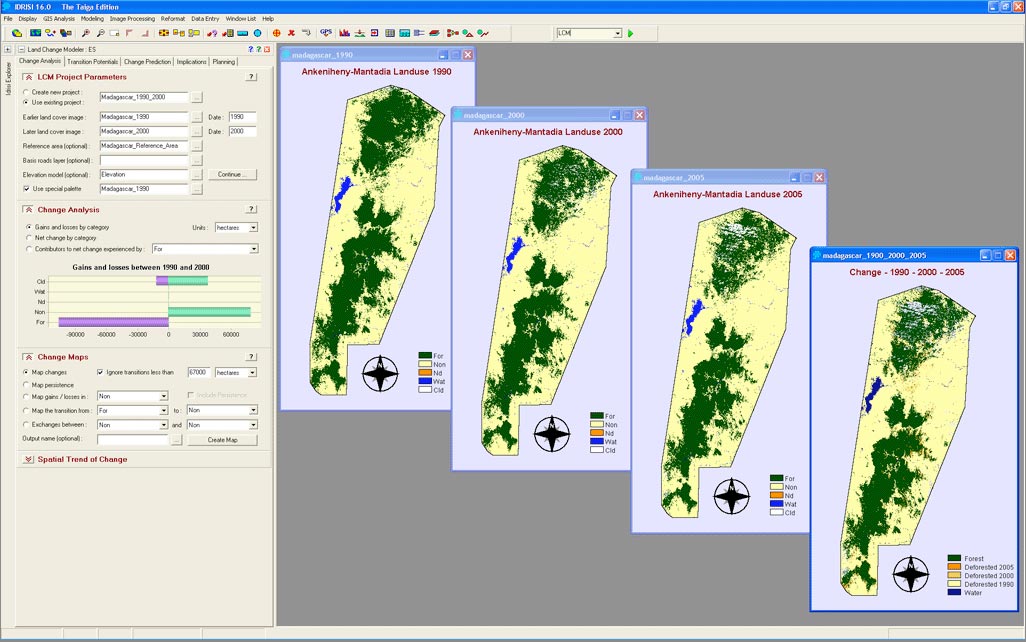
Google has taken a step towards boosting the deforestation monitoring capabilities the Google Earth Engine by contracting Massachusetts-based Clark Labs to develop an online version of its Land Change Modeler application.
Clark Labs' Land Change Modeler is a geographic information system (GIS) software package that enables users to estimate of historical deforestation rates and patterns, identify the drivers of deforestation, and project future deforestation scenarios and associated greenhouse gas emissions. The firm has been marketing the tool for use in projects under the proposed REDD program, a U.N.-backed climate change mitigation mechanism that aims to compensate developing countries for reducing emissions from deforestation and forest degradation.
According to a statement from Clark Labs, Google's philanthropic arm, Google.org, is looking to add Land Change Modeler functionalities to the Google Earth Engine, an online platform which leverages technologies developed by scientists to rapidly analyze and map vegetation, land use, and other environmental data. The engine, unveiled in December at climate talks in Copenhagen, initially launched with forest monitoring tools developed by Carnegie Institution for Science and IMAZON. These tools allow analysts to track changes in forest cover at extremely high resolution in near real-time in the Amazon. The project was coordinated and supported by the Gordon and Betty Moore Foundation.
"The objective of Earth Engine is to enable organizations such as Clark Labs to run their algorithms on-line, powered by Google's computational capacity, with easy access to massive earth observation data sets," said Dr. Amy Luers, Senior Environment Program Manager for Google.org.
The first stage of a REDD project is the understanding of the historical trends in land use change. The Change Analysis tab in Land Change Modeler provides tools for the rapid assessment of change, allowing one to generate a series of evaluations of gains and losses, net change, persistence and specific transitions both in map and graphical form. This figure shows the historical pattern of change in the Ankeniheny-Mantadia Corridor in Madagascar. CLICK IMAGE TO ENLARGE.
Clark Labs says the Land Change Modeler is currently being used by "many governmental and non-governmental organizations" for REDD project development.
The Land Change Modeler is a software extension to ArcGIS, a suite of GIS software products generally used for viewing spatial data, creating maps, and performing spatial analysis.
An important element for predicting future scenarios is understanding the underlying driving forces of change. The transition potential modeling facility in Land Change Modeler allows users to derive transition potential maps based on a set of driver variables, such as: slope, distance from roads, distance from markets, elevation, etc... These variables can be static or dynamic.CLICK IMAGE TO ENLARGE.

Copyright mongabay 2010
Read more... Sphere: Related Content04 February 2010
EU agrees to fund carbon capture trials
By Joshua Chaffin | Financial Times | February 4 2010
Europe’s ambition to become a leading player in carbon capture and storage received a boost when member states agreed a plan that will direct billions of euros to test the unproven technology.
CCS – which involves capturing carbon from power plants and other industrial installations and then burying it underground so that it cannot collect in the atmosphere – is seen by some as a vital part of efforts to reduce global warming.
But it has also aroused considerable opposition because it has not yet been shown to work on a large scale at commercially viable rates. Critics complain that investment in CCS could divert much-needed funds from renewable energy sources – such as wind and solar – and energy-efficiency initiatives.
The European agreement, reached on Tuesday, broke a months-long deadlock between the European Commission and some member states that had imperilled an EU plan to build up to a dozen CCS-equipped demonstration plants by 2015.
Chris Davies, the British MEP who was a co-author of the original initiative, hailed it on Wednesday as “a positive step forward” and estimated that it could yield as much as €10bn ($14bn, £8.7bn) in public funding for CCS in Europe.
“We have now got in place the largest programme in the world for the funding of CCS technology,” said Mr Davies.
The pilot plants are the cornerstone of an EU effort to bring down the cost of the technology and prove its safety so it can become commercially available by 2020. European leaders adopted a European parliament proposal in December 2008 to use revenues from the sale of 300m carbon permits under the EU’s emissions trading scheme to help finance the pilot plants. They also agreed to dedicate some unspecified share to support “innovative renewable energy technologies”.
Those plans have since languished amid a power struggle between member states and the Commission about who should have authority over the allocation of those funds. CCS proponents warned that the delay was causing Europe to lose ground to the US and China in a potentially lucrative green industry of the future.
Under the EU agreement, the Commission and the European Investment Bankwill have a final say as to which projects receive funding to ensure the full range of capture and storage technologies is tested across Europe. The EIB will also oversee the sale of the permits, which will ultimately determine how much money is available.
At current carbon prices, which have been depressed since December’s Copenhagen climate summit, the permits would be worth about €3.8bn. Although it is not compulsory, member states are expected to contribute to the test projects, potentially resulting in billions of additional euros.
Mr Davies expressed confidence that CCS projects would soak up the majority of the funding because their size and financial requirements were much greater than those of the renewable technologies.
Copyright The Financial Times Limited 2010
Read more... Sphere: Related Content22 January 2010
INTERVIEW - Brazil to create climate fund, technology for poor
Brazil will propose the creation of a joint fund with China, India and South Africa to help poor countries adapt to global warming as part of a broader attempt to revive stalled global climate talks.
By Raymond Colitt | Reuters | Thu Jan 21, 2010
Brazil's Environment Minister Carlos Minc said in an interview late on Wednesday that he would make the proposal at a climate summit involving the four emerging market nations this weekend in New Delhi.
"Its purpose will be to help very poor countries adapt to climate change," Minc said, adding that China had already expressed interest in the project.
The proposal is an attempt to breathe new life into global climate talks after the Copenhagen summit failed to produce a broad and definitive accord. Brazil, South Africa, India and China -- a group dubbed BASIC -- reached a non-binding agreement on broad principles with the United States in Copenhagen.
But several poor countries said the rich industrialized world was not offering to cut emissions enough and they expressed fears they would not receive sufficient technology and funding to deal with global warming.
The New Delhi meeting would seek to provide concrete solutions for poor nations but also highlight the need of the rich countries, particularly the United States, to do more, said Minc.
"The resources we'll put into it will call attention to how they are escaping their responsibilities," Minc said without giving a figure.
Rich countries had pledged $30 billion in climate change funding for the 2010-12 period and set a goal of $100 billion by 2020, far less than what developing countries had wanted.
Minc said failure by the U.S. Senate to pass a climate control bill would further hamper chances for a post-Copenhagen deal this year and tarnish President Barack Obama's leadership on the issue.
The future of the bill looked uncertain after the Democrats lost a key Senate seat in Massachusetts to the Republicans this week.
"This would hamper things further," said Minc.
Because Copenhagen failed to provide a road map, groups such as the European Union and the BASIC bloc need to have unified positions to accelerate talks between one another, Minc said.
Brazil, South Africa, India and China would try to standardize their emission targets using the same measurements, Minc said. Brazil aims to cut its emissions as much as 39 percent by 2020, while China pledged to cut carbon dioxide produced for each unit of economic growth by 40-45 percent by 2020.
TECHNOLOGY TRANSFER
The BASIC nations will also seek a common position on technology transfer. Minc proposes measures to create partnerships in which poor countries are not only given access to technology but receive assistance in applying it properly.
Countries like Australia, Canada, and the United States should immediately provide countries like China and India technology to store carbon underground, he said.
"Rich countries demand emissions cuts from the BASICs and we'll say yes but you must provide us the latest technology," Minc said.
Brazil offers satellite images for Latin American and African countries to be able to measure tropical forest destruction, which contributes up to 20 percent of global carbon emissions.
It also provides know-how on water resource management as well as technology to produce and use low-emission ethanol as an automotive fuel, Minc said.
He added that Brazil will spend 20 percent of its Amazon fund on projects in neighbouring countries.
Brazil launched the fund last year to promote sustainable development and scientific research in the world's largest rain forest. It named the first projects last month.
Norway has pledged $1 billion to the fund through 2015 and Germany pledged 18 million euros ($26.8 million). Minc said three more European countries would soon announce donations.
(Editing by Stuart Grudgings and Paul Simao)
Copyright © 2010 Reuters Limited. All rights reserved
Read more... Sphere: Related ContentNot In Our Backyard
Most Germans are in favor of the expansion of renewable energy -- provided the plants aren't built in their neighborhood. All over the country, local groups are coming together to stop solar, wind and biogas projects. But where can power plants be built if no one wants them in their backyard?


Green energy in Germany / DER SPIEGEL
By Wiebke Hollersen | Spiegel Online | Friday, January 22, 2010
Part 1: Popular Protests Put Brakes on Renewable Energy
Hans Fliege likes to go for walks, and he loves the view across the Main River, which is why he moved to the village of Obertheres in Bavaria 30 years ago. But he knows that it isn't a strong enough argument against solar energy parks.
After all, the other side can base its arguments on the prospect of impending climate catastrophe. They could accuse Fliege of being prepared to accept rising sea levels, dried-up fields and hurricanes -- all so that his view of the Main River would remain undisturbed.


Photo Gallery: Citizens against Solar
An investor wants to set up solar modules on two sites in Fliege's village, covering a combined area of 40 hectares (99 acres). Fliege wants to prevent it from happening. He scored an initial victory after recently collecting enough signatures to force a referendum, the first ever in the municipality of Theres, which Obertheres belongs to.
Now Fliege is trying to convince his neighbors to vote against the solar parks in the referendum, which will be held on the last Sunday in February. He is standing in the middle of the assembly room at the Obertheres Gymnastics Association next to his laptop, which he has connected a new projector. "So, from the standpoint of energy production, the issue is complete nonsense for Germany," he says.
The citizens of Theres will not just be voting on the planned solar parks. Instead, they are being asked to decide whether open spaces within the town limits can be used for solar power projects at all.
Fine in Theory
It is a small, local issue, but it relates to some of the world's biggest problems. For instance, it brings to mind the December 2009 United Nations Summit on Climate Change in Copenhagen, which failed when politicians from 192 countries were unable to come to an agreement. This is bad enough, but what happens when citizens are involved in the decision? Are they prepared to adopt a climate-friendly lifestyle? Do they actually want renewable energy?
Hardly anyone opposes it, at least in principle. According to surveys, more than three-quarters of Germans support more green energy. They want to be able to consume energy with a good conscience, preserve their lifestyles and still save the climate -- just not in their own backyards.
Very few Germans live in the vicinity of a conventional large power plant. Renewable energy, however, can be produced anywhere, in every small city or village, using solar panels, wind turbines and biogas plants. But when these energy-producing plants are built close to residential areas, their drawbacks quickly become clear, in the form of noise, stench and changes to the landscape.
This does, in fact, lead to "many reasons for communication" says Björn Klusmann, managing director of the German Renewable Energy Federation (BEE). His choice of words is as smooth as the image of his industry. "In places where things are changing, issues of acceptance arise," he says. But he is also convinced that every dispute is in fact an opportunity for renewable energy.
'People Will Think We're Insane'
Hans Fliege, who is wearing a red cardigan, begins his PowerPoint presentation with a map of the municipality, on which many areas are shaded. These are the potential sites of solar parks, he says.
Fliege, 62, is a retired electrical engineer. Until now, he has kept a relatively low profile, not joining any local clubs and avoiding community events. In fact, he had his first longer conversations with many of his neighbors when he began collecting signatures against the solar parks. He then invited those who seemed the most receptive to his ideas to his meeting at the sports club. Of the roughly two dozen people in the room, most are couples in Fliege's age group, and all are opposed to the solar parks and ready for battle.
"People will think that we're insane," Fliege tells them right off the bat. It will not be easy, he says, to make it clear to people why solar parks in the area are not just ugly, but also a bad idea.
It's warm in the room and the smell of frying grease from the Greek restaurant next door is in the air. Fliege's presentation is getting complicated. He shows his audience tables and diagrams, energy consumption graphs and efficiency figures. He seems to have computed everything possible and has dealt with every conceivable issue.
Emotional Reaction
Does climate change really exist, he asks? Couldn't Germany's nuclear power plants -- which Fliege, who used to vote for the Green Party, generally regards critically because of the question of where to store the nuclear waste -- be kept running for a while longer? Is there even an energy crisis in Germany?
The audience is getting restless. Fliege's wife reminds her husband not to forget about people's emotional reactions to the project. The residents are more concerned about real estate prices in the village than energy consumption figures. Some are probably wondering what solving the radioactive waste storage problem has to do with being against solar parks.
"We don't want those things here. Isn't that enough?" one man asks.
Dieter Rucht from the Social Science Research Center Berlin (WZB) has been studying protest movements for years. Establishing a citizens' initiative or collecting signatures against a development project is no longer seen as the work of troublemakers, but as a rational way of defending one's interests, he says. According to Rucht, everyone feels obliged to establish his or her own lobby. People today are self-confident when dealing with authority figures, more capable of voicing their criticism and more articulate.
But this, says Rucht, has also made the situation more confusing. Large numbers of groups calling themselves citizens' initiatives are being set up. Some claim to be promoting the environment, but are in fact sponsored by industry. "The battle lines are all over the place, and it isn't always clear who's behind a particular initiative," Rucht says.
Part 2: Taking on the Power Companies
In the town of Greifswald in northeastern Germany, Oskar Gulla spent three years fighting the construction of a coal-fired power plant, and now he plans to celebrate victory. The Danish energy company Dong, which was to fund the construction of the plant as the principal partner in the venture, withdrew from the project in December.
The coal-fired power plant was to be built in Lubmin, a nearby beach resort, but four citizens' initiatives blocked the project. Gulla heads the one in Greifswald. Instead of disbanding the group, he says, he wants to push for new regulations and a zoning plan that would ban the burning of coal in Lubmin altogether.
Gulla, 61, is a rotund man with a white beard and many years of protest experience. The student protest movement of the late 1960s, the protests against the Kalkar fast breeder reactor in northwestern Germany, the anti-nuclear power initiatives -- he has been part of them all. He has also been a member of the center-left Social Democratic Party (SPD) for the past 40 years. Eight years ago, he moved from the industrial Ruhr region to Greifswald, partly because of the better air quality, and partly because of his love of sailing and yacht building. He has been very involved in climate protection efforts in recent years.
The new power plant would emit close to 10 million tons of CO2 every year, says Gulla -- at a time when the world is negotiating over every single ton of reduced CO2 emissions. Climate protection was his best argument. However, the proponents of the power plant also used climate change to support their argument, claiming that new coal-fired power plants are part of the energy revolution, because they are cleaner and more efficient than the old plants. Besides, they argued, coal is a necessary part of the energy mix, because wind and solar energy are not constantly available.
Now a modern power plant will not be built in Lubmin, a plant whose electricity would replace that generated in old, heavily polluting coal plants. Is this a success for the climate cause? Gulla wants to see wind turbines built in Lubmin, and he is already preparing for a conference on the subject.
'Criminal Destruction'
Perhaps he should take up the matter with Thomas Jacob, who lives in the eastern state of Brandenburg. He is opposed to new brown coal (lignite) plants and underground CO2 storage in Brandenburg. He also questions the efficiency of solar plants and whether the corn monoculture that is being developed to supply biogas plants is good for the environment.
Jacob is sitting on a couch in his house in the Märkische Heide region, southeast of Berlin, weighing the pros and cons of the energy debate. He has come up with many arguments against wind power, including their shadows, low-frequency infrasound, irritating noise and dead birds. Wind turbines could also be hazardous to human health, he says, but he wants to conduct a study on the issue first.
What bothers him most about wind turbines is what he calls "the criminal destruction of an entire state." Jacob is worried that a forest of giant wind turbines could soon render Brandenburg unrecognizable. A year-and-a-half ago, he co-founded a citizens' initiative called "Against the Mass Development of Wind Energy Plants in Brandenburg."
Nevertheless, Jacob doesn't want to be called an opponent of wind energy. He says he can imagine wind farms being built on abandoned strip mines or decommissioned military bases. His initiative wants to see regulations put in place that would require a distance of at least 1,500 meters (4,920 feet) between a wind turbine and a residence. "We have nothing against wind energy where it doesn't do any harm," he says. He points out that wind energy production in large offshore wind farms is more efficient and doesn't disturb anyone. (The residents of the North Sea resort island of Sylt who have come together to oppose a planned nearby offshore wind farm would presumably disagree.)
Harmful Shadows
When Jacob's initiative compiled its list of demands, it collected almost 27,000 signatures in Brandenburg. But when his group ran in the 2009 election to the state assembly, it won less than 5,000 votes.
Jacob, a TV film director by trade, filmed wind turbines for his group's campaign ad. The turbines are near houses and, in his view, cast harmful shadows on fields. Since the election, however, he has had to rethink his strategy for the initiative.
But now he has a new, smaller fight on his hands: His own neighborhood could be affected by a planned turbine project.
The proposed site is along the B87 highway, near the town of Biebersdorf, a short drive from his house. As he drives by the site, he points to a meadow where 11 turbines are to be built. Eleven new wind turbines, says Jacob, "yet another industrial wind project."
He points to the other side of the highway, where he says a pair of black storks lives. The birds have long been on the International Union for Conservation of Nature's "red list" of threatened species. In a letter to the district commissioner, in which he listed his objections to the proposed wind turbines, he cited the black storks as one of the arguments against the project. He also wrote: "As we see it, the future operators of this industrial wind park are in no way concerned about the climate issue, but are purely in it for the profit."
Sitting on his couch, Jacob says that he finds the hysteria and fuss of the energy debate annoying. With logs burning in the fireplace and apple trees in the garden -- and with not a wind turbine in sight -- he lives in a quiet, idyllic environment. "Why do we need an indoor ski run in Brandenburg?" Jacob asks. Wouldn't it be better if everyone started by saving electricity and reflecting on energy conservation?
It seems that the energy source of the future hasn't been discovered yet -- the one that doesn't bother anyone, isn't visible, doesn't make any noise, doesn't produce objectionable odors and doesn't generate any waste or toxic emissions.
Part 3: Darkness on the Edge of Town
The kind of reflection Thomas Jacob is talking about began last fall in Timmaspe, a village in northern Germany near the city of Kiel. Things suddenly became very loud in Timmaspe, when the energy revolution descended on village life.
Suddenly trucks were roaring through the village day and night, disturbing everyone's sleep, says Jörg Bobsien. He is sitting in his living room, which has a view of Timmaspe's main street. Things have quieted down again, and the traffic has all but vanished.
The trucks were carrying corn waste to a field on the outskirts of town. They eventually left, at which point the farmer who owned the field announced that a biogas plant was going to be built there.
Soon a citizens' initiative was formed in Timmaspe, and Bobsien became its spokesman. The members of the group met, drank wine and produced a flyer. They talked to other residents in the area and discovered that "every community is currently worried about the issue." Biogas plants were in the works all over the area, often sparking protests from local residents.
The Timmaspe citizens' initiative distributed its flyers and collected signatures in the village. Its campaign was a success, at least for the time being. The operator of the planned facility apparently decided to build a new biogas plant in a nearby town, says Bobsien.
No Sensible Policy
"Of course, no one wants a thing like this," Bobsien says. For a spokesman, he tends to be on the taciturn side. He talks about the traffic, the stench and the industrialization of the local economy. A small plant already exists in Timmaspe, at the other end of the village, but Bobsien says he can live with that. But another plant, one that would be at least twice as big, is too much for a village of 1,100 inhabitants, he says.
Bobsien, 46, owns a parquet and interior decorating shop in Hamburg. He lives in a renovated farmhouse in Timmaspe. His windsurfing boards hang in the garage. Bobsien is the kind of person who is sensitive to his immediate environment, and he buys his milk and meat from local farmers. He is worried that farmers will be priced out of the area if local fields are increasingly used to grow corn for the biogas plants.
"And what kind of corn is it, anyway?" asks his wife, who has just walked into the house with the couple's daughters and joins her husband at their long wooden table. "And where does the electricity go?"
Bobsien nods. The traffic, the stench, the industrialization -- these are things he could live with if there were a plan. He is opposed to nuclear power and pollution from coal-fired power plants, But he says that he has the feeling "that no one bothers to think about a sensible energy policy."
Bobsien sounds a lot like Hans Fliege, the man who questions the usefulness of solar parks in Bavaria, and Thomas Jacob, the Brandenburg resident who is convinced that there is no real plan behind all the wind turbines.
Shouldering the Burden
If people have the feeling "that their region is expected to deal with the whole problem on its own," and that they are expected to shoulder the burden without seeing any of the benefits, it's understandable that they would want to fight back, says social scientist Dieter Rucht. One way forward, he suggests, would be if people in each region had to decide for themselves how to provide their electricity.
Perhaps it's a good thing that we now have to think about these things, says Jörn Bobsien, the activist in Timmaspe.
When the members of the Timmaspe citizens' initiative hold their next meeting, they decide that their village should produce its own energy in the future. And to achieve that goal, they say, they would even accept a biogas plant.
Translated from the German by Christopher Sultan
© SPIEGEL ONLINE 2010 All Rights Reserved
Read more... Sphere: Related Content10 January 2010
No hiding place?
The betting is that 2010 will be the hottest year on record. But understanding how the planet’s temperature changes is still a challenge to science
The Economist | Jan 7th 2010
Science Photo Library
IT MAY seem implausible at the moment, as northern Europe, Asia and parts of America shiver in the snow, but 2010 may well turn out as the hottest year on record. Those who doubt that greenhouse gases are quite the problem they have been cracked up to be by most of the world’s climatologists have taken comfort from the fact that the Hadley Centre, part of Britain’s Meteorological Office, reckons the warmest year since records began was 1998 (see chart 1). Twelve years without a new record would, the sceptics reckon, be rather a large lull in what is supposed to be a rising trend. Computer modelling by the Met Office, though, gives odds-on chances of the lull being broken.

The fact that no record high happened in the 2000s does not mean that there was no warming over the decade—trends at scales coarser than the annual continued to point upwards, and other authorities suggest there have been record years during the period. Nor was the length of time without an annual record exceptional. Models simulating centuries of warming normally have the occasional decade in which no rise in surface temperatures is observed. This is because heat can be stored in other parts of the system, such as the oceans, for a time, and thus not show up on meteorologists’ thermometers.
Indeed, one reason for thinking that the coming year will be hotter than all known previous ones is that the tropical Pacific is currently dumping heat. This phenomenon, by which heat that has been stored up in the sea over the previous few years is released into the atmosphere, is known as El Niño. A strong Niño contributed to the record temperatures in 1998. In 2007 and 2008 the opposite phenomenon, a cooling Niña, was happening. That goes some way to explaining why those years were chilly by the standards of the 2000s.
And on top of El Niño, there is the sun. The sun’s brightness fluctuates over an 11-year cycle. Though the fluctuation is not vast, it is enough to make a difference from peak to trough. In 2009 the sun was at the bottom of its cycle. Unless it is behaving particularly strangely, it should, over the next 12 months, begin to brighten.
The Met Office’s forecast was made using the Decadal Prediction System, or DePreSys (pronounced “depresses”, which is what it sometimes does to Doug Smith and his colleagues, who run it). Climate models are normally used to show how the climate’s behaviour will respond to changes in things like greenhouse-gas levels. But though a model’s response will, it is hoped, be similar to the real climate’s, models are caricatures, not portraits. Trying to force one into a state that looks exactly like the real climate at a specific time, as prediction requires, will distort it, and it is likely to misbehave as a result.
DePreSys is an attempt to work round this “initialisation” problem—to give the model’s caricature not just an all-purpose resemblance to the way the real climate behaves, but one that captures its pose and expression at a particular moment. In 2007 the first study using DePreSys correctly predicted that there would be a few more years which would set no records. After this, it said, there would be a definite rise in temperature. More recently, Dr Smith and his team have been using clusters of computers around Britain to run multiple models with slightly different initial conditions. Four-fifths of these runs suggest 2010 will be warmer than any previous year—which could be taken as odds of four-to-one on. The techniques are still in their infancy. But they are at least making predictions that can be checked.
Balancing the books
Dr Smith and his colleagues are trying to predict some of the natural variability to come. Kevin Trenberth of America’s National Centre for Atmospheric Research wants to understand in detail the natural variability just seen. His quest gained unexpected prominence when one of his forcefully expressed e-mails on the subject—“The fact is that we can’t account for the lack of warming at the moment and it is a travesty that we can’t”—found its way into the public domain as one of thousands of e-mails from the Climatic Research Unit of the University of East Anglia in the “climategate” furore of November 2009.
Dr Trenberth was not, he has since been at pains to stress, saying that the relatively unwarmed 2000s were particularly out of the ordinary. Instead, he was saying that, given the panoply of satellites and measurement networks that are being installed to monitor the climate, it should now be possible to identify the places and processes that hide energy from the prying eyes of climatologists. That would make it possible to determine what has actually happened to the energy trapped by increasing levels of greenhouse gases.

For the first part of the decade this turns out to be possible. From 1998 to 2003, although surface temperatures were not rising, a lot of energy was mopped up by the oceans (see chart 2). This is borne out by the rise in sea level during the period, which matches (once the additional effects of melting glaciers and ice sheets are taken into account) the expansion of the water in the oceans caused by this heating. Until the middle of the 2000s, therefore, the sums seem to balance.
It is after that that the problem comes. Runoff’s role in the rising sea level increases, meaning the fraction attributable to expansion, and thus the amount of heat taken up by the sea, has fallen (and the chart therefore levels out). The missing heat must therefore be going somewhere else. One possibility is that it is being reflected back into space by changes in cloud cover. The data, however, seem to say no. America’s CERES programme, the result of observations by seven different instruments on six different satellites, suggests the Earth has actually absorbed more energy and reflected away less over the past few years, rather than the other way round. It is all rather mysterious.
Nevertheless, while there is a lot of scepticism in, around and about climate science, none of it is aimed at the first law of thermodynamics, which says that energy cannot be created or destroyed. The energy that the sun delivers to the Earth must therefore be equal to the energy that is reflected back into space, plus that re-emitted as infra-red radiation, plus that stored in some part of the atmosphere, the oceans or the land.
The fact that the books cannot currently be balanced is therefore an admission of ignorance—an ignorance that better, future measurements should help abolish. That, in turn, should allow predictions of what the climate will do next, for good or ill, to become significantly better, and thus deprive climatic bookies of their trade.
Copyright © The Economist Newspaper Limited 2010. All rights reserved
Read more... Sphere: Related Content30 December 2009
Is clean tech the next bubble?
Out with the Aughts
Vanmala Subramaniam | Financial Post | December 28, 2009
President Barack Obama visits DeSoto Next Generation Solar Energy Center in Arcadia, Fla. (ReutersU.S.)
The past decade saw investors do a tap dance to the tune of Boom and Bust. First there was the dot-com bubble and the slew of other technological breakthroughs that came with it. Then we witnessed the supposedly invincible housing market complete a jaw-dropping boom-bust cycle. The young 21st century even delivered a notable financial bubble, as well as its inevitable bust.
Sidling along in the background were the seedlings of an industry on the verge of taking flight - alternative-energy technology.
Despite a drop in the overall volume of venture-capital deals last year, investments in clean-technology companies totalled US$8.4-billion, up nearly 40% from 2007, says a 2008 report by Cleantech Group, a San Francisco-based trade organization. In the third quarter of 2008 alone, venture capitalists poured US$2.65-billion into clean technology, a quarterly record. In the fourth quarter, they invested US$1.7-billion.
Public and interest-group furor over climate change has escalated in the past decade. The result? Major governments are waking up from their long slumber and pumping dollars into the clean-tech industry. Leading this pack is Barack Obama, the U.S. President, who recently vowed to triple investment in the United States' clean-tech industry over the next four years.
This is significant, says Donald Dewees, an environmental economist and professor at the University of Toronto.
"Governments are pouring millions or billions of dollars, euros or pesos on green-energy technology," said Prof. Dewees. "Then there is the added factor of expectation of more aggressive public policy on global warming after Copenhagen. Stocks of alternative-energy producers will rise as investors anticipate these growing subsidies. We are definitely going to see a clean-tech bubble in the first few years of the next decade."
Should breathless clean-tech investors be worried? Technological booms, after all, do not seem to have a history of sustainability.
"Whether or not this alternative-energy technology boom will last depends on how far we will go initially and how much we invest, and hence how disappointed we will be by the underperformance," says Vaclav Smil, a leading environmental researcher and professor at the University of Manitoba.
Prof. Smil is skeptical. He says there is just too much hype about renewable conversions, while the reality is that they simply cannot supply as high a share of electricity consumption as is now widely, and mistakenly, assumed.
"We are not going to be able to heat our houses, power our industries and cars and grow our food with wind- or solar-generated electricity any time soon," he says.
That overestimation, and the sky-high costs of generating alternative energy, seem to be the two main factors that may catalyse the burst of this bubble in the next decade. Alternative energy costs at least four times more than conventional energy. Thus, it cannot survive without subsidies.
"Where the subsidy is in the form of a feed-in tariff, the cost of the electricity that is generated will rise to unpopular levels. Public outrage will cause share values in alternative energy firms to drop as the bubble bursts," said Mr. Dewees.
There is some optimism, however.
Kerry Adler, chief executive of Skypower Inc., an Ontario-based solar-panel energy firm, believes that next decade's bubble will not be an alternative-energy technology one.
"I won't call it a bubble. It's more of a flower garden - some [innovations] will wilt and some will sprout," said Mr. Adler. "We will definitely see a form of consolidation of the best technology."
Mr. Adler is confident alternative energy is in for the long haul.
"This is not like the dot-com bubble. In that industry, it was all about traffic and revenue. This industry has the look and feel of dot-com, but it is much more advanced than that. When you are in a world that is energy-starved, there is no bubble - it is serious. Venture capital is going in but it is going to stay in."
© 2009 National Post Inc. All rights reserved
Read more... Sphere: Related Content
Subscribe to:
Posts (Atom)


 Posts
Posts