Showing posts with label fossifuels. Show all posts
Showing posts with label fossifuels. Show all posts
19 April 2012
Read more... Sphere: Related Content
 Friday marks the two-year anniversary of the explosion of the Deepwater Horizon drilling rig in the Gulf of Mexico. Photo: Reuters
13 April 2012
Fuel to Burn: Now What?
The reversal of fortune in America’s energy supplies in recent years holds the promise of abundant and cheaper fuel, and it could have profound effects on what people drive, domestic manufacturing and America’s foreign policy
By JAD MOUAWAD | The New York Times | April 10, 2012
 Jesse Lenz
Read more...
Sphere: Related Content
Out of Africa (and Elsewhere): More Fossil Fuels
The world’s largest energy companies have big plans for Mozambique
By MARK SCOTT | The New York Times | April 10, 2012
 A rig near the village of Lesniowice in Poland, where Chevron has been exploring for shale gas. Kacper Pempel/Reuters
Read more...
Sphere: Related Content
08 April 2012
How to Start Your Own Power Company, Stop Coal and Nukes, and Transform Your City
2011 Goldman Prize winner Ursula Sladek discusses how she became an unwitting energy mogul -- and a global environmental hero
By Sven Eberlein | AlterNet |March 28, 2012
 Photo Credit: Goldman Environmental Prize
Read more...
Sphere: Related Content
31 March 2012
Indonesia opposition parties block fuel price hike
Leading Indonesian political parties said on Friday they will oppose a government plan to raise fuel prices unless oil prices climb further, dealing a blow to the ruling party's efforts to control a swelling budget deficit in Southeast Asia's largest economy
Reuters | Mar 30, 2012
Read more... Sphere: Related Content28 March 2012
Global oil risks in the early 21st century
The Deepwater Horizon incident demonstrated that most of the oil left is deep offshore or in other locations difficult to reach. Moreover, to obtain the oil remaining in currently producing reservoirs requires additional equipment and technology that comes at a higher price in both capital and energy. In this regard, the physical limitations on producing ever-increasing quantities of oil are highlighted, as well as the possibility of the peak of production occurring this decade
by Dean Fantazzini, Mikael Höök, and André Angelantoni | Mar 27 2012 by The Oil Drum in Energy Bulletin | Mar 27 2012
Read more... Sphere: Related ContentEnd of coal power plants? EPA proposes new rules
The Obama administration on Tuesday proposed the first-ever standards to cut carbon dioxide emissions from new power plants -- a move welcomed by environmentalists but criticized by some utilities as well as Republicans, who are expected to use it as election campaign fodder
By msnbc.com Staff | MSNBC | March 27, 2012
 This coal-fired power plant is used by the city of Chicago, which last month decided to close it down by the end of 2014. A second coal plant will be closed by the end of this year. Chicago is the only large U.S. city with coal-fired power plants operating within its city limits. M. Spencer Green / AP
Read more...
Sphere: Related Content
26 March 2012
RIP Exxon Valdez
For some Saturday’s Anniversary would have been a painful reminder of the reckless behaviour of Big Oil
Andy Rowell | Oil Change International | March 26, 2012

24 March 2012
Shell in court over Nigeria oil spill compensation
Lawyers representing a Nigerian fishing community are taking the oil firm Shell to court in London over alleged unpaid compensation for recent oil spills
BBC News | 23 March 2012
 Ogoni people say their land has been devastated by pollution from the oil industry over many years
Read more...
Sphere: Related Content
21 March 2012
The oil price is the new eurozone crisis
No sooner has the pressure on markets from the eurozone crisis begun to ease than investors have found something else to worry about – the oil price
By Tom Stevenson | The Telegraph | 17 Mar 2012
 An oil price spike is never welcome but it would be particularly damaging with the global economy in such a weak state Photo: AP
Read more...
Sphere: Related Content
20 March 2012
Drilling for Oil in Eden: Initiative to Save Amazon Rainforest in Ecuador Is Uncertain
The most biologically diverse habitat in the western hemisphere, the Yasuní rainforest in Ecuador, is under threat. One hectare contains more species of trees than all of North America, but hidden beneath this Garden of Eden lies temptation: oil worth billions
By R. Douglas Fields | Scientific American | March 17, 2012
 Pumping gasoline in Quito, Ecuador. Oil drilling threatens the Yasuní rainforest. Petroleum is Ecuador's primary source of income, but the country's reserves will be depleted in 15-20 years.
Read more...
Sphere: Related Content

15 March 2012
Has the global economy become less vulnerable to oil price shocks?
This paper examines the impact of oil price changes on global economic growth. Unlike some recent studies, this paper finds that oil price rises have had significant negative impacts on world economic growth
by Dr. Mingqi Li | Mar 14 2012 by The Oil Drum in Energy Bulletin | Mar 14 2012
Read more... Sphere: Related Content14 March 2012
A tough-oil world
A Tough-Oil World: Why High Gas Prices Are Here to Stay
by Michael T. Klare | Mar 13 2012 by Tom Dispatch in Energy Bulletin | Mar 13 2012

10 March 2012
China Coal Update
World coal production and consumption data for 2011 are not yet compiled and published, but one key number is in. China’s Ministry of Industry and Information Technology reports that the country’s coal output rose 8.7 percent from 2010 to reach 3.88 billion short tons last year
by Richard Heinberg | Mar 8 2012 by Post Carbon Institute in Energy Bulletin | Mar 9 2012

07 March 2012
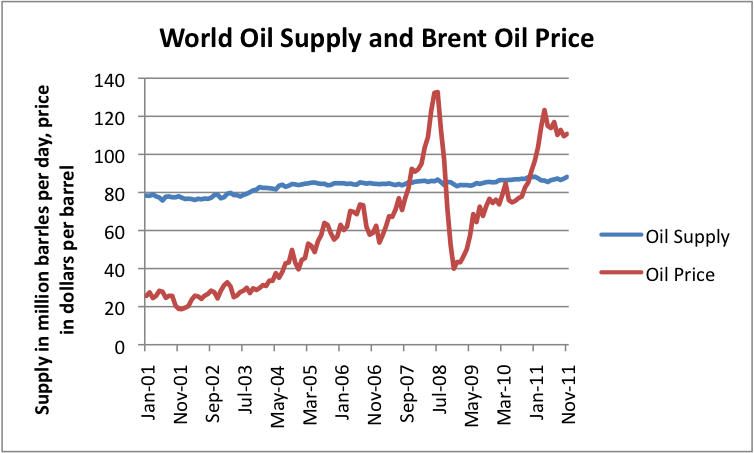
Why high oil prices are now affecting Europe more than the US
The world is presently sharing a limited supply of oil. When oil prices rise, oil production doesn’t rise very much, if at all
by Gail Tverberg | Mar 5 2012 by Our Finite World in Energy Bulletin | Mar 7 2012
 Figure 1. Brent oil spot price and world oil supply (broadly defined), based on EIA data.
Read more...
Sphere: Related Content
06 March 2012
How forest cover and oil reserves match four countries’ positions on REDD
In the outcome of the Ad Hoc Working Group on Long Term Cooperative Action at the Durban COP17, the LCA invited “views on modalities and procedures for financing results-based actions and considering activities related to decision 1/CP.16, paragraphs 68–70 and 72″
By Chris Lang | REDD-Monitor | 6th March 2012

Insight: Papua New Guinea mountain disaster questions Exxon
A deadly landslide in the mountains of Papua New Guinea, near where U.S. oil major Exxon Mobil is building a $15.7 billion gas project, is raising fresh questions about the global energy industry's scramble for ever harder-to-reach resources
By Rebekah Kebede | Reuters | Mar 6, 2012

03 March 2012
BP reaches $7.8 billion deal over Gulf of Mexico spill
BP Plc has reached an estimated $7.8 billion deal with plaintiffs suing over the massive 2010 Gulf of Mexico oil spill, the company said on Friday, but the oil giant still faces claims by the U.S. government, Gulf states and drilling partners
By Andrew Longstreth | Reuters | Mar 3, 2012
 Fire boat response crews battle the blazing remnants of the offshore oil rig Deepwater Horizon, off Louisiana, in this April 21, 2010 file handout image. Credit: Reuters/U.S. Coast Guard/Files/Handout
Read more...
Sphere: Related Content
Venezuela's Opec stand is a win for climate change campaigners
Environmentalists who support developing countries' fight against polluters should also back their struggle for control of oil
Mark Weisbrot | guardian.co.uk | 2 March 2012
 Pablo Fajardo, the lead Ecuadorian lawyer in indigenous peoples' case over pollution against oil company Chevron. Photograph: Jose Jacome/EPA
Read more...
Sphere: Related Content
01 March 2012
Mining boom accelerates land grabbing and ecosystem destruction
“This trend is now a major driver of land grabbing globally, and poses a significant threat to the world’s indigenous communities, farmers and local food production systems, as well as to precious water, forests, biodiversity, critical ecosystems and climate change.”
Ian Angus | Climate and Capitalism | March 1, 2012
Read more... Sphere: Related Content
Subscribe to:
Posts (Atom)


 Posts
Posts