Showing posts with label world. Show all posts
Showing posts with label world. Show all posts
07 May 2012

07 April 2012
Growing Food Demand Strains Energy, Water Supplies
The northern region of Gujarat State in western India (map) is semi-arid and prone to droughts, receiving almost all of its rain during the monsoon season between June and September. But for the past three decades, many crop and dairy farms have remained green—even during the dry season
Jeff Smith | National Geographic News | April 6, 2012
 A man irrigates his field with an electric water pump east of Gauhati, in northern India. Excessive water pumping has strained both water and energy supplies in India, China and other hot spots around the world. Photograph by Anupam Nath, Associated Press
Read more...
Sphere: Related Content
17 March 2012
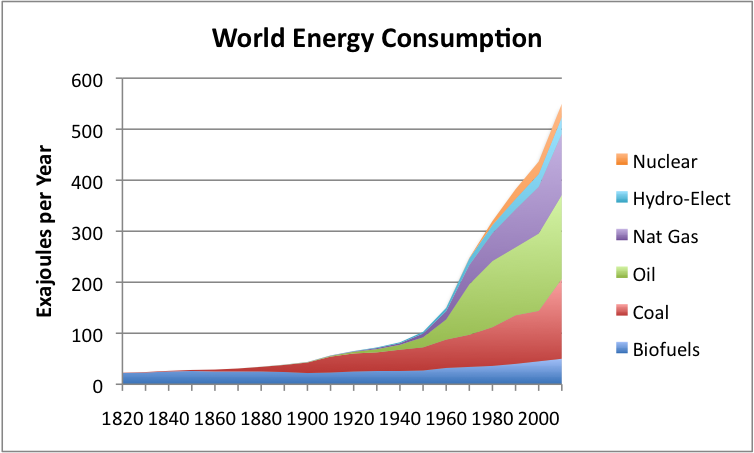
World energy consumption since 1820 in charts
With energy consumption rising as rapidly it is hard to see what is happening when viewed at the level of the individual
by Gail Tverberg | Mar 16 2012 by The Oil Drum in Energy Bulletin | Mar 16 2012
 Figure 1. World Energy Consumption by Source, Based on Vaclav Smil estimates from Energy Transitions: History, Requirements and Prospects together with BP Statistical Data for 1965 and subsequent
Read more...
Sphere: Related Content
15 March 2012
Has the global economy become less vulnerable to oil price shocks?
This paper examines the impact of oil price changes on global economic growth. Unlike some recent studies, this paper finds that oil price rises have had significant negative impacts on world economic growth
by Dr. Mingqi Li | Mar 14 2012 by The Oil Drum in Energy Bulletin | Mar 14 2012
Read more... Sphere: Related Content13 March 2012
World water supply threatened
Increasing demand and climate change are threatening global water supplies
By Irinia Bokova | United Nations in Disaster News Network | March 12, 2012
Read more... Sphere: Related ContentRio in 100 days: A consuming challenge
For anyone still persuaded that the phrase "sustainable development" is deployed as a treehugger plot to prevent any development at all, the words of the UN's top climate official on Friday should act as something of a corrective
Richard Black | BBC News Science & Environment | 12 March 2012
 Rio may result in a commitment to shift away from fossil fuels towards new energy technologies
Read more...
Sphere: Related Content
10 March 2012
Remotely Piloted War
In the American mind, if Apple made weapons, they would undoubtedly be drones, those remotely piloted planes getting such great press here. They have generally been greeted as if they were the sleekest of iPhones armed with missiles
By Tom Engelhardt | Foreign Policy in Focus | March 6, 2012
Read more... Sphere: Related Content12 February 2012
Processed food and coronary capitalism
The food industry is characterised by market failures that pass external costs on to consumers and to society
Kenneth Rogoff | Al Jazeera | 11 Feb 2012
 More than one in six US children and adolescents are reportedly obese, triple the 1980 rate [GALLO/GETTY]
Read more...
Sphere: Related Content
10 February 2012
The new geography of trade
Globalisation's decline may stimulate local recoveries
Fred Curtis and David Ehrenfeld | Al Jazeera | 09 Feb 2012
 Relocalisation and Transition Towns movements are springing up in developed countries in response to higher oil prices and transport costs - and many 'eco-towns' have been built in Europe [GALLO/GETTY]
Read more...
Sphere: Related Content
31 January 2012
'Peak timber' concerns in tropics
Current tropical timber practices are not sustainable and nations should consider the "implications of 'peak timber'", a study has suggested
By Mark Kinver | BBC News | 24 January 2012
 Tropical timber production exceeds forests' ability to replace the felled trees, the study says
Read more...
Sphere: Related Content
30 January 2012
No oil for old countries
I THINK my colleague is right to take some encouragement from the latest Energy Information Agency outlook. As one would expect to occur amid a period of sustained, high oil prices, American oil consumption has fallen from 2005 while its production has risen
The Economist | Jan 24th 2012
Read more... Sphere: Related Content22 January 2012
The future of food
By 2050 there will be another 2.5 billion people on the planet. How to feed them? Science's answer: a diet of algae, insects and meat grown in a lab
John Vidal | The Observer | 22 January 2012
 Seaweed harvesting in Bali. From seaweed to slime, algae is the future of food, says Professor Mark Edwards Photograph: Ed Wray/AP
Read more...
Sphere: Related Content
21 January 2012
Theme and variations
State capitalism is not all the same. It is easy for a casual visitor to China to be fooled into thinking that he is in a normal capitalist country. The big cities are dotted with Starbucks and Kinkos. The newspapers run stories about small businesspeople falling prey to loan sharks
The Economist | Jan 21st 2012

Why now? What’s next? Naomi Klein on Occupy
Naomi Klein in discussion with Occupy Wall Street activist Yotam Marom
Naomi Klein, Yotam Marom | Red Pepper | January 2012

From Davos to Dystopia
Not long ago the World Economic Forum (WEF) found itself in the sights of the global economic justice movement. At the turn of the last century, before anyone was “occupying” public spaces in protest at the growing inequalities between the top strata of society and the rest, a broad global coalition of environment, development, and peace activists were targeting the public meetings of major institutions such as the WTO, the IMF, and the G8
By Ben Zala | Foreign Policy in Focus | January 19, 2012
 World Economic Forum in Davos
Read more...
Sphere: Related Content
Fossil fuel subsidies: a tour of the data
Fossil fuels are subsidised in much of the world, causing billions of tonnes of addition CO2 emissions
by Duncan Clark | guardian.co.uk | 19 January 2012
 Fossil fuels are subsidised in much of the world, causing billions of tonnes of addition CO2 emissions. Photograph: AFP/Getty Images
Read more...
Sphere: Related Content
14 January 2012
Oil's Trouble Spots
At a time of rising dependence on oil, the potential for supply disruptions and the stability of energy-rich regions pose major concerns. While disruptions can happen anywhere along the supply chain, certain areas are particularly vulnerable
Toni Johnson | Council on Foreign Relations | January 13, 2012
Read more... Sphere: Related ContentScientists scrutinise first draft of Rio+20 agreement
The starting document for negotiations ahead of the Rio+20 summit ― the 'zero draft' ― contains more references to science than was expected by the scientific community, but still falls short on the specifics and avoids mentioning some critical, science-related issues
Mićo Tatalović | Science and Development Network | 12 January 2012

Local scientists should be supported to develop green technologies, says the zero draft. Flickr/Sustainable_Sanitation
Read more... Sphere: Related Content
11 January 2012
The return of "The Limits to Growth"
The return of interest in "The Limits to Growth" continues. After decades of ridicule and insults, the value of the 1972 study and of its sequels is more and more recognized. The latest item in the series of revisitations is the article published by Debora McKenzie in the New Scientist on Jan 10, 2012 and titled "Boom and Doom, revisiting prophecies of collapse" (can be read on the New Scientist site after registration)
by Ugo Bardi | Jan 10 2012 by Cassandra's legacy in Energy Bulletin | Jan 10 2012
 The main results of the "base case" scenario of "The Limits to Growth" study, from a recent article on theNew Scientist by Debora McKenzie (available upon registration)
Read more...
Sphere: Related Content

09 January 2012
Time to Worry: World Oil Production Finishes Six Years of No Growth
As oil prices rose ever higher in the last decade, the optimists kept predicting rising production capacity and plummeting prices. Looks like they got it wrong
By Kurt Cobb | SCITIZEN | 2 Nov 2011

Subscribe to:
Posts (Atom)


 Posts
Posts