Showing posts with label data. Show all posts
Showing posts with label data. Show all posts
05 January 2012
29 October 2011
Why Economic Models Are Always Wrong
Financial-risk models got us in trouble before the 2008 crash, and they're almost sure to get us in trouble again
By David H. Freedman | Scientific American | October 26, 2011
Read more... Sphere: Related Content
MESSY MARKETS: Financial models get put to the test in the New York Stock Exchange on Wall Street and other markets.Image: ToonariPost
25 October 2011
Breakthrough technology enables 3D mapping of rainforests at the level of individual trees
High above the Amazon rainforest in Peru, a team of scientists and technicians is conducting an ambitious experiment: a biological survey of a never-before-explored tract of remote and inaccessible cloud forest. They are doing so using an advanced system that enables them to map the three-dimensional physical structure of the forest as well as its chemical and optical properties
Rhett A. Butler | mongabay.com | October 24, 2011
Read more... Sphere: Related Content
This image shows a small deforested patch with individual trees, colored by height. The densest biomass is red, while deforested areas — with low biomas — are shades of blue. Image courtesy of the Carnegie Airborne Observatory. Click picture to enlarge.
11 October 2011
2010 drought damaged Amazon as much as man-made deforestation
The drought of 2010 caused about as much damage to the Amazon as man-made deforestation in that year, according to researchers in the US.
Nadya Anscombe | Environmental Research Web | Oct 3, 2011
Read more... Sphere: Related Content

Forest loss

01 April 2010
Climategate’s culture
British MPs are concerned about the way climate scientists have worked, but not about their results
The Economist | Mar 31st 2010
The University of East Anglia’s climate scientists, and indeed the results of climate science in general, are OK. The practice and culture of climate science, and the procedures of the university, are not. That is the conclusion of a report on the “climategate” e-mails by the MPs on the Science and Technology Committee of Britain’s House of Commons, the first of three different reports on the subject expected over the next few months. The e-mails, apparently stolen, have been seized on as evidence of various types of dishonesty and skulduggery in climate science since their release onto the internet late last year.
The MPs’ most striking prescription is that climate science should hold itself, and be held to, a higher standard than heretofore when it comes to openness and transparency. When giving evidence to the committee, Phil Jones, the head of the UEA’s Climatic Research Unit (CRU), from which the e-mails came, said that freely disclosing data and the computer codes used to work with them “has not been standard practice” in the field. “If it is not standard practice how can the science progress?” asked Graham Stringer, a member of the committee. “Maybe it should be standard practice,” replied Dr Jones, “but it is not standard practice across the subject.” The MPs concluded that in a field as significant and important to policy as climate change this was not good enough. They are calling for data and methodological workings to be made openly available. On occasions when data are provided to scientists on the basis that they will not be further promulgated (as with some of the data Dr Jones used from meteorological agencies in other countries) that should be made clear, with all requests redirected to the relevant data-holders.

Many climate scientists will claim that the field is already highly transparent in these regards, and it is true that much data is freely available. But Dr Jones’s position on what has, in the past, constituted standard practice suggests that such claims to transparency have to be judged case by case.
In remarks he made at the launch of the report, the committee’s chairman, Phil Willis, said the current “culture of non-disclosure” was “reprehensible”. Evan Harris, another member of the committee, was quick to point out that that is not a word used in the report proper, which is supportive of Dr Jones and his colleagues: Dr Harris himself successfully moved an amendment to the report which said that, on the basis of the evidence seen, “the scientific reputation of Professor Jones and CRU remains intact”, a conclusion that the university particularly welcomed. The report says that on the evidence the MPs saw no reason to think the scientists dishonest or their science besmirched, or to doubt the consensus among climate scientists that humans are warming the world and will warm it further. The MPs accepted that the much-blogged-about use of “trick”, when applied to a way of representing data, and “hide the decline”, as applied to a set of data in which tree rings that were held to be useful at some times were held to be useless at others, were in no way evidence of obfuscation. And it sympathised with the scientists’ frustration at having to deal with numerous freedom of information requests from people who the scientists believed wanted to obstruct their work.
Frustration aside, the committee deemed the approach which CRU took to at least some of these requests made under the Freedom of Information Act (FOIA) unacceptable. But its criticisms over prima facie evidence that the act had been breached were aimed more at the university authorities than at the scientists. The university, it found, had supported the scientists in non-disclosure, rather than helping them follow the act’s procedures. If a small number of FOIA requests had been dealt with properly early on, it seems possible that the large number of requests last year (over 100) might have been averted, or could, perhaps, have been rejected as vexatious. The committee also chided the office of the information commissioner for going beyond what it could say for sure when it told theSunday Times that the act had been broken but that it could do nothing about it because six months had elapsed. And it took the opportunity for a dig at the government, which said last summer that there was no reason to see that six-month limit as posing problems. It does here.
A full account of whether the terms of the act were actually broken, the MPs said, should come from either the information commissioner or from the “Independent Climate Change Email Review” that the university has set up, and which will produce one of the next two reports on the matter. The other will be from a “Scientific Appraisal Panel” with members chosen by the Royal Society. The e-mail review panel will look further at evidence for manipulation or suppression of data, for poor practice with respect to peer review, at attempts to circumvent FOIA and at how the e-mails got out in the first place. The appraisal panel will look to see whether any of the issues raised invalidate the scientific papers produced at CRU over the past decades.
The membership of both panels has been criticised for partiality by various blogs taking a close and unfriendly interest in the matter, pointing out, for example, that the chairman of the appraisal panel, Lord Oxburgh, has investments in clean energy companies (he was also, briefly, the chairman of Shell), and that some of the panels’ members have pre-existing commitments to the consensus view among climate scientists, or academic links to the CRU scientists. Their criticisms were taken up by Mr Stringer, who in the end voted against the report as released.
Mr Stringer moved to have the report urge that it is “vital that these two inquiries have at least one member each who is a reputable scientist, and is sceptical of anthropogenic climate change.” The rest of the committee voted this suggestion down, arguing that scepticism was a proper attitude expected of all, rather than the badge of a preceding conviction. Steve McIntyre, a retired Canadian mining consultant whose blog, Climate Audit, has been the source for much detailed critique of climate reconstructions, including those of CRU, might, though not an academic, be the sort of person Mr Stringer is thinking of. For his part, Mr McIntyre says that his preference would not be for someone sceptical of anthropogenic global warming per se, but rather for someone familiar with the detailed issues that he and others have raised—or, better yet, for a judge.
Copyright © The Economist Newspaper Limited 2010. All rights reserved
Read more... Sphere: Related Content30 March 2010
U.N. panel suspends two more carbon emissions auditors
The reputation of a Kyoto Protocol carbon finance scheme was dealt another blow after a UN climate panel late on Friday suspended the third emissions cut verifier in 15 months, and partially suspended a fourth
Michael Szabo | Reuters | Mar 26, 2010
The scheme's executive board suspended emissions auditors TUEV SUED and partially suspended Korea Energy Management Corporation (KEMCO) after spot checks at the companies' offices revealed procedural breaches.
The board, an arm of the UN's climate change secretariat, said it will work with TUEV SUED and KEMCO to ensure timely resolution of the issues.
Under Kyoto's Clean Development Mechanism (CDM), companies can invest in greenhouse gas cuts in developing countries and in return receive carbon offsets which they can sell for profit.
In the tightly regulated $33 billion market, clean energy projects need to be validated by private sector certification firms called designated operational entities (DOEs). DOEs also verify the emissions cuts before projects can receive offsets from the UN.
Germany's TUEV SUED is the second largest CDM validator having approved 1,147 projects or nearly one fifth of all validated to the end of February.
The firm is also a major emissions cuts verifier, confirming from some 100 projects reductions of nearly 84 million tonnes of CO2, or 21 percent of the 395 million tonnes verified to date.
By contrast, KEMCO is much smaller, validating only 0.8 percent of all projects so far and verifying the cuts for a single project.
The CDM's executive board said it suspended TUEV SUED for not following procedures and for giving "a positive validation opinion to some projects even though it had concerns about additionality."
Additionality refers to projects needing to prove they are financially unviable without the prospect of receiving funding through the CDM.
The board said it also had concerns over the qualifications of some of TUEV SUED's personnel.
The board rejected KEMCO's re-accreditation application due to issues also including employee qualifications.
Both firms can continue with existing work but are barred from taking on new validations or verifications, the board said.
"There's such a backlog of offset issuances (at the UN) that a suspension merely means TUEV SUED's issuances will be replaced by other ones," said Alessandro Vitelli of IDEAcarbon, adding that it likely will not immediately affect offset prices.
The CDM's board suspended DOEs SGS UK last September and DNV in December 2008. Both have since been reinstated, but analysts said the effects of the suspensions on offset supplies have not yet been fully felt by the market.
The board also confirmed on Friday the accreditation of another DOE, TUEV NORD, after it passed a similar spot check.
PROJECTS
The board registered around 40 projects, mainly in China, including some 24 hydroelectric dams and six wind farms.
It rejected registration requests from three projects in China, two cement plant waste heat recovery projects and a hydroelectric dam, collectively expected to generate over 500,000 tonnes in carbon cuts by 2012, according to UN data.
Britain's Climate Change Capital and Dutch bank Rabobank were listed as offset buyers for the projects.
The board's meeting report can be read at cdm.unfccc.int/EB/index.html. The board's next meeting is scheduled for May 24-28.
(Editing by Marguerita Choy)
© Copyright 2010 Thomson Reuters
Read more... Sphere: Related Content14 March 2010
UN climate change claims on rainforests were wrong, study suggests
The United Nations' climate change panel is facing fresh criticism after new research contradicted the organisation's claims about the devastating effect climate change could have on the Amazon rainforest
By Richard Gray | Telegraph.co.uk | 13 Mar 2010
A new study, funded by Nasa, has found that the most serious drought in the Amazon for more than a century had little impact on the rainforest's vegetation Photo: REX
A new study, funded by Nasa, has found that the most serious drought in the Amazon for more than a century had little impact on the rainforest's vegetation.
The findings appear to disprove claims by the Intergovernmental Panel on Climate Change (IPCC) that up to 40% of the Amazon rainforest could react drastically to even a small reduction in rainfall and could see the trees replaced by tropical grassland.
The IPCC has already faced intense criticism for using a report by environmental lobby group WWF as the basis for its claim, which in turn had failed to cite the original source of the research.
Scientists have now spoken out against the 40% figure contained in the IPCC report and say that recent research is suggesting that the rainforest may be more resilient to climate change than had been previously thought.
It comes just days after the UN announced an independent review into the panel's procedures following a series of scandals over its most recent report which was found to contain factual errors and claims which were not based on rigorous scientific research.
The InterAcademy Council, which is the umbrella organisation for the national academies of science around the world, will examine how the IPCC's reports are compiled and communicated.
Dr Jose Marengo, a climate scientist with the Brazilian National Institute for Space Research and a member of the IPCC, said the latest study on the Amazon's response to drought highlighted the errors in the previous claims.
He said: "The way the WWF report calculated this 40% was totally wrong, while (the new) calculations are by far more reliable and correct."
The new study, conducted by researchers at Boston University and published in the scientific journal Geophysical Research Letters, used satellite data of the Amazon rainforest to study the effects of a major drought in 2005 when rainfall fell to the lowest level in living memory.
The drought saw rivers and lakes dry up, causing towns and cities that rely upon water flowing out of the rainforest to suffer severe water shortages.
But the researchers found no major changes in the levels of vegetation and greenery in the forests despite the drought.
They claim this contradicts the statements made in the IPCC's 2007 assessment report on climate change.
It said: "Up to 40 % of the Amazonian forests could react drastically to even a slight reduction in precipitation; this means that the tropical vegetation, hydrology and climate system in South America could change very rapidly to another steady state.
"It is more probably that forests will be replaced by ecosystems that have more resistance to multiple stresses caused by temperature increase, droughts and fires, such as tropical savannahs."
Professor Ranga Myneni, from the climate and vegitation research group at Boston University who was the senior researcher in the study, said criticised the IPCC’s claim that a “even a slight reduction in precipitation” would cause drastic changes in the rainforest.
He said: “There was more than a slight reduction in precipitation during the drought of 2005. It is that particular claim of the IPCC that our analysis rejects.”
Sangram Ganguly, a scientist from the Bay Area Environmental Research Institute in California and one of the researchers who conducted the new study, said: "Our results certainly do not indicate such extreme sensitivity to reductions in rainfall."
Dr Arindam Samanta, the lead author of the study, said: "We found no big differences in the greenness levels of these forests between drought and non-drought years, which suggests that these forests may be more tolerant of droughts than we previously thought."
The IPCC has been left embarrassed after it emerged the panel had quoted unsubstantiated and erroneous claims about the melting of glaciers in the Himalayas and had also used information from student dissertations and magazine articles to compile its report.
The chair of the panel, Rajendra Pachauri has come under mounting pressure to resign following the scandal and questions over his ability to lead the organisation.
Dr Keith Allott, head of climate change at WWF UK, said: "The WWF report from 2000 on the threat of wildfires in Amazon was based on respected sources and peer-reviewed literature available at the time.
"Subsequent peer-reviewed literature has confirmed that the Amazon faces serious risks from climate change. This new study is a welcome addition to the growing body of evidence."
Dr Simon Lewis, an expert on forest die back at Leeds University and a research fellow at the Royal Society, said the Boston University study had helped to clear up debate about how the rainforest responded to short-term drought.
But he added that long-term reductions in rainfall might have a very different impact.
No one was available to respond at the IPCC yesterday.
© Copyright of Telegraph Media Group Limited 2010
Read more... Sphere: Related Content11 March 2010
RI maps forests with satellite images
Indonesia is intensifying efforts to map forest areas nationwide using remote-sensing satellite technology, to maximize on their role in absorbing greenhouse gas emissions, a seminar has heard
Desy Nurhayati | The Jakarta Post | March 11, 2010
The announcement was made Wednesday at the start of the three-day symposium of the 4th Asia-Pacific Global on Earth Observation System in Bali. Attending the event are delegations from 26 member states of the Group on Earth Observations (GEO).
The forest observations, being conducted by the National Aeronautics and Space Agency (Lapan), is aimed at collecting data on forest coverage and monitoring changes in the areas, including pinpointing fire hot spots.
Lapan remote-sensing unit deputy head Nur Hidayat said Indonesia had teamed up with Australia for the project.
“We’re looking to reduce the number of forest and peatland fires by 20 percent a year, so we’re continuously observing forests using remote-sensing satellite technology,” he said.
“The number of hot spots can now be monitored in real time.
“We’re intensifying our annual monitoring of forests to collect reliable and accurate data that can be used to calculate the forest’s capacity to absorb carbon emissions.”
Data collected by the agency will be used to draft a recommendation for follow-up action from other agencies, Hidayat said.
Indonesia is targeting to cut carbon emissions by 26 percent by 2020, or 2.95 gigatons of CO2, 14 percent of it to come from the forestry sector.
The country’s total forest cover is 98.5 million hectares, according to Forestry Ministry estimates. Islands with the highest coverage include Papua, which is 33 percent forest, and Kalimantan with 27.8 percent.
Lapan liaison director Ratih Dewanti Dimyati said the partnership with Australia was aimed at providing data on land changes for Indonesia’s National Carbon Accounting System (INCAS).
INCAS is a joint forest carbon partnership program between the two countries to support Indonesia in providing significant and cost-effective reduction of greenhouse gas emissions by reducing deforestation, encouraging reforestation and promoting sustainable forest management.
“We’re currently in the process of updating the previous data on forest areas nationwide, and we expect to complete it by the end of this year,” she said.
“However, because this is still the early stage of the observation, we can’t say conclusively if there has been any increase in deforestation or the number of hot spots.”
The agency’s will crosscheck its findings with those from the Australian team, to ensure the accuracy.
Forest fires are common across the country, particularly in Kalimantan and Sumatra.
The number of hot spots in Central Kalimantan has fluctuated wildly over the past 13 years, says the Environmental Systems Research Institute (ESRI) Indonesia.
In 2009, the figure was 4,860, up from 1,827 in the previous year and 2,793 in 2007.
Copyright © 2008 The Jakarta Post - PT Bina Media Tenggara. All Rights Reserved
Read more... Sphere: Related Content14 February 2010
"Climategate" scientist says data disorganised
Phil Jones, the professor behind the "Climategate" affair, has admitted some of his decades-old weather data was not well enough organised
Telegraph.co.uk | 14 Feb 2010
Professor Phil Jones from the Climate Researh Unit University of East Anglia
He said this contributed to his refusal to share raw data with critics - a decision he says he regretted.
But Prof Jones said he had not cheated over the data, or unfairly influenced the scientific process.
He said he stood by the view that recent climate warming was most likely predominantly man-made.
But he agreed that two periods in recent times had experienced similar warming. He also said that the debate had not been settled over whether the Medieval Warm Period was warmer than the current period.
The statements are likely to be welcomed by people sceptical of man-made climate change who have felt insulted to be labelled by government ministers as flat-earthers and deniers.
Prof Jones agreed that scientists on both sides of the debate could suffer sometimes from a "bunker mentality".
He said "sceptics" who doubted his climate record should compile their own dataset from material publicly available in the US.
"The major datasets mostly agree," he said. "If some of our critics spent less time criticising us and prepared a dataset of their own, that would be much more constructive."
His colleagues said that keeping a paper trail was not one of Prof Jones' strong points. He told BBC News: "There is some truth in that.
"We do have a trail of where the [weather] stations have come from but it's probably not as good as it should be," he admitted.
"That's similar with the American datasets. There were technical reasons for this, with changing data from different countries. There's a continual updating of the dataset. Keeping track of everything is difficult. Some countries will do lots of checking on their data then issue improved data so it can be very difficult. We have improved but we have to improve more."
Prof Jones clarified later that when he said that his paper trail was insufficient he meant data trail. He insisted that he had not lost any original data, but that the sources of some of the data may have been insufficiently clear.
His account is the most revealing so far about his decision to block repeated requests from people demanding to see raw data behind records showing an unprecedented warming in the late 20th Century.
Prof Jones said that climate scientists needed to do more to communicate the reasons behind their conclusion that humans were driving recent climate change.
They also needed to be more transparent with data - although he said this process had already begun.
He also defended references in his emails to using a "trick" to "hide the decline" in temperatures.
These phrases had been deliberately taken out of context and "spun" by sceptics keen to derail the Copenhagen climate conference, he said.
And he denied any attempt to influence climate data: "I have no agenda," he said.
"I'm a scientist trying to measure temperature. If I registered that the climate has been cooling I'd say so. But it hasn't until recently - and then barely at all. The trend is a warming trend."
He said many people had been made sceptical about climate change by the snow in the northern hemisphere - but they didn't realise that the satellite record from the University of Alabama in Huntsville showed it had been the warmest January since records began in 1979.
© Copyright of Telegraph Media Group Limited 2010
Read more... Sphere: Related Content09 February 2010
Climate row scientist 'contemplated suicide'
By Matt Williams, Press Association | The Independent | 8 February 2010
The scientist at the centre of the "climategate" row contemplated suicide after hackers leaked his emails suggesting that he was selectively releasing information to fit his theories of climate change.
Professor Phil Jones, head of the Climatic Research Unit at the University of East Anglia, said that it had been his "David Kelly moment" – a reference to the scientist who killed himself in the aftermath of the "sexed up" Iraq intelligence dossier claims. He also said that he had received death threats.
"I thought about suicide several times, but I think I've got past that stage now," he said, adding that family support had got him through the tough times.
The 57-year-old, who has lost a stone in weight and is on beta-blockers and sleeping pills, has stepped aside from his role as director of the unit while an inquiry takes place.
Hackers exposed the emails from Professor Jones just days before the Copenhagen climate summit in December. He acknowledged that he had not dealt with requests for climate data in "the right way", but said he was provoked by those obstructing his work into writing messages that his detractors claim called on colleagues to destroy or withdraw information. "It was just frustration. I thought the requests were just distractions."
©independent.co.uk
Read more... Sphere: Related Content08 February 2010
Google Earth boosts deforestation monitoring capabilities
Rhett A. Butler | mongabay.com | February 07, 2010
Google has taken a step towards boosting the deforestation monitoring capabilities the Google Earth Engine by contracting Massachusetts-based Clark Labs to develop an online version of its Land Change Modeler application.
Clark Labs' Land Change Modeler is a geographic information system (GIS) software package that enables users to estimate of historical deforestation rates and patterns, identify the drivers of deforestation, and project future deforestation scenarios and associated greenhouse gas emissions. The firm has been marketing the tool for use in projects under the proposed REDD program, a U.N.-backed climate change mitigation mechanism that aims to compensate developing countries for reducing emissions from deforestation and forest degradation.
According to a statement from Clark Labs, Google's philanthropic arm, Google.org, is looking to add Land Change Modeler functionalities to the Google Earth Engine, an online platform which leverages technologies developed by scientists to rapidly analyze and map vegetation, land use, and other environmental data. The engine, unveiled in December at climate talks in Copenhagen, initially launched with forest monitoring tools developed by Carnegie Institution for Science and IMAZON. These tools allow analysts to track changes in forest cover at extremely high resolution in near real-time in the Amazon. The project was coordinated and supported by the Gordon and Betty Moore Foundation.
"The objective of Earth Engine is to enable organizations such as Clark Labs to run their algorithms on-line, powered by Google's computational capacity, with easy access to massive earth observation data sets," said Dr. Amy Luers, Senior Environment Program Manager for Google.org.
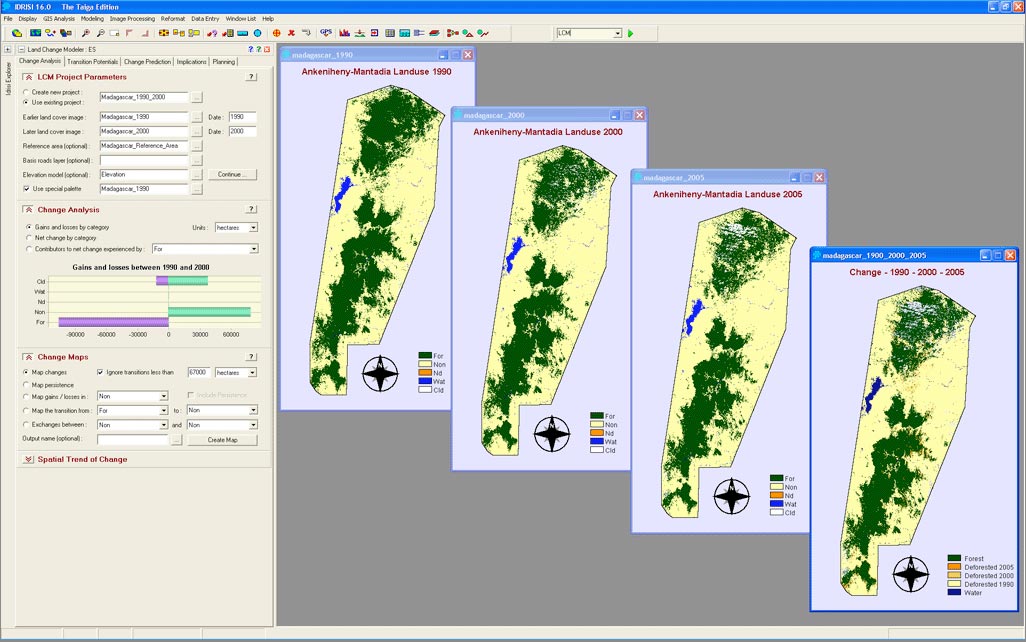
The first stage of a REDD project is the understanding of the historical trends in land use change. The Change Analysis tab in Land Change Modeler provides tools for the rapid assessment of change, allowing one to generate a series of evaluations of gains and losses, net change, persistence and specific transitions both in map and graphical form. This figure shows the historical pattern of change in the Ankeniheny-Mantadia Corridor in Madagascar. CLICK IMAGE TO ENLARGE.
Clark Labs says the Land Change Modeler is currently being used by "many governmental and non-governmental organizations" for REDD project development.
The Land Change Modeler is a software extension to ArcGIS, a suite of GIS software products generally used for viewing spatial data, creating maps, and performing spatial analysis.
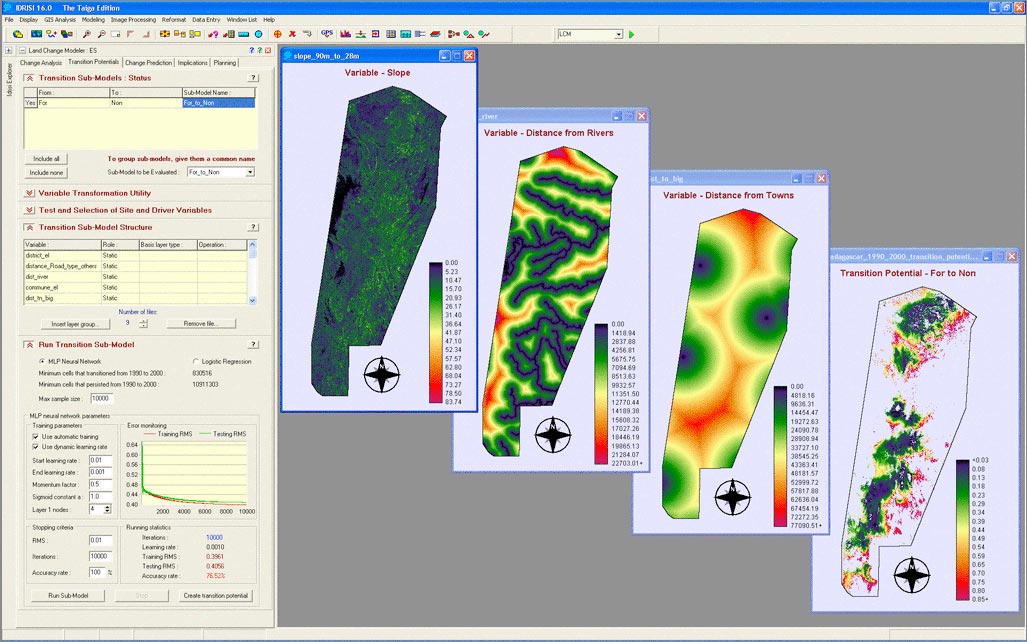
An important element for predicting future scenarios is understanding the underlying driving forces of change. The transition potential modeling facility in Land Change Modeler allows users to derive transition potential maps based on a set of driver variables, such as: slope, distance from roads, distance from markets, elevation, etc... These variables can be static or dynamic.CLICK IMAGE TO ENLARGE.
Copyright mongabay 2010
Read more... Sphere: Related Content07 February 2010
New errors in IPCC climate change report
The United Nations panel on climate change is facing fresh criticism today as The Sunday Telegraph reveals new factual errors and poor sources of evidence in its influential report to government leaders
By Richard Gray and Ben Leach | Telegraph.co.uk | 06 Feb 2010
The Intergovernmental Panel on Climate Change’s (IPCC) report is supposed to be the world’s most authoritative scientific account of the scale of global warming.
But this paper has discovered a series of new flaws in it including:
- The publication of inaccurate data on the potential of wave power to produce electricity around the world, which was wrongly attributed to the website of a commercial wave-energy company.
- Claims based on information in press releases and newsletters.
- New examples of statements based on student dissertations, two of which were unpublished.
- More claims which were based on reports produced by environmental pressure groups.
They are the latest in a series of damaging revelations about the IPCC’s most recent report, published in 2007.
Last month, the panel was forced to issue a humiliating retraction after it emerged statements about the melting of Himalayan glaciers were inaccurate.
Last weekend, this paper revealed that the panel had based claims about disappearing mountain ice on anecdotal evidence in a student’s dissertation and an article in a mountaineering magazine.
And on Friday, it emerged that the IPCC’s panel had wrongly reported that more than half of the Netherlands was below sea level because it had failed to check information supplied by a Dutch government agency.
Researchers insist the errors are minor and do not impact on the overall conclusions about climate change.
However, senior scientists are now expressing concern at the way the IPCC compiles its reports and have hit out at the panel’s use of so-called “grey literature” — evidence from sources that have not been subjected to scientific scrutiny.
A new poll has revealed that public belief in climate change is weakening.The panel’s controversial chair, Rajendra Pachauri, pictured right, is facing pressure to resign over the affair.
The IPCC attempted to counter growing criticism by releasing a statement insisting that authors who contribute to its 3,000-page report are required to “critically assess and review the quality and validity of each source” when they use material from unpublished or non-peer-reviewed sources. Drafts of the reports are checked by scientific reviewers before they are subjected to line-by-line approval by the 130 member countries of the IPCC.
Despite these checks, a diagram used to demonstrate the potential for generating electricity from wave power has been found to contain numerous errors.
The source of information for the diagram was cited as the website of UK-based wave-energy company Wavegen. Yet the diagram on Wavegen’s website contains dramatically different figures for energy potential off Britain and Alaska and in the Bering Sea.
When contacted by The Sunday Telegraph, Wavegen insisted that the diagram on its website had not been changed. It added that it was not the original source of the data and had simply reproduced it on its website.
The diagram is widely cited in other literature as having come from a paper on wave energy produced by the Institute of Mechanical Engineering in 1991 along with data from the European Directory of Renewable Energy.
Experts claim that, had the IPCC checked the citation properly, it would have spotted the discrepancies.
It can also be revealed that claims made by the IPCC about the effects of global warming, and suggestions about ways it could be avoided, were partly based on information from ten dissertations by Masters students.
One unpublished dissertation was used to support the claim that sea-level rise could impact on people living in the Nile delta and other African coastal areas, although the main focus of the thesis, by a student at the Al-Azhar University in Cairo, appears to have been the impact of computer software on environmental development.
The IPCC also made use of a report by US conservation group Defenders of Wildlife to state that salmon in US streams have been affected by rising temperatures. The panel has already come under fire for using information in reports by conservation charity the WWF.
Estimates of carbon-dioxide emissions from nuclear power stations and claims that suggested they were cheaper than coal or gas power stations were also taken from the website of the World Nuclear Association, rather than using independent scientific calculations.
Such revelations are creating growing public confusion over climate change. A poll by Ipsos on behalf of environmental consultancy firm Euro RSCG revealed that the proportion of the public who believe in the reality of climate change has dropped from 44 per cent to 31per cent in the past year.
The proportion of people who believe that climate change is a bit over-exaggerated rose from 22 per cent to 31per cent.
Climate scientists have expressed frustration with the IPCC’s use of unreliable evidence.
Alan Thorpe, chief executive of the Natural Environment Research Council, the biggest funder of climate science in the UK, said: “We should only be dealing with peer-reviewed literature. We open ourselves up to trouble if we start getting into hearsay and grey literature. We have enough research that has been peer-reviewed to provide evidence for climate change, so it is concerning that the IPCC has strayed from that.”
Professor Bob Watson, who chaired the IPCC before Dr Pachauri and is now chief scientist at the Department for Environment, Food and Rural Affairs, insisted that despite the errors there was little doubt that human-induced climate change was a reality.
But he called for changes in the way the IPCC compiles future reports.
“It is concerning that these mistakes have appeared in the IPCC report, but there is no doubt the earth’s climate is changing and the only way we can explain those changes is primarily human activity,” he said.
Mr Watson said that Dr Pachauri “cannot be personally blamed for one or two incorrect sentences in the IPCC report”, but stressed that the chairman must take responsibility for correcting errors.
Another row over the IPCC report emerged last night after Professor Roger Pielke Jnr, from Colorado University’s Centre for Science and Technology Policy Research, claimed its authors deliberately ignored a paper he wrote that contradicted the panel’s claims about the cost of climate-related natural disasters.
A document included a statement from an anonymous IPCC author saying that they believed Dr Pielke had changed his mind on the matter, when he had not.
© Copyright of Telegraph Media Group Limited 2010
Read more... Sphere: Related ContentIndia forms new climate change body
The Indian government has established its own body to monitor the effects of global warming because it “cannot rely” on the United Nations’ Intergovernmental Panel on Climate Change, the group headed by its own leading scientist Dr R.K Pachauri
By Dean Nelson | Telegraph.co.uk | 04 Feb 2010
Scientists believe it could take more than 300 years for the HImalayan glaciers to disappearPhoto: ALAMY
The move is a significant snub to both the IPCC and Dr Pachauri as he battles to defend his reputation following the revelation that his most recent climate change report included false claims that most of the Himalayan glaciers would melt away by 2035. Scientists believe it could take more than 300 years for the glaciers to disappear.
The body and its chairman have faced growing criticism ever since as questions have been raised on the credibility of their work and the rigour with which climate change claims are assessed.
In India the false claims have heightened tensions between Dr Pachauri and the government, which had earlier questioned his glacial melting claims. In Autumn, its environment minister Mr Jairam Ramesh said while glacial melting in the Himalayas was a real concern, there was evidence that some were actually advancing despite global warming.
Dr Pachauri had dismissed challenges like these as based on “voodoo science”, but last night Mr Ramesh effectively marginalized the IPC chairman even further.
He announced the Indian government will established a separate National Institute of Himalayan Glaciology to monitor the effects of climate change on the world’s ‘third ice cap’, and an ‘Indian IPCC’ to use ‘climate science’ to assess the impact of global warming throughout the country.
“There is a fine line between climate science and climate evangelism. I am for climate science. I think people misused [the] IPCC report, [the] IPCC doesn’t do the original research which is one of the weaknesses… they just take published literature and then they derive assessments, so we had goof-ups on Amazon forest, glaciers, snow peaks.
“I respect the IPCC but India is a very large country and cannot depend only on [the] IPCC and so we have launched the Indian Network on Comprehensive Climate Change Assessment (INCCA),” he said.
It will bring together 125 research institutions throughout India, work with international bodies and operate as a “sort of Indian IPCC,” he added.
The body, which he said will not rival the UN’s panel, will publish its own climate assessment in November this year, with reports on the Himalayas, India’s long coastline, the Western Ghat highlands and the north-eastern region close to the borders with Bangladesh, Burma, China and Nepal. “Through these we will demonstrate our commitment to climate science,” he said.
The UN panel’s claims of glacial meltdown by 2035 “was clearly out of place and didn’t have any scientific basis,” he said, while stressing the government remained concerned about the health of the Himalayan ice flows. “Most glaciers are melting, they are retreating, some glaciers, like the Siachen glacier, are advancing. But overall one can say incontrovertibly that the debris on our glaciers is very high the snow balance is very low. We have to be very cautious because of the water security particularly in north India which depends on the health of the Himalayan glaciers,” he added.
The new National Institute of Himalayan Glaciology will be based in Dehradun, in Uttarakhand, and will monitor glacial changes and compare results with those from glaciers in Pakistan, Nepal and Bhutan.
© Copyright of Telegraph Media Group Limited 2010
Read more... Sphere: Related Content31 January 2010
Amazongate: new evidence of the IPCC's failures
The IPCC is beginning to melt as global tempers rise, says Christopher Booker
The claim in an IPCC report that 40 per cent of the Amazon rainforest could disappear through global warming turned out to be unfounded Photo: LEE FOSTER/ALAMY
By Christopher Booker| Telegraph.co.uk | 30 Jan 2010
It is now six weeks since I launched an investigation, with my colleague Richard North, into the affairs of Dr Rajendra Pachauri, chairman of the UN's Intergovernmental Panel on Climate Change (IPCC), the hugely influential body which for 20 years has been the central driver of worldwide alarm about global warming. Since then the story has grown almost daily, leading to worldwide calls for Dr Pachauri's resignation. But increasingly this has also widened out to question the authority of the IPCC itself. Contrary to the tendentious claim that its reports represent a "consensus of the world's top 2,500 climate scientists" (most of its contributors are not climate experts at all), it has now emerged, for instance, that one of the more widely quoted scare stories from its 2007 report was drawn from the work of a British "green activist" who occasionally writes as a freelance for The Guardian and The Independent.
Last week I reported on "Glaciergate", the scandal which has forced the IPCC's top officials, led by Dr Pachauri, to disown a claim originating from an Indian glaciologist, Dr Syed Husnain, that the Himalayan glaciers could vanish by 2035. What has made this reckless claim in the IPCC's 2007 report even more embarrassing was the fact that Dr Husnain, as we revealed, was then employed by Dr Pachauri's own Delhi-based Energy and Resources Institute (Teri). His baseless scaremongering about the Himalayas helped to win Teri a share in two lucrative research contracts, one funded by the EU.
The source the IPCC cited as its "scientific" authority for this claim, however (as Dr North first reported on his EU Referendum blog), was a propagandist pamphlet published in 2005 by the WWF, the environmentalist pressure group, citing a magazine interview with Dr Husnain six years earlier.
Dr North next uncovered "Amazongate". The IPCC made a prominent claim in its 2007 report, again citing the WWF as its authority, that climate change could endanger "up to 40 per cent" of the Amazon rainforest – as iconic to warmists as those Himalayan glaciers and polar bears. This WWF report, it turned out, was co-authored by Andy Rowell, an anti-smoking and food safety campaigner who has worked for WWF and Greenpeace, and contributed pieces to Britain's two most committed environmentalist newspapers. Rowell and his co-author claimed their findings were based on an article in Nature. But the focus of that piece, it emerges, was not global warming at all but the effects of logging.
A Canadian analyst has identified more than 20 passages in the IPCC's report which cite similarly non-peer-reviewed WWF or Greenpeace reports as their authority, and other researchers have been uncovering a host of similarly dubious claims and attributions all through the report. These range from groundless allegations about the increased frequency of "extreme weather events" such as hurricanes, droughts and heatwaves, to a headline claim that global warming would put billions of people at the mercy of water shortages – when the study cited as its authority indicated exactly the opposite, that rising temperatures could increase the supply of water.
Little of this has come as a surprise to those who have studied the workings of the IPCC over the years. As I show in my book The Real Global Warming Disaster, there is no greater misconception about the IPCC than that it was intended to be an impartial body, weighing scientific evidence for and against global warming. It was set up in 1988 by a small group of scientists all firmly committed to the theory of "human-induced climate change", and its chief purpose ever since has been to promote that belief.
The blatant bias of each of its four reports has been pointed out by scientists – notably the rewriting of key passages in its 1995 report after the contributing scientists had approved the final text. This provoked a magisterial blast from Professor Frederick Seitz, a former president of the US National Academy of Sciences, who wrote that in all his 60 years as a scientist he had never seen "a more disturbing corruption" of the scientific process, and that if the IPCC was "incapable of following its most basic procedures", it was best it should be "abandoned".
The centrepiece of the IPCC's 2001 report was Michael Mann's notorious "hockey stick", the graph purporting to show temperatures in the late 20th century soaring at an unprecedented rate – later exposed as a statistical artefact. Another new book, The Hockey Stick Illusion by A W Montford, brilliantly tells the bizarre tale of how Mann's colleagues, calling themselves "the Hockey Team" and now at the heart of the IPCC, managed to resurrect the discredited graph for inclusion in its 2007 report. Montford's book, if inevitably technical, expertly recounts a remarkable scientific detective story. And of course, it was incriminating leaked emails between members of the Hockey Team that were at the centre of the recent "Climategate" scandal at the University of East Anglia.
Most disturbing of all are the glimpses the story gives of the inner workings of the IPCC, an institution now so discredited and scientifically corrupted that only those determined to shut their eyes could possibly defend it. This is now compounded by the recent revelations by Dr North and myself in these pages of how its chairman, Dr Pachauri, has built a worldwide network of business links which provide his Delhi institute with a sizeable income.
It is noticeable how many of those now calling for Dr Pachauri's resignation, led by Professor Andrew Weaver, a senior IPCC insider, are passionate global warming believers. Fearing that Pachauri damages their cause, they want him thrown overboard in the hope of saving the IPCC itself. But it is not just Pachauri who has been holed below the waterline. So has the entire IPCC process. And beyond that – and despite the pleading of Barack Obama, Gordon Brown and the BBC that none of this detracts from the evidence for man-made global warming – so has the warmist cause itself. Bereft of scientific or moral authority, the most expensive show the world has ever seen may soon be nearing its end.
© Copyright of Telegraph Media Group Limited 2010
Read more... Sphere: Related Content30 January 2010
Cycle: Manmade climate change triggers more warming
Data indicates that a rise of 1 degree Celsius could increase carbon dioxide concentrations by about 7.7 parts per million in the atmosphere
CO2 RESEARCH: The experts made 220,000 comparisons of carbon dioxide levels — trapped in tiny bubbles in annual layers of Antarctic ice — against temperatures inferred from natural sources such as tree rings or lake sediments over the years 1050-1800. (Photo: Charles Hanley/AP)
By Alister Doyle | Reuters | Jan 28 2010
OSLO — Climate change caused by mankind will release extra heat-trapping gases stored in nature into the atmosphere in a small spur to global warming, a study showed.
But the knock-on effect of the additional carbon dioxide — stored in soils, plants and the oceans — on top of industrial emissions building up in the atmosphere will be less severe than suggested by some recent studies, they said.
"We are confirming that the feedback exists and is positive. That's bad news," lead author David Frank of the Swiss Federal Research Institute WSL said of the study in an edition of the journal Nature.
"But if we compare our results with some recent estimates (showing a bigger feedback effect) then it's good news," Frank, an American citizen, told Reuters of the report with other experts in Switzerland and Germany.
The data, based on natural swings in temperatures from 1050-1800, indicated that a rise of 1 degree Celsius (1.6 degree Fahrenheit) would increase carbon dioxide concentrations by about 7.7 parts per million in the atmosphere.
That is far below recent estimates of 40 ppm that would be a much stronger boost to feared climate changes such as floods, desertification, wildfires, rising sea levels and more powerful storm, they said.
Carbon dioxide levels in the atmosphere have already risen to about 390 ppm from about 280 ppm before the Industrial Revolution. Only some models in the last major U.N. climate report, in 2007, included assessments of carbon cycle feedbacks.
Frank said the new study marks an advance by quantifying feedback over the past 1,000 years and will help refine computer models for predicting future temperatures.
Surprises
"In a warmer climate, we should not expect pleasant surprises in the form of more efficient uptake of carbon by oceans and land," Hugues Goosse of the Universite Catholique de Louvain, Belgium, wrote in a comment in Nature.
The experts made 220,000 comparisons of carbon dioxide levels — trapped in tiny bubbles in annual layers of Antarctic ice — against temperatures inferred from natural sources such as tree rings or lake sediments over the years 1050-1800.
Goosse said the study refined a general view that rising temperatures amplify warming from nature even though some impacts are likely to suck carbon dioxide from the air.
Carbon might be freed to the air by a projected shift to drier conditions in some areas, for instance in the east Amazon rainforest. But that could be partly offset if temperatures rise in the Arctic, allowing more plants to grow.
Warmer soils might accelerate the respiration of tiny organisms, releasing extra carbon dioxide to the air. Wetlands or oceans may also release carbon if temperatures rise.
Frank said it was hard to say how the new findings might have altered estimates in a report by the U.N.'s Intergovernmental Panel on Climate Change in 2007 that world temperatures could rise by between 1.1 and 6.4 Celsius by 2100.
"Of the models that did include the carbon cycle, our results suggests that those with slightly below average feedbacks might be more accurate," he said. "But we can't now say exactly what sort of temperature range that would imply."
Copyright 2010 Reuters Environmental Online Report
Read more... Sphere: Related Content27 January 2010
UN climate change expert: there could be more errors in report
Jeremy Page, South Asia Correspondent | Times Online | January 23, 2010
Rajenda Pachauri (Bob Strong/Reuters)

The Indian head of the UN climate change panel defended his position yesterday even as further errors were identified in the panel's assessment of Himalayan glaciers.
Dr Rajendra Pachauri dismissed calls for him to resign over the Inter-governmental Panel on Climate Change’s retraction of a prediction that Himalayan glaciers could disappear by 2035.
But he admitted that there may have been other errors in the same section of the report, and said that he was considering whether to take action against those responsible.
“I know a lot of climate sceptics are after my blood, but I’m in no mood to oblige them,” he toldThe Times in an interview. “It was a collective failure by a number of people,” he said. “I need to consider what action to take, but that will take several weeks. It’s best to think with a cool head, rather than shoot from the hip.”
The IPCC’s 2007 report, which won it the Nobel Peace Prize, said that the probability of Himalayan glaciers “disappearing by the year 2035 and perhaps sooner is very high”.
But it emerged last week that the forecast was based not on a consensus among climate change experts, but on a media interview with a single Indian glaciologist in 1999.
The IPCC admitted on Thursday that the prediction was “poorly substantiated” in the latest of a series of blows to the panel’s credibility.
Dr Pachauri said that the IPCC’s report was the responsibility of the panel’s Co-Chairs at the time, both of whom have since moved on.
They were Dr Martin Parry, a British scientist now at Imperial College London, and Dr Osvaldo Canziani , an Argentine meteorologist. Neither was immediately available for comment.
“I don’t want to blame them, but typically the working group reports are managed by the Co-Chairs,” Dr Pachauri said. “Of course the Chair is there to facilitate things, but we have substantial amounts of delegation.”
He declined to blame the 25 authors and editors of the erroneous part of the report , who included a Filipino, a Mongolian, a Malaysian, an Indonesian, an Iranian, an Australian and two Vietnamese.
The “co-ordinating lead authors” were Rex Victor Cruz of the Philippines, Hideo Harasawa of Japan, Murari Lal of India and Wu Shaohong of China.
But Syed Hasnain, the Indian glaciologist erroneously quoted as making the 2035 prediction, said that responsibility had to lie with them. “It is the lead authors — blame goes to them,” he told The Times. “There are many mistakes in it. It is a very poorly made report.”
He and other leading glaciologists pointed out at least five glaring errors in the relevant section.
It says the total area of Himalyan glaciers “will likely shrink from the present 500,000 to 100,000 square kilometers by the year 2035”. There are only 33,000 square kilometers of glaciers in the Himalayas.
A table below says that between 1845 and 1965, the Pindari Glacier shrank by 2,840m — a rate of 135.2m a year. The actual rate is only 23.5m a year.
The section says Himalayan glaciers are “receding faster than in any other part of the world” when many glaciologists say they are melting at about the same rate.
An entire paragraph is also attributed to the World Wildlife Fund, when only one sentence came from it, and the IPCC is not supposed to use such advocacy groups as sources.
Professor Hasnain, who was not involved in drafting the IPCC report, said that he noticed some of the mistakes when he first read the relevant section in 2008.
That was also the year he joined The Energy and Resources Institute (TERI) in Delhi, which is headed by Dr Pachauri.
He said he realised that the 2035 prediction was based on an interview he gave to the New Scientist magazine in 1999, although he blamed the journalist for assigning the actual date.
He said that he did not tell Dr Pachauri because he was not working for the IPCC and was busy with his own programmes at the time.
“I was keeping quiet as I was working here,” he said. “My job is not to point out mistakes. And you know the might of the IPCC. What about all the other glaciologists around the world who did not speak out?”
Dr Pachauri also said he did not learn about the mistakes until they were reported in the media about 10 days ago, at which time he contacted other IPCC members. He denied keeping quiet about the errors to avoid disrupting the UN summit on climate change in Copenhagen, or discouraging funding for TERI’s own glacier programme.
But he too admitted that it was “really odd” that none of the world’s leading glaciologists had pointed out the mistakes to him earlier. “Frankly, it was a stupid error,” he said. “But no one brought it to my attention.”
Copyright 2010 Times Newspapers Ltd
Read more... Sphere: Related Content05 June 2009
€14 million Finland/FAO forestry programme
Data collection and management skills for developing country forestry
Forests dwellers, hard hit by deforestation, are key actors in mitigating the climate change burden.

FAO Newsroom, 27 March 2009
Finland and FAO signed a €14 million partnership agreement to improve forest data collection and analysis as well as management skills in selected developing countries for sustainable forest management.
The aim of the four-year programme is to help developing country governments protect their forest resources, build sustainable forest livelihoods and provide governments with the knowledge to mitigate and adapt to climate change.
Country selection
The selection process for the three to six countries that will pilot the “Sustainable Forest Management in a Changing Climate” programme is under way and should be concluded in the coming weeks.
“FAO is very grateful to the Finnish government for having the foresight to realise just how important this work is and for providing the financial, technical and political support to carry it out,” said Jan Heino, FAO’s Assistant Director-General for Forestry.
“It is vital that we strengthen the information base for sustainable forest management so that developing countries are able to manage their trees and forests based on timely and reliable information,” he said.
The experience and knowledge gained in the countries participating in the programme will then be shared through FAO’s global networks to benefit a wider group of FAO member countries.
Knowledge is power
"If you don't know what you have it is difficult to act,” said Jim Carle, Chief of FAO’s Forest Resources Development Service.
“The Finnish contribution will allow FAO to strengthen the capacity of developing countries to gather information on forest resources and land-use change, forest uses and users and to formulate more consistent land-use and livelihoods policies not only to reduce an important cause of climate change but also to mitigate its impacts," he said.
According to the recently published FAO State of the World’s Forests 2009 report, 7.3 million hectares of forests were lost every year between 2000 and 2005. The report added that the global economic turmoil has resulted in reduced demand for wood, shrinking investments in forest industries and forest management.
Forest emissions
Around 18 percent of global CO2 emissions stem from deforestation and forest degradation in developing countries, a figure comparable to the total annual carbon dioxide emissions of the United States and China.
FAO is the lead UN agency for supporting developing countries in establishing forestry management and assessment systems, developing and implementing National Forest Programmes, deriving and implementing best practice guidelines for forest management.
The bilateral programmes in the selected beneficiary countries will in turn collaborate with and feed into the UN-REDD (United Nations Collaborative Programme on Reducing Emissions from Deforestation and Forest Degradation in Developing Countries) and the World Bank’s Forest Carbon Partnership facility and the Forest Investment Programme.
FAO is one of the three UN agencies that form a part of UN-REDD. The others are UNDP and UNEP.
© FAO, 2009
Read more... Sphere: Related Content01 June 2009
Hypocritical modelers
by Kurt Cobb, Energy Bulletin, May 31 2009
Oil companies like to use models to estimate their reserves and the potential of unexplored fields. Exxon Mobil Corp., the world's largest oil company and a longtime supporter of the global warming denial lobby, tells us the following on page 8 of its 2007 annual report: "Using proprietary technologies and tools, including advanced reservoir prediction models and geological data visualization, we have significantly improved our ability to identify, model, and understand oil and gas reservoirs."
Exxon and its fossil fuel partners in the denial lobby seem to like models well enough when they use them for their own purposes; but through their hired mouthpieces they decry the use of models for climate change forecasting. (The Heritage Foundation to whose pages the previous link leads received consistent funding from Exxon throughout this decade.)
The companies support the dissemination of statements such as the following:
Scientific forecasting research has shown that experts aren’t able to provide accurate predictions in this kind of complex and uncertain situation. It doesn’t matter whether experts present their forecasts as certain outcomes, detailed scenarios, expectations, likelihoods or probabilities. Or that the forecasts are the product of hard thinking by many highly qualified experts, or even of mathematics or computer simulations. The expert forecasts are nonetheless worthless.
What could be more complex than the modeling suggested by this Exxon press release detailing projects around the world, some of them deep underwater, in which modeling was an important component? What could be more complex than modeling the oil and natural gas reserves of the world's largest oil company? Except perhaps modeling the entire world's oil and natural gas reserves. (See Exxon's claim about the extent of those reserves below.)
Exxon wants the public, their shareholders, the Securities and Exchange Commission, the Minerals Management Service and the United States Geological Survey to accept their reported reserves and their estimates of potential new reserves all based on their models. The company's chief executive officer even wants us to believe that fossils fuels will still be the dominate fuels 100 years from now. Is that what the company's models are telling it? And, yet Exxon and its fellow travelers send forth messages into the world that implore us not to believe in models--that "expert forecasts are...worthless." That being the case, should these companies' forecasts of the fossil fuels they believe they can get out of the ground be considered worthless as well?
Clearly, it is not modeling which Exxon and others in the fossil fuel lobby want us to distrust. They merely dislike modeling which demonstrates a possible future that is disadvantageous to their executives and their shareholders. The truth is that corporations of all kinds, governments, nonprofits,and even individuals rely on forecasting models to give them some starting point for evaluating possible outcomes. And, while forecasts of many kinds often have wide margins of error, they can point out possible risks, which, if they indicate severe consequences, may cause us to act to head off those consequences or prepare to mitigate them.
Don't believe Exxon and its hired hands when they feign concern over climate change models. They, too, like to use models to substantiate their pronouncements. What the members of fossil fuel lobby are really telling us with their critique of models is that they are hypocrites of the first order. But, that's something that should come as no surprise to anyone who has been following the activities of Exxon and the fossil fuel lobby in the public discussion of climate change.
Content on this site is subject to our fair use notice.
Read more... Sphere: Related Content31 May 2009
Positive Feedback Hint Between Tropical Cyclones And Global Warming
ScienceDaily, May 29, 2009
Tropical cyclones could be a significant source of the deep convection that carries moist air upward to the stratosphere, where it can influence climate, according to Harvard University researchers David M. Romps and Zhiming Kuang.
Using 23 years of infrared satellite imagery, global tropical cyclone best-track data, and reanalysis of tropopause temperature, the authors found that tropical cyclones contribute a disproportionate amount of the tropical deep convection that overshoots the troposphere and reaches the stratosphere.
Their findings appear in a recent issue of Geophysical Research Letters.
Tropical cyclones account for only 7 percent of the deep convection in the tropics, but 15 percent of the convection that reaches the stratosphere, the researchers found. They conclude that tropical cyclones could play a key role in adding water vapor to the stratosphere, which has been shown to increase surface temperatures.
Because global warming is expected to lead to changes in the frequency and intensity of tropical cyclones, the authors believe their results suggest the possibility of a feedback mechanism between tropical cyclones and global climate.
Journal reference:
-
David M. Romps and Zhiming Kuang. Overshooting convection in tropical cyclones. Geophysical Research Letters, 2009; 36 (9): L09804 DOI: 10.1029/2009GL037396
Adapted from materials provided by American Geophysical Union, via EurekAlert!, a service of AAAS.
Copyright © 1995-2009 ScienceDaily LLC — All rights reserved
Read more... Sphere: Related Content22 May 2009
IIED report on Tenure in REDD: Theory 1, Reality 7
By Chris Lang, REDD-Monitor, 21st May 2009

The International Institute for Environment and Development published an important new report last week, “Tenure in REDD: Start-Point or Afterthought?“. Written by Lorenzo Cotula and James Mayers, it is a welcome addition to the discussion on REDD.
Like a football match, this is a report of two halves. In the first half, the authors discuss the issues surrounding tenure of land and trees in the context of REDD: “the systems of rights, rules, institutions and processes regulating their access and use”.
The second half consists of seven country studies. The authors note the “often apparent gulf between policy and practice” in looking at the land tenure situation in the seven countries. “The current international drive to explore REDD could do more harm than good,” if it focusses on the letter of the law rather than the practice, Cotular and Mayers write.
“REDD is simply an idea cooked up at an international level,” Mayers said in an interview with theNew York Times. In their report, Cotula and Mayers note that the “vibrant international debates on REDD” have only recently begun to consider tenure issues. Much of the debate has focussed on international aspects, partly because of the urgency of negotiating a post-Kyoto agreement in Copenhagen in December 2009. “But whether REDD will benefit – or marginalise – forest communities ultimately depends on local to national arrangements about the allocation of benefits within countries. So resource tenure is key,” they write.
Early in 2009, IIED carried out a review of REDD initiatives world wide. They came up with a total of 144 REDD initiatives, carried out by a range of organisations, including banks, UN organisations, aid agencies, governments, NGOs, academic institutions and companies. But Cotula and Mayers point out that in the country submissions made to the UNFCCC so far, only one includes a proposal to make community-managed forests or indigenous peoples’ rights a binding part of REDD. That submission came from the tiny island nation of Tuvalu. (Bolivia’s submission at the end of April 2009 also recognises indigenous peoples’ rights.)
Cotula and Mayers acknowledge that addressing tenure alone will not stop deforestation:
It appears evident that many countries are ill-equipped in practice to ensure that REDD schemes benefit local people. Improvements in tenure alone will not achieve this. Tackling some of the powerful players behind deforesting activities, like destructive logging, pressures for infrastructure development and conversion of forests to agribusiness, will require concerted action on an unprecedented scale in many countries.
However, they argue, effective and equitable local property rights are needed, to achieve effective local institutional capability. “Consideration of tenure will thus need to be the start point, not an afterthought.”
The introduction to the report points out some of the reasons why avoided deforestation was, until recently, unpopular as a climate strategy:
- Emissions from forest loss are hard to measure, monitor and control (giving rise to questions of additionality and measurement).
- Benefits from efforts to reduce emissions would be short-lived (the permanence issue) and suffer leakage (reduced emissions in one place linked to increased emissions in another place).
- Focusing on deforestation in developing countries reduces pressure on developed countries to cut their own emissions.
- Including forests in trading schemes would flood carbon markets and make other types of measures to reduce emissions unprofitable.
- ‘Fines and fences’ approaches to forest protection would be given a new lease of life, with governments attempting to displace and disenfranchise local communities.
Although REDD is now an important part of the climate negotiations, the authors note that “the above worries did not disappear”. In order for REDD to work, “high levels of central coordination will be important – strong and fair rules and institutions, macroeconomic and agricultural policies in tune with forest policies, effective monitoring – and issues of tenure at local level will be critical.”
The report acknowledges that none of this will be easy and mentions “temptations for corruption and the flouting of weakly enforced law in relation to land use. To create effective incentives for protecting forests, action to strengthen resource tenure must be combined with policy interventions to address these forces.”
The report takes the risks of REDD seriously, which is particularly important given the international rush for REDD:
While hopes for some are running high about the opportunities that REDD may offer to forest communities, there are also risks that REDD schemes may result in governments, companies, conservation NGOs or speculators carving up forestlands, and pursuing forest protection approaches that marginalise rather than empower forest people.
[ . . . ]
[T]rees are not just sticks of carbon, and while the old worry among foresters was that the forest sector is so complex that it will not figure in climate change regimes, the new worry is almost the opposite: that forest carbon finance is coming forward so quickly that it will not support sustainable forestry and livelihoods.
Cotula and Mayers suggest some of the “governance hardware” that might be needed to implement REDD successfully.
Securing climate change mitigation and adaptation from forestry is thus a complex task, especially in circumstances where few other forest goods and services are themselves secure. A combination of the following ‘governance hardware’ is likely to be needed: strong forest and environmental institutions effectively enforcing tenure and use rules and regulations; macroeconomic and agricultural policies that make it less profitable to clear additional forest; payments for maintaining natural forests and forest resources; strong civil society support for, and scrutiny of, sustainable forestry; and regular and systematic monitoring. Tenure is thus a critical part of the forest governance agenda to which REDD may contribute, but not the full agenda.
The second half of the report looks in more detail at the “governance hardware” in seven countries: Brazil, Cameroon, Democratic Republic of Congo, Guyana, Indonesia, Malaysia and Papua New Guinea. The authors find serious problems in each country.
Of the seven countries, Brazil is the only one that has signed ILO Convention 169, which recognises the “rights of ownership and possession” of indigenous peoples and requires states to consult indigenous peoples on the allocation of natural resource concessions on indigenous lands.
The report observes (without comment) Brazil’s plans to expand its area of industrial tree plantations and “sustainably managed forest”: “Under the National Forest Programme 2000–2010, Brazil is seeking to establish 50 million hectares of sustainably managed forest and 20 million hectares of forest plantations [sic] on private land by 2010.” While the report mentions that land settlement schemes since 1995 “have been the largest resettlement in history and a huge issue in deforestation” and that soybean production is “another major source of deforestation”, there is no mention of the expansion of soybean or sugar plantations planned for Brazil.
In Cameroon,
Many institutional limitations in Cameroon have been exacerbated by the lack of concerted effort to address governance problems in the forest sector: i) diverging initiatives with often ill-conceived approaches to development and poverty alleviation; ii) limited contributions of forest management units, community forestry and forest conservation projects to socio-economic development and poverty reduction in neighbouring or involved communities; iii) increasing problems in the collection, management and distribution of Annual Forest Royalties and forest incomes in general; iv) increasing conflicts over forest access and benefit sharing among forest actors, and an upsurge of intra-community conflict; v) dwindling capacity and financial resources within the Ministry of Forestry and Wildlife (MinFoF); and vi) inadequate levels of training/awareness of field staff regarding governance issues.
In the Democratic Republic of Congo,
The main legal instruments for land and forest are the 1967 Bakajika Law, the 1973 Land Tenure Law and the 2002 Forest Code. The state of implementation of these laws, however, is unclear and there are often significant inconsistencies. Many of the decrees needed to implement the reforms under the 2002 Forest Code and 1973 Law have not been made. The transitional government was almost exclusively guided by external agencies, including the FAO, the World Bank and some NGOs, in its forest policy formulation. Since then, some further development of application decrees has taken place, but there is almost no activity at implementation level.
[ . . . ]
To date the decrees necessary to implement the Code have only concerned industrialised logging, with important elements remaining in a legal vacuum.
In Guyana, the authors note that the Guyana Forestry Commission has seen its budget slashed in recent years.
There is some evidence of a breakdown in the operation of the system. For example: corrupt acquisition of concession lands, failure of concessionaires to produce appropriate management plans and the collapse of log tracking and monitoring procedures. The GFC has considerably reduced its field monitoring capacity since 1999, and there is concern that it is no longer effective in controlling logging practice.
The authors also note the “major challenge” of regulatory capture, “the consequence of which is that 98 per cent of large-scale forest concessions are controlled by Asian loggers.”
The implications of this for Guyana’s forests are serious:
Although not permissible without prior presidential approval, subletting of concessions is a common practice. The procedures for estimating annual allowable cut are also poorly implemented. This leads to unsustainable targeting by loggers of the few commercially valuable timber species and out of area harvesting, together with many other slippages between laws, regulations, procedures and what actually happens on the ground, largely due to regulatory capture.
In Indonesia, the authors point out that “Between 1990 and 2000 an estimated 1.3 million hectares (1.2 per cent) was lost due to illegal logging.” They mention palm oil as a major driver of deforestation but they do not comment on the area of forest damaged or destroyed through legal logging or the impact of the pulp and paper industry on Indonesia’s forests.
The authors note the structural problems in the forest sector:
The Agrarian law of 1960 and Forestry Law of 1999 are the primary legislation for the regulation and management of natural resources in Indonesia. Conflicting provisions have been a major constraint in the application of these laws. They are mirrored by ineffective control within the government, corporations and communities in managing forest resources. Corruption is a widespread symptom of ineffective governance.
In Malaysia, “Logging in forest areas claimed by indigenous communities has created conflicts between timber operators and local communities, particularly in Sarawak and chiefly for the nomadic Penan people.”
In Papua New Guinea, “[T]here is a significant problem with non-compliance with forestry laws in PNG, due to the lack of effective implementation and monitoring of the laws and regulations, and lack of inadequate financial and human resource.”
There is of course much more to be said about each of these countries and none of these problems are completely insurmountable. But they do present serious problems for local communities, indigenous people and forests. They should also create something of a headache for international negotiators in discussing REDD.
The first half of IIED’s report ends with a series of recommendations:
- Shape REDD schemes to contribute to improved forest governance, not vice versa.
- Strengthen local resource rights, including customary rights.
- Ensure carbon rights are effectively established in national regulations.
- Build on practical mechanisms for cross-sectoral engagement.
- Develop effective arrangements to channel benefits to the local level.
- Connect national policy to key international thinking and requirements.
- Support learning groups for REDD and related approaches.
- REDD simply will not work unless it is locally credible; it will be undermined and overthrown.
These recommendations are important. But there is one topic that is omitted from the recommendations: the rights of indigenous peoples and local communities to decide for themselves how their forests and land are to be managed. Free, prior and informed consent is referred to five times in IIED’s report. Once in relating to the outcome of the climate negotiations in Poznan, December 2008, once in a discussion about ILO 169 and in three case studies (pointing out that there is no legal recognition of FPIC in the Democratic Republic of Congo, Papua New Guinea or Cameroon).
In a section on “Customary rights and indigenous peoples”, Cotula and Mayers refer to the importance of the United Nations Declaration on the Rights of Indigenous Peoples:
The United Nations Declaration on the Rights of Indigenous Peoples will also be of increasing importance in this regard. This requires the promotion of processes for the recognition of the rights of indigenous peoples to their lands, territories and resources (including carbon assets), and for the implementation of provisions on free, prior and informed consent of indigenous peoples, small forest owners and local communities.
This should have been a key recommendation in the report, rather than a couple of sentences tucked away in the depths of the report. Without the recognition of indigenous peoples’ rights and the free, prior and informed consent of indigenous peoples and local communities, REDD will never work.
Cotula and Mayers’ report focusses on an important aspect of REDD and one that is not receiving enough attention at the international level. In the article about the report in the New York TimesMayers is reported as saying that “it is important to consider how such an international mechanism is applied and to include a wider range of stakeholders, such as locals, in the ongoing international climate change treaty discussions.” This is not happening. Instead, Denmark, the host government of COP15, seems to be doing everything it can to include big business in the climate negotiations. The World Business Summit on Climate Change (24-26 May 2009) is the brainchild of the Danish government, as Corporate Europe Observatory points out in a new report. For three days, up to 1,000 business leaders will discuss climate change and produce “The Copenhagen Call”, a joint statement aimed at influencing the climate negotiations. Meanwhile indigenous peoples and local communities must struggle to get their voices heard, without the help of the governments that have signed on to UNDRIP, and without the help of the large conservation organisations that are so conspicuous in the REDD discussions (and projects) so far.
Content written by REDD-Monitor on this site is licensed under a Creative Commons License
Read more... Sphere: Related Content
Subscribe to:
Posts (Atom)


 Posts
Posts