How to Avoid a Wind and Solar Trade War
China and the United States are drifting toward a trade war in clean-tech energy
Matthew J. Slaughter | Wall Street Journal | March 13, 2012
Read more... Sphere: Related Content
Matthew J. Slaughter | Wall Street Journal | March 13, 2012
Read more... Sphere: Related Content Relocalisation and Transition Towns movements are springing up in developed countries in response to higher oil prices and transport costs - and many 'eco-towns' have been built in Europe [GALLO/GETTY]
 Tropical timber production exceeds forests' ability to replace the felled trees, the study says
 World Economic Forum in Davos
 The main results of the "base case" scenario of "The Limits to Growth" study, from a recent article on theNew Scientist by Debora McKenzie (available upon registration)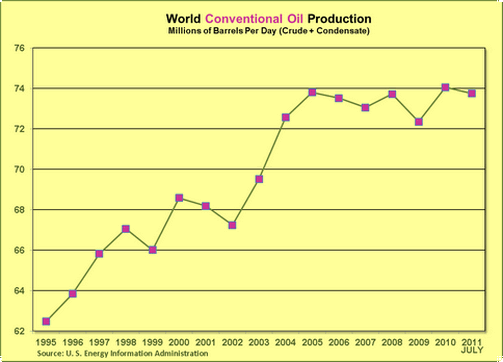
By CHRIS KAHN | AP in Yahoo News | Dec 31, 2011
Read more... Sphere: Related Content
In this Nov. 10, 2010 file photo, oil refineries are shown in this aerial … FILE
If fatty foods and snacks and drinks sweetened with sugar and high fructose corn syrup are proven to be addictive, Big Food may face the most drawn-out consumer safety battle since the anti-smoking movement took on the tobacco industry a generation ago. Photographer: Denis Stenderchuck/Getty Images
Read more... Sphere: Related Content
Cupcakes sit on display at a bakery in New York. Photographer: Rich Press/Bloomberg
The decree (no. 2010-141), which prohibits all exports of rosewood and precious timber for two to five years, was announced during a council meeting held yesterday at Ambohitsorohitra Palace in Antananarivo, Madagascar's capital city. Madagascar's Minister of Environment has already proposed a plan to address the illegal timber trade, according to the Madagascar Tribune.
With the export ban in place, the fate of 10,000-15,000 metric tons of rosewood awaiting export remains uncertain. It is also unclear whether illegal loggers and traders will be prosecuted. Nevertheless, groups that have been protesting the resumption in exports of illegally logged timber cautiously welcomed the move.
Rosewood logs.
Precious hardwood logs are tied together with lianas and floated down rivers on rafts made from lighter species as trees. 5-6 lighter logs are needed to float each rosewood log, exacerbating the impact of rosewood extraction.
"The moratorium is a massive victory on the rosewood front," said Derek Schuurman, a tour operator and author who has been a vocal opponent of rosewood trafficking. "Global outcry over rosewood logging obliged the government to take action."
"There is still a lot to do... but we have succeeded on the first step," added Lucienne Wilmé, a French scientist who has been tracking the rosewood trade.
Criticism of rosewood trafficking ratcheted up in last week when Delmas, a French cargo company, resumed timber shipments from Vohemar, a port in northeastern Madagascar where large stockpiles of rosewood are held. Ecological Internet, a Web-based activist group, expanded an email campaign which has sent thousands of messages of protest, while environment groups Global Witness and the Environmental Investigation Agency (EIA) launched a public appeal to the governments of France and Madagascar. The concerns were spotlighted in national and international press, putting pressure on Madagascar's transition government, which sanctioned timber exports at the end of 2009 despite a long-standing ban on rosewood logging.
But questions remain on whether the current government — which seized power during a military coup a year ago — has the will to effectively implement and enforce the moratorium. Some prominent advisers to the administration have been linked to the timber trade.
Andrea Johnson of EIA, an NGO that has been documenting timber trafficking, told mongabay.com that it is too early to say whether the moratorium will effectively address Madagascar's illicit rosewood trade.
"We're hopeful that this moratorium marks a decision by the transition government to consider the long-term value of Madagascar’s natural resources and end the uncontrolled exploitation of the forest for quick profit," she wrote via email. "We'd like to believe this is actually the beginning of a new book, not just the start of another chapter in the recent sad story of corruption and plunder of Madagscar’s irreplaceable forests."
In the aftermath of a military coup last March, Madagascar's rainforests were pillaged for precious hardwoods, including rosewood and ebony. Tens of thousands of hectares were affected, including some of the island's most biologically diverse national parks: Marojejy, Masoala, and Makira. Illegal logging spurred the rise of a commercial bushmeat trade. Hunters slaughtered rare and gentle lemurs for restaurants. Timber trafficking, which involved armed gangs marauding through national parks, also hurt tourism, a critical source of direct and indirect income for many Malagasy, as the people of Madagascar are known. Rosewood traders intimidated, and in some cases, beat, those who attempted to stop the plunder.
 In 2007, he was named as a hero of the environment by Timemagazine. “Sandor is an innovator and a great booster of new markets, and he had the vision to create something out of nothing,” writes James Cameron in Time. Creating something (money) out of nothing (carbon offsets) is a good description of the carbon market. “And he’s always been phenomenal at making money,” Cameron writes. Last year, Sandor earned US$1 million.
Since 2000, Sandor has been a director of American Electric Power, the biggest coal burner in the USA. AEP has teamed up with The Nature Conservancy for two controversial REDD-type projects: the Noel Kempff project in Bolivia and the Guaraqueçaba project in Brazil. And where does AEP plan to sell its carbon credits from the Noel Kempff project? The Chicago Climate Exchange. Cozy.
In February 2009, in a discussion on Al Jazeera, Sandor explained that “The mess in the financial markets is related to opaqueness, which doesn’t exist on exchanges.” But an article in the current issue of Private Eye reveals that Sandor’s operations in the climate business seem to be pretty murky.
Of course, this isn’t only about Sandor. As Larry Lohmann, of the UK-based organisation The Corner House, points out, “There are close parallels between the rampant financial innovations behind the current financial crisis and the innovations feeding carbon trading.” A Corner House Briefing, from September 2009, “When Markets are Poison: Learning about Climate Policy from the Financial Crisis” is available here (pdf file, 568 KB).
Here’s the Al Jazeera debate, where Patrick Bond, Director of the Centre for Civil Society, University of KwaZulu-Natal, corrects some of Sandor’s myths, followed by the article inPrivate Eye. “I think in fact that many of these emissions markets are full of chancers”, Bond notes on Al Jazeera.
Private Eye, No. 1258, 19 March – 1 April 2010
CARBON emissions trading might be useless at tackling climate change but it is proving to be highly profitable for the financial engineers behind it – men like the godfather of pollution trading, an American called Richard Sandor, who was one of the founders of financial derivatives in the 1980s at junk bond trader Drexel Burnham Lambert.
It was at Drexel Burnham Lambert that Sandor pioneered the “collateral mortgage obligations” that eventually brought the financial markets to their knees. He was also architect of the first pollution permit trading scheme (in sulphur emissions) in the US in the 1990s.
Today he chairs the company controlling more than 80 percent of EU carbon emissions trading, Climate Exchange plc, which regularly launches “innovative” carbon products such as daily futures contracts and has set up trading exchanges in China, Canada and Australia. Sandor meanwhile has been a big mover behind plans for a mandatory trading system in the US that would see his company’s income multiply.
‘Significant long-term growth potential’
Under Sandor and chief executive and offshore insurance specialist Neil Eckert, Climate Exchange plc owns the European Climate Exchange based in London’s Bishopsgate, as well as the Chicago Climate Exchange and the Chicago Climate Futures Exchange. Business is especially booming in London, as Eckert boasted in a results announcement last week: “ECX had a wonderful year and with the continuing EU discussion of an anticipated 30 percent cut [in emissions] by 2020 and particularly the move to 100 percent auctioning [of allowances] in 2011, shows significant long-term growth potential.”
Last year Sandor earned $1m and Eckert £575,000. Sandor’s shares in the company are worth more that £40m, and Eckert’s around £5m on top of £7m worth of options. These riches came on the back of operating profits last year of £11.5m, made almost entirely in London where trading in £70bn worth of emissions allowances by the European exchange’s 100 members, including such renowned environmentalists as Shell, Barclays and RBS, earned the exchange £11.4m.
Not that any of this finds its way into the government’s coffers in the form of tax that might be invested in slightly more useful environmental measures. Climate Exchange plc is registered in the tax haven of the Isle of Man, where, according to its accounts, “it is subject to tax at zero percent” having been set up there when it was simply a fund company in order to avoid capital gains tax. But the company also claims that its operating subsidiaries “are resident in various jurisdictions where they are subject to local rates of taxation”.
Same name, different company
In Britain this might be thought to refer to the company ostensibly running the exchange in Bishopsgate, European Climate Exchange Ltd. But its accounts, filed quietly at Companies House, show that it is owned by an Irish company with, er, exactly same the same name: European Climate Exchange Ltd. It is this Irish company, registered at its lawyer’s office at 70 Sir John Rogerson’s Quay in Dublin (without a trading exchange in sight and only a company secretary to be found there), that earns the commissions.
The synonymous British company is reimbursed for its costs of running the exchange while the profits that accumulate in Dublin are then returned to its ultimate parent company, Climate Exchange plc, in the Isle of Man in the form of tax-free interest payments on the substantial loans from Douglas that fund the operation.
This kind of tax planning requires plenty of carbon-intensive jetting off to board meetings in whichever countries the directors want their companies to be tax resident. As a Climate Exchange plc spokesman told the Eye: “They’re always travelling.” This might not do much for the planet but it’ll be good for business when airlines are forced into the trading scheme from 2012.
The corals are harvested to make jewelry. But harvests of the coral have seen a significant decline: over 85 percent in thirty years. Marine conservations warn that the corals are too slow-growing to sustain such heavy collecting, since they require a hundred years to reach maturity.
Japan, which also led the movement to reject the ban on the Atlantic bluefin tuna trade, lobbied others to vote 'no' against the monitoring. The country argued that deep water corals are not facing extinction and that monitoring would impact poor coastal fishing communities, especially in North African nations. The vote was done secretly.
"TRAFFIC and WWF are deeply disappointed with the decision not to list red and pink corals," said Ernie Cooper of TRAFFIC Canada. "Without the trade control measures this would have introduced, the current overharvesting of these precious corals will continue unabated."
It is estimated that 30 to 50 metric tons of the corals are harvested every year. The United States is the world's largest purchaser of coral jewelry.

 Posts
All Comments
Posts
All Comments