Showing posts with label pollution. Show all posts
Showing posts with label pollution. Show all posts
05 March 2012
Read more... Sphere: Related Content
 Fears: Aluminium expert Prof Chris Exley says he is concerned about the metal's ubiquity - in water, food packaging, vaccines, drugs and food and drink Photo: Guzelian
04 March 2012
China lead pollution poisons 160 children: report
Lead emission from factories and the natural environment in China's manufacturing heart of Guangdong has poisoned 160 children, Xinhua said on Sunday in the country's latest case of unfettered industrial toxins
Reuters | Mar 3, 2012
Read more... Sphere: Related Content22 February 2012
EU to vote on oil sands pollution
European Union officials are expected to vote on draft legislation that would label Canadian fuel as more polluting than oil from other parts of the world
By Pallab Ghosh | BBC News | 21 February 2012
 The Canadian province of Alberta has vast oil sand reserves
Read more...
Sphere: Related Content
13 February 2012
Cycle city Kathmandu
Jennie O’Hara meets Nepali campaigners seeking to tackle pollution and inequality by transforming their capital into a cycle-friendly city
Jennie O’Hara | RedPepper | 13 Feb 2012

15 January 2012
Mexico pipeline oil spill may take month to clean
Two weeks after a pipeline leak in coastal Mexico sent oil gushing into a river, state oil monopoly Pemex has recovered about two-thirds of the spilled crude, but the full clean-up could take another month
By Julie Gordon | Reuters | Jan 14, 2012
Read more... Sphere: Related Content30 December 2011
Global hunger for plastic packaging leaves waste solution a long way off
Despite measures to increase recycling, discarded plastic packaging continues to blight Earth
Juliette Jowit | guardian.co.uk | 29 December 2011
Read more... Sphere: Related Content
The "Plastic Bag Monster", a creation by Slovenian artist Miha Artnak, is displayed outside the European Commission headquarters in Brussels May 24, 2011. Photograph: Francois Lenoir/Reuters
20 December 2011
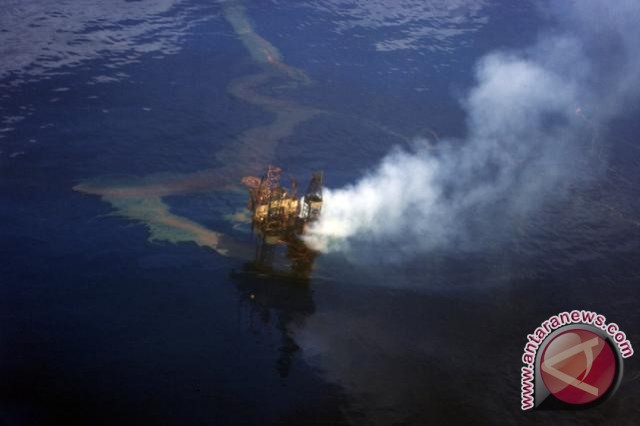
Montara oil spill victims still awaiting promised compensation
East Nusatenggara (NTT) fishermen who lost their livelihoods by the Montara oil spill in 2009 are still waiting for the promised compensations, two years after the disaster
by Fardah | ANTARA | December 19 2011
Read more... Sphere: Related Content
Montara Block. (guardian.co.uk)
Study finds link between air pollution and increase in DNA damage
A study in the Czech Republic has found a link between exposure to certain air pollutants and an increase in DNA damage for people exposed to high levels of the pollution
by ClickGreen staff | ClickGreen | 18 Dec 2011
Read more... Sphere: Related Content

14 December 2011
Durban feedback: Is the carbon market “still on life support” or did it get a “Viagra shot”?
The agreement that came out of the Conference of Polluters (COP-17) in Durban included no new commitments to reduce emissions. “What we got instead was a clear signal that we might get another clear signal in 2015,” as Jonathan Grant, director of carbon markets and climate policy at PricewaterhouseCoopers told the Financial Times
By Chris Lang | REDD-Monitor | 13th December 2011
Read more... Sphere: Related Content11 November 2011
BP agrees to pay Texas $50M for pollution violations at refinery where ‘05 explosion killed 15
BP will pay Texas $50 million after the sides reached an unprecedented settlement over air pollution violations at the beleaguered oil giant’s Gulf Coast refinery, the site of a massive explosion in 2005 that killed 15 people
Associated Press | Washington Post | November 3, 2011
Read more... Sphere: Related Content30 October 2011
Two more ethical challenges to Canada's oil sands
In a previous article, I listed the first five of ten ethical oil challenges Canada faces. Find those here. Two more are presented today, with the final three to be published next week
by Andrew Nikiforuk | The Tyee, Oct 26 2011 in Energy Bulletin | Oct 28 2011
Read more... Sphere: Related Content
Bitumen: Its Energy Return on Energy Investment is vastly lower than light oil.
12 March 2010
Group: polluters use offsets to avoid carbon cuts
Major European polluters are buying their way out of making big cuts to greenhouse gas emissions by purchasing carbon offsets that pay for environmental programs in developing nations, a nonprofit group said Friday
By GRETCHEN MAHAN | Associated Press | Mar 11, 2010
To avoid the high cost of becoming greener, power companies and steel makers are using offsets to meet emissions-reduction requirements, and thus undermining the EU's cap-and-trade program that would otherwise punish them financially for not cleaning up their operations, the group Sandbag said.
Businesses and regulators should be "striving for the highest environmental standards, rather than the minimum level of compliance," said the British-based nonprofit organization, which campaigns for stricter cap-and-trade rules to require companies to make bigger cuts.
Sandbag says European polluters are becoming heavily dependent on buying U.N.-monitored offsets, which pay for solar panels in India or environmental cleanup in China, in exchange for canceling out part of the company's emissions. As a result, the company can avoid buying pollution permits from the EU's cap-and-trade program.
Spanish energy company Endesa SA bought offsets worth a quarter of its total emissions, Sandbag said, while German steel maker ThyssenKrupp AG offset 29.6 percent of its emissions and Italian power firm Enel SpA purchased offsets for 12.4 percent of its carbon output.
The group said its data came from a European Union database, but it did not say how much money the companies had spent on the offsets.
Sandbag urged the EU executive to tighten its cap-and-trade program, saying more needs to be done to make sure offsets are not a "replacement for domestic action."
Offsets are supposed to help pay for projects in poor nations that would help them reduce future carbon emissions.
But Sandbag says most of the offset money from wealthy European companies bypasses needy African nations and goes to wealthier, developing countries such as China, India and Brazil.
China dominates the offset scene, with some 41 percent of all projects. India has 31 percent, South Koreahas 15 percent and Brazil 8 percent.
Copyright © 2010 The Associated Press. All rights reserved
Copyright © 2010 Yahoo! Inc. All rights reserved
Read more... Sphere: Related Content05 March 2010
Ghana's 2010 oil 'boom': Ensuring public interest over private gain
Ghana is on the precipice of an oil 'boom'. The nation’s anticipated oil production begins this year, 2010. And along with the production, the public’s high expectations from oil wealth, in addition to the potential threats that come with this oil 'boom'. Even as we remain optimistic, we should not underestimate the potential dangers of our new circumstances to our democracy, national unity and our nation’s socio-political security. There sure are no greater exigencies now than laying strong foundations for transparency and accountability, both in the preparatory stage and the eventual management of our oil wealth
By Mawuli Dake | Pambazuka in Foreign Policy in Focus | February 25, 2010
Disputes related to natural resources have exacted a toll on far too many African societies, turning the dreams of national prosperity that come with the discovery of such natural resources into perpetual nightmares. Consequently, these disputes have resulted in violent conflicts, environmental destruction, corruption, untold human hardship, displacements and a devastated future for entire communities. This sad but true reality causes even the most exuberant optimist to wonder if the discovery of oil in one’s country should be a cause of jubilation or trepidation. I am cautiously optimistic about Ghana, that the nation will take full advantage of the positive and negative lessons from others to ensure transparency and accountability as oil production begins.
This article is a contribution to Ghana’s determination to ensure a peaceful, productive and prosperous oil era. It outlines specific critical statutory, institutional, social and community strategies for ensuring transparency and accountability in the management of Ghana’s oil.
The reality of oil in Africa today
Aside from a few exceptions, wherever there is oil on the continent, there is misery and conflict. The causes of these conflicts, as seen across the region, range from a lack of mechanisms for accountability, inequities in the distribution of oil wealth, to injustices of endemic political and corporate abuses of human rights in affected communities. This is manifested through the violations of rights, total disregard for laws and flagrant disregard for the interests and wellbeing of communities.
A common trend as seen in oil-related conflicts from Angola and Nigeria to Sudan, among others, is the emergence of aggrieved and exploited groups of citizens, who resort to violence as the only means of demanding accountability, inclusion and justice. 'A riot is the language of the unheard', as Martin Luther King put it. The billions of oil wealth generated do not reflect in the conditions of the people and the communities from which the oil is drilled. The continent's leading oil producers – Algeria, Nigeria and Angola[i] – rank 104, 158 and 143 respectively on the 2009 United Nations Human Development Index. Other resource-endowed African countries like the Democratic Republic of Congo (DRC) also rank near the bottom of human development in the world.
The absence of strong mechanisms for accountability and oversight have allowed small cliques of greedy elites and their corporate allies to amass the oil wealth to the detriment of national development in too many of our countries. It is a trend too pervasive across the continent, but Ghana can and must do things differently.
Outlook of Ghana’s extractive sector
Until its independence in 1957, Ghana was called the 'Gold Coast' for its rich endowment in gold. In addition, Ghana is blessed with bauxite, aluminium, manganese ore and diamonds. Today Ghana is the 2nd and 10th leading gold producing country in Africa and the world respectively[ii], bringing in export earnings of US$1,277.2 million in 2006 and US$1,733.78 million in 2007, according to the 2008 official budget statement. Heretofore, the several decades of management of Ghana’s mining resources has been characterised by very little transparency and accountability, a characterisation that should not be repeated with the management of oil resources. There’s never been any serious public discourse, oversight or curiosity about where the revenues from the millions of ounces of gold produced so far end up. Consequently, the interest of foreign multinationals and a few local elites have dominated and controlled the management and wealth from the sector.
The 2007 discovery of oil reserves and the anticipated production estimates of up to 150,000 barrels per day[iii] is likely to change Ghana’s economic outlook. Oil will topple the mining sector as Ghana’s foreign exchange earner.[iv]
The significance of the expected impact on both the country’s economic outlook and on the communities and livelihoods of citizens demands a more responsible management than we have seen with mining in Ghana and in oil production in other African countries. The government of Ghana and the other stakeholders have indicated their laudable intentions for the effective and equitable management of the oil and the oil wealth, as citizens continue to outline their expectations and aspirations towards this wealth. Transparency mechanisms and tools, citizenry awareness and political will are important ingredients needed for the fulfilment and realisation of the commitments and aspirations.
The choices we make and the mechanisms we put in place at this critical stage, will shape the economic and security conditions of our country in far more ways than we can imagine.
We have woefully failed some of the initial tests, particularly with the initial negotiations and allocation of shares and contracts. Many critical details on contracts, investments and government plans remain unavailable to the citizenry. Other critical decisions and commitments have been made behind closed doors with alleged suspicious 'sweat equity' deals for some politicians and their allies. The Financial Times on 7 January 2010 reported on an ongoing investigation by Ghanaian and US authorities into one of such deals[v] involving key associates of ex-president John Kufuor. The new government has also abrogated a number of contracts for not following due diligence.
The ultimate guarantee for transparency and accountability is the citizens of Ghana – citizenry oversight. We all have a role and a responsibility to help Ghana turn the page on the management of oil in Africa. Citizenry oversight with regulatory and institutional mechanisms for transparency and accountability are prerequisites for safeguarding Ghana’s socio-economic and security interests in the oil era. I wish the intense interest in oil aroused among foreign interests and Ghanaian elites would inspire the same level of interest among the country's citizens.
Why Ghana can and must be different
A number of existing conditions present Ghana with the opportunity to ensure transparency and accountability. Not only do Ghanaians take great pride in being lauded for outstanding democratic and peaceful credentials, they are serious about it. Getting the oil thing right will no doubt boost this international recognition and national pride. Ghana also enjoys a high sense of national unity compared to its regional neighbours. Ghana’s stable and peaceful political environment, democratic space for free press and civil society activism are all important conditions that can help Ghana in this endeavour.
Ghana is fortunate to have a president at this critical moment that is widely regarded as a leader of high integrity. Most Ghanaians including even his fiercest opponents express their confidence in President John Atta Mills’s integrity. As encouraging as this is, it does not guarantee the same level of uprightness from the rest of his team who would be involved in the management of the oil. It also does not guarantee that he will have the political savvy to identify and expel his appointees who indulge in corruption. More importantly, as Barack Obama said in his historic speech in Accra, 'Africa doesn’t need strongmen, it needs strong institutions',[vi] institutions that can prevent and, when it does happen, can detect and redress corruption. Above all, 'we the people' are Ghana’s greatest asset.
Statutory and institutional mechanisms
Two important legislative provisions must be met before oil production begins. The proposed Freedom of Information Act should be passed and must guarantee unconditional public access to information, including on revenues, investments and contracts. Second, our law-makers must upgrade our statutory framework to 21st century standards. Ghana’s situation today is significantly different from what it was when the two major statutes governing the exploration, development and production of petroleum resources in Ghana – the PNDC Law 64 and the Petroleum Exploration and Production Law, PNDC Law 84 – were enacted in 1983 and 1984 respectively. The government has indicated its readiness to strengthen the country’s legal framework. 'It is imperative that Ghana's legal regime relating to the oil and gas industry is reviewed and adapted to Ghana's new condition as a major oil producer', states Ghana’s attorney general.[vii] This commitment must translate into expeditious and deliberate action.
Accountability and disclosures
Our institutional frameworks must ensure accountability from both state and non-state actors in the oil sector. Multinational corporations play a major role and sometimes wield even greater power in the management of these resources and should be adequately checked and monitored. Additionally, there must be institutional mechanisms in place to allow regular disclosure and publication of all agreements and licences, payments, collections and contracts. Furthermore, I would go as far as to recommend an 'anti-kick-back' law that mandates all public officials to disclose any gifts or payments received from any of the stakeholders in the oil sector. 'Kick-backs' are increasingly becoming an acceptable norm in Ghanaian politics. It is a system where public officials knowingly and wilfully expect or accept bribes or indulge in other forms of quid pro quo for favours from certain commercial interests.
Checks and balances
Ensuring genuine accountability and transparency will require a clearly defined system of independent but accountable regulatory, governing and commercial bodies. These bodies should be independent enough to perform their functions without fear or favour but with checks and balances to prevent any functionary body becoming too powerful or isolated.
Institutional capacity development
Government must proactively invest in the capacity development of the relevant institutions and public officials who will be responsible for management, regulatory and revenue functions. We must pursue these efforts with the same level of aggressiveness we see with infrastructural development efforts.
Formal civil society role
Official oversight framework should have a formal role for civil society.
SOCIAL AND COMMUNITY MECHANISMS
Citizenry participation
The media and civil society actors must foster public engagement and dialogue on all aspects of the process, particularly on environmental impacts, oil revenue management and the defence of the rights of journalists, activists and communities that may be targeted for daring to demand accountability from powerful interests.
Accountability for the wellbeing of host communities
There must be clear mechanisms for protecting the interests and wellbeing of communities – all interest groups and not only the local elite. For example, compensation for farming and fishing communities who may be affected by oil production must be appropriated in ways that cater for the various actors whose livelihoods depend on it and not just the interest of the chiefs and traditional leaders. Additionally, there must be full disclosures on all potential threats resulting from the oil production in these communities. There must be a clearly defined system through which citizens and communities affected by the oil process can channel their concerns and grievances.
Citizenry oversight
Vigilant citizens remain the best guarantee against corruption and for safeguarding the public interest. Citizens and the media must see and treat their monitoring role as a responsibility. Based on the pathetic track record of most of our political and public officials, personal and not public interest is going to be the foremost priority of most of those who would be representing us in the planning, negotiations and decision processes. If 'we the people' don’t stand up for our collective interest, no one else will do it for us.
Alternative and shadow reports
Civil society actors, including think-tanks and citizens groups, should produce regular alternative and shadow reports on key aspects of the oil sector, including environmental and community impacts, oil-wealth management and adherence to human rights and international standards. These shadow reports will offer important perspectives that may be missing from official reports.
Capacity development
Capacity development is required for civil society actors and activists so that their oversight and activism will be constructive, effective and enlightened. Various citizenry constituencies must be sensitised and empowered for effective public oversight of our public and private activities.
Finally, President Atta Mills has the opportunity to leave a legacy of transparency and accountability. After all, the single most important quality that propelled his candidacy to power is his perceived high level of integrity. Such a legacy will not only guarantee him an enviable place among Ghana’s presidents, but will be a vindication of the confidence Ghanaians posed in him. Above all, it will be the right thing to do and Ghana will be better for it. We will need our president’s leadership in this regard but all Ghanaians must share in the responsibility of making 'our oil' the most transparently managed on the continent.
Mawuli Dake, a leading African human advocate and strategist, is the CEO of the Africa Group Consult. He is a co-founder of the soon-to-be-launched GhanaOilMonitor.com, a one-stop citizenry platform for fostering greater transparency and accountability in the management of Ghana’s oil resources.
This work by Institute for Policy Studies is licensed under a Creative Commons Attribution 3.0 United States License.
Read more... Sphere: Related Content13 February 2010
Chevron says expert biased in cleanup case
By CHRIS KAHN, AP Energy Writer | AP in Yahoo! News | Feb 10, 2010
NEW YORK – Chevron Corp. has stepped up its offensive against a group that says the oil giant poisoned sections of the Amazon rain forest.
After spending months discrediting the political and legal system inEcuador, where a court is considering a fine against the company,Chevron now claims that a court-appointed expert gave biased testimony in the case.
The expert, Richard Cabrera, could not be reached for comment Wednesday. But lawyers representing people affected by the pollution said Chevron is simply making a last-ditch effort to delay what could be a massive penalty against the company.
The judgment may reach $27 billion, more than twice the company's 2009 earnings.
"They're losing the case based on the evidence," said Steven R. Donziger, an American legal adviser to the plaintiffs. "So they're trying to fabricate issues to try to taint the image of the trial."
Karen Hinton, a spokeswoman for the Amazon Defense Coalition, pointed out that the company previously praised the fairness and competency of Ecuador's courts and lobbied to have the case moved there from a U.S. federal court.
"They change their argument depending on how desperate they are at any given time," Hinton said.
The battle over who should clean up a beleaguered swath of the Amazon has tumbled through several courts over the past 17 years. Ecuadoreans blame Texaco, which operated oil fields in the area from 1972 to 1990. Chevron bought Texaco in 2001.
Communities near the oil fields say Texaco dumped billions of gallons of toxic wastewater into unlined pits. Their lawyers say the contamination may have led to a spike in cancer rates.
Chevron doesn't dispute that the region was damaged. But Texaco previously paid $40 million to clean up the area and Chevron says Ecuador released the company from any further liability.
Last year, before the Ecuador court could issue its ruling, Chevron released secretly recorded videos that it claims show that the judge had already decided to rule against Chevron. The Ecuador government quickly disputed those claims and said the video appeared to be manipulated.
Judge Juan Evangelista Nunez recused himself from the case, nevertheless.
This week, Chevron said in a court filing that the court's environmental expert, Cabrera, is the majority owner of an oil field cleanup company. Chevron said Cabrera's company could profit from such a massive settlement. Company lawyers also said Cabrera inflated the amount of money it would take to clean up the area and accused Ecuador of allowing the court proceeding to replenish government coffers.
"What you have now is a judicial charade in which the government is pretending" the lawsuit came from private interests, Chevron attorney Hewitt Pate told The Associated Press. But the government intends to collect most of the fine, he said.
Pate said Chevron would refuse to pay any fine out of the Ecuador court. Chevron wants an international arbitrator to hear the case.
But if Chevron loses the case, Donziger said the plaintiffs will force it to comply by taking the judgment before courts in other countries where Chevron is currently operating.
"Chevron has (assets) in 100 different countries in the world," he said. "If we need to, we will go to every last one of them to satisfy this judgment."
Copyright © 2010 The Associated Press. All rights reserved
Copyright © 2010 Yahoo! Inc. All rights reserved
Read more... Sphere: Related Content
Subscribe to:
Comments (Atom)


 Posts
Posts